
18 New Missionaries of Africa
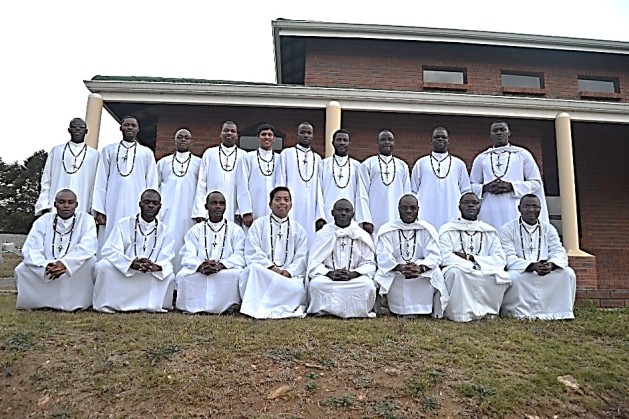
On Friday 15th December at 4:30 pm, in the beautifully decorated chapel of the Merrivale Formation House in KwaZulu Natal, South Africa, eighteen young men were officially received in the Society of the Missionaries of Africa by pronouncing their Missionary Oath. Many relatives and friends had come from near and far to pray with them and witness this serious life commitment of these generous new confreres. Their Oath was received by Fr. Didier Sawadogo, M.Afr, one of the Assistants to the Superior General. The Provincial of the Southern Africa Province, Fr. Felix Phiri, M.Afr, as well as the Provincial Delegate for South Africa, Fr. Raymond McQuarrie, M.Afr, were also present. The occasion was also enhanced by the presence of Bishop Jan De Groef, M.Afr of Bethlehem Diocese (South Africa) and Bishop Sanctus Lino of Nebbi Diocese in Uganda.
Our new confreres are: Maurice Aduol (Kenya), Jean-Pierre Badjanga Titi (DR Congo), Jean-Paul Basikaba (DR Congo), Stephen Beru (Ghana), Ryan Contamina (Philippines), Philippe Dakono (Mali), Siby Dominic (India), Francis Eze (Nigeria), Eric Kambale (DR Congo), Christopher Nkandu (Zambia), Silas Nsambimana (Burundi), Robert Ouedraogo (Burkina Faso), Justin Ramde (Burkina Faso), Elie Sango (DR Congo), Victor Sanou (Burkina Faso), Martin Somda (Burkina Faso), Jean-Baptiste Todjro (Togo) and Pierre Chanel Ulama (DR Congo).
 18 New Priests for 2018!
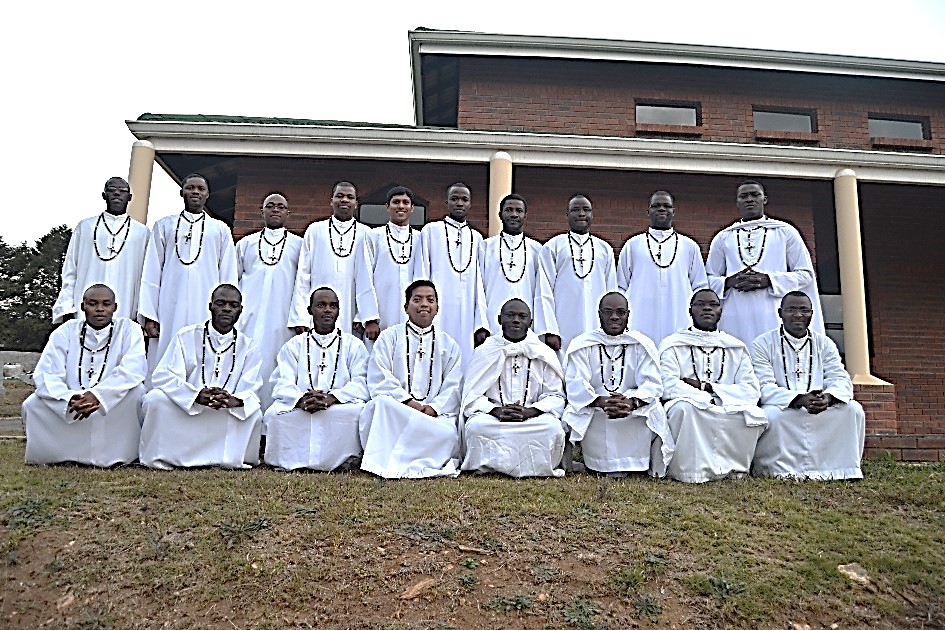
This makes a lot of 18’s! What a wonderful gift for our jubilee year, our 150 years of foundation!
Indeed, the day after the Missionary Oath, on 16th December, in St. Vincent Parish Kwampumuza in South Africa, we had the pleasure to celebrate the ordinations to the diaconate of the same eighteen new confreres for the Missionaries of Africa and two others for the Dominicans (O.P.).
Cardinal Wilfrid Napier, ofm, Archbishop of Durban Archdiocese, presided the celebration assisted by Bishop Jan De Groef, Bishop Sanctus Lino of Nebbi Diocese in Uganda and over fifteen priests. Everything went smoothly with the enthusiastic and brilliant participation of the local parish choir, the altar servers and all the other liturgical ministers.
After the four-hour celebration, the parishioners, under the wise leadership of their parish councillors, treated everybody to a delicious meal and to some great entertainments. This parish was recently taken by the Missionaries of Africa and we find the people very responsive and generous. They organised everything and contributed not only their time and energy but also all the food and drinks for this great occasion. Great! Siyabonga kakulu! (Thank you very much!)
God’s Family Is Expanding!
By Deacon Jean-Baptiste Todjro, M.Afr.
‘I was glad when I heard them say let us go to the house of the Lord’ Ps 122: 1. These words mark the beginning of our immediate preparation for our Missionary Oath and Diaconate Ordination. Indeed great was our joy to be accepted into the family of the Missionaries of Africa.
One word was echoed strongly throughout the celebration of our Missionary Oath and Diaconate Ordination: FAMILY. Prior to the celebration of the oath, Didier Sawadogo, representing the Superior General, presented to us the message of the General Council by giving to each of us the positive affirmation of our Society which states: ‘Filled with the joy of the Gospel and guided by the Spirit, we are an intercultural missionary society with a family spirit. Sent out to the African world and wherever our charism is needed, for a prophetic mission of encounter and of witness to the love of God’ (Capitular Acts 2016:17). It is with this sense of belonging and willingness that we responded YES to the call of God and the desire of making God’s love known and flourish in the African world. The word FAMILY was at the heart of the homily of Cardinal Wilfrid Napier who in addressing us insisted that we have to participate in the mission of the Church and identify the challenges that families are facing as our primary mission in collaboration with the universal Church. As such one can boldly say we are ordained to be APOSTLES TO FAMILIES, NOTHING BUT APOSTLES TO FAMILIES.
We wish to thank all those who made this event possible: our community, our formators and provinces of origin who believed we can contribute positively to the Mission of Jesus Christ within the Society of the Missionaries of Africa. Our gratitude also goes to you, our parents, friends and confreres who graced this event with your presence or with a thought or a prayer. Please, continue praying for us and supporting us.
Please remember us and all missionaries of Africa with this hymn that served as a procession and entrance hymn during our Missionary Oath:
À vous mes chers Missionnaires d’Afrique, l’amour est notre unique vocation. Dieu nous envoie en Afrique en mission, pour proclamer par notre vie son Amour. Aimons-nous d’un amour tendre et fidèle, soyons apôtres et rien que cela. Soyons unis pour que la vie soit plus belle, allons sans peur vers notre Dieu qui nous appelle. Nous sommes la présence, du Dieu de l’alliance. Qui nous parle dans le silence, Dieu d’amour et d’espérance. Nous sommes sa présence, ici en Afrique. Qui proclame ses merveilles, Dieu d’amour et d’un nouveau jour.
We are the presence, of God in Africa. Who speaks to us in the silence, God of love and God of hope. We are God’s presence, here in Africa. That proclaims God’s great deeds, God of love and of a new day.


 By Romaric Bationo, M.Afr
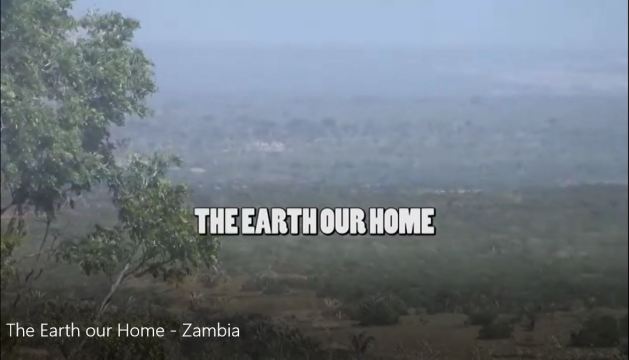
FENZA organised and hosted the launch of the documentary video “The Earth Our Home: conservation for integrity of creation” by Fr Venerato Babaine, the Provincial Delegate of the Missionaries of Africa in Zambia. The event was held at FENZA multipurpose hall on 28th October 2017 from 14:00 to 16:30.
The launch was attended by dozens of people, including Missionaries of Africa, some religious, friends of FENZA and people who heard of the event. Considering the publicity that preceded the launch, and the invitations that were extended to various people and organisations, the attendance was rather below expectation. Among the distinguished guests there were Fr Thomas Banda, the Diocesan Pastoral Coordinator of Lusaka Archdiocese, and Fr Felix Phiri, the Provincial of the Missionaries of Africa in Southern Africa, who was also a keynote speaker.
In his opening speech, Fr Babaine spoke of the events that inspired him to embark in the production of the video. He disclosed that it is a combination of his childhood experience in Uganda, his missionary journeys in many countries of Africa and Europe, and the “cry of the Earth” that led him to the making of the documentary. He also said that he drew inspiration from the recent encyclical of Pope Francis, “Laudato Si”. In his speech, Fr. Babaine explained the purpose of the documentary. He said that the purpose of the video is to show the beauty of nature in Zambia, and to alert people on the devastation of this beautiful countryside due to human activity and lack of care. He said that the exciting thing about the documentary is that it exposed the exemplary efforts of conservation that are undertaken by many people and organisations in parts of Zambia.
Fr Felix Phiri in his address expanded on the place of creation in the Christian faith teaching and tradition. He explained how the integrity of creation has gained attention in the Church’s mission in the last decades and that it cannot be overlooked anymore today. He cited examples of concerns for the earth and creation from other religions. He concluded by commending Fr Babaine for producing the documentary, which he said is timely and would be another contribution to the care of the earth.
The producer of the video, the Catholic Media Services (CMS), was also given an opportunity to address the audience. Speaking on behalf of the director of CMS, Mr Mwamainda said that the CMS was delighted to produce yet another documentary for the Catholic pastoral work. Helping the Catholic Church, and pastoral workers to evangelise through the media, he said, is their vocation; and they are looking forward to being called upon for more such endeavours.
After these speeches, the video was ceremoniously launched; and the audience could view the documentary. This was followed by a short discussion. Most contributors welcomed the video and recommended it to be used in gatherings, schools and various forums as a tool to promote the care for creation. One intervener suggested that the content of the video to be put on other media such as YouTube for a wider reach.
It was another interesting event at FENZA, attended by concerned and supportive friends of the earth. “The Earth Our Home” is a short and easy-to-watch movie which combines a show of the beautiful nature in Zambia, a public education on the environment and a presentation of laudable works of conservation, which aims to inspire people to care for the earth, our home.
The DVD is available for purchase at FENZA and at the Missionaries of Africa Provincial House, for K50.
Venerato Babaine, M.Afr, DVD Producer – November 01, 2017.

 By Jos Kuppens, M.Afr
I was asked to try and record in the form of an article what we have been going through here in Kampala, close to the place where young Kizito, Charles Lwanga and companions and Mapera were walking, praying, suffering and gave their life.
So, what to start with? The reality that we as a group of missionaries are slowly living on our reserves to survive? A bit like sheep in winter, having eaten all summer and having built up reserves the sheep will, to a large extent, live on these reserves in winter. Or that in quite a few communities we are able to take care of ourselves using the income produced by our various ministries? Or the initiative of raising rabbits in the community where I live (they do multiply as rabbits!! following a now famous quote). Or the last Chapter where our confrere capitulants raised the alarm on the fact that we need to ensure that we can continue our mission well into the future by becoming proactive in looking for resources and start Income Generating Projects (IPGs).
Our last Chapter charged the General Council to look into Income Generating Initiatives / Projects for the society. Not that nothing was ever done in this regard. We have had initiatives that were mainly centred in the Northern Hemisphere. More recently we have had some initiatives in Africa that operated on a trial and error basis, while some were quite successful. But more often than not the enthusiasm about starting such projects was high but was not matched by corresponding success rates. Hence the need for a more professional approach. Thus the calling into being of a team of confreres (mainly treasurers) who worked with experts in the field of Project Management for Income Generation Projects. They produced a book of guidelines to steer our Income Generation Projects on a more professional course. Using this resource book (Guidelines for ), about 20 of us coming from various Anglophone Provinces in Africa were ‘workshopped’ into the rather complex matter of the Income Generation Projects cycle, using the concrete example of construction of hostel.
The Three phased approach
We were taken through three different phases. They seem very logical and simple. Planning, Implementing of plans and operating the result of our effort: the planned building. In the diocese where I am now the Christians have decided to start a project to build a cathedral. They have decided to do it professionally. The workshop in Kampala has helped me to understand a bit better what it means to work professionally to construct a building as it did for all the participants.
Phase one
What is it that we are supposed to do? All together as missionaries of Africa we need to wake up to the fact that things are not the same as they used to be. At all times there seemed to be enough funding to do our work, to train our candidates, to venture into new missionary challenges. Well, that time is definitely finished. So all of us are asked to do the needful, like: budget, implement budgets, raise funds to meet the shortfalls, generally to live more according to our means.
So this common effort will underlie all of the other efforts for which the society has now put in place Development Committees, at the level of the Sectors and the Province, with, in the future, a coordinating office in Rome.
The Sector Council will appoint two members to the Sector Development Committee (SDC) to work with the confrere who is part of the provincial development committee and participated in the training. In order to help all of us in our Sectors to be part and parcel of this process, some mini seminars will be organized at the occasion of Sector Assemblies. This will assist in understanding the basics of managing IGPs and in finding some of the opportunities and potential ideas for IGPs. This will help the SDCs to identify some projects in their Sector. These should be developed up to a point where it will be clear that the eventual income is worth the investment. These committees will work on the following points:
- Is the idea sound, has it been tried elsewhere; how does it fit in with our lifestyle?
- What are the competitive advantages, its potential and uniqueness?
- What are the project goals?
- Who are the beneficiaries?
- Map out the stakeholders/ competitors/ operators.
- Point out the potential risks/ success factors.
- Included a rough draft of what it will cost.
The end result of this will be cast in the form of a Draft Concept Paper in which already some analysis is done and the project classification of the IGP is also determined. The Sector council will look at this concept, have its input and approve it to be sent to the Provincial Development Committee (PDC). There it will be examined and worked on further in order to send it to the Provincial Treasurer and Provincial Council. They in turn will examine the draft concept and after deliberation (with some possible modifications) approve it to be sent to the General Treasurer and the Financial Council in Rome. Once reviewed, it will go to the General Council. The General Council will be the one to either approve the concept or shelve/ archive it.
If approved
They will give it the “Go for Plan” signal. We are speaking about potential projects between 150 and 500 thousand Euro.
In depth planning
It will now be the task of the PDC to go deeper into the planning stage. The GC will release a small budget to assist in the planning because it will involve hiring the expertise needed to do a professional plan.
In the ‘Go for Plan’ stage the already gathered information will be further worked out and new documents will be added. One of the main ones is a Business Plan, which includes a market survey and financial projection. Ownership, administration, organization are mapped out. Risks are analysed. A detailed explanation of all this can be found in the new guidelines. All these preparations are done to give the PC, Treasurer General and his Financial Council and the GC all the tools they need to actually give the final go ahead or shelve it. As one can see little or nothing is left to chance.
The ‘Go / or No Go’
 First of all the decision will be published. If the project is approved a project team is setup. Accounts are created. A project structure is elaborated. A project manager may be appointed. (Sub)-Contractors will be found. Contracts will be negotiated. All this is then submitted to a thorough scrutiny which in the planning lingo is called a ‘quality gate’. If it passes here the project is now ready for Phase 2: the implementation stage.
If the decision is ‘no go’ all results are archived, all activities and accounts are closed. Documentation submitted to GC.
Phase two: the implementation stage
Most likely the Project Committee will now become the Management Committee. They are responsible to see to it that the Project Manager has all he needs. Legal experts may need to be involved. Risks need to be shared equally between contractors and MAFrs. Sub-contractors will agree to delivery dates, work out more concrete plans. Efforts are made to create a good understanding between all those involved so they communicate properly and at regular intervals.
It is now important to control the project. The actual versus planned status of the project is regularly worked out. This includes use of resources, use of budget. In all this the Project Manager, (Financial Manager, Quality and Risk Manager, if needed for the project) and the Project Management Committee divide the work.
Reporting up to the Treasurer General is required when the variance of actual expenditure with the budget exceeds 10 %. When the project has been finalised all accounts are closed.
The last ‘quality gate’ is the handover of the finished project (building, hostel, etc.) to the operator who has been identified already even in Phase 1.
This leads us to the Third Phase which is the operation of the project.
Phase Three: successful operation of the project
The final points that need attention are shared with the Operational Team. All documentation is also shared with them as well as technical know-how such as maintenance schedules and warranties. The Management Committee and the Operational Committee visit the site together and finally the handover can be done with some sort of celebration.
The Provincial Treasurer will now be in charge of supervising the operations but may delegate the Provincial Delegate or the Treasurer Delegate. Now on a yearly basis the operational profit will for 80% go to the province, while 20% will be saved for maintenance and repairs.
 Conclusion

The project journey has been painstakingly prepared, implemented and the success rate should be high. In other words our IGP guidelines are of a quality that should guarantee a good success rate. The future of our mission will in that way be better guaranteed than it is now. At the end of the workshop the participants in the workshop were still apprehensive about the complexity of the whole cycle, but did give their wholehearted approval to the process and started already to plan how to implement it in each Province.
In the place, which is steeped in history and tradition of the best kind, the place of martyrdom of the martyrs of Uganda, the same Society of Missionaries of Africa that brought father ‘Mapera’ to Uganda, started charting a new course to support the very same Mission that was crowned by the faith of the martyrs.


-

- Frank Kalala, M.Afr
PDF DOCUMENT:
Project Cycle Meeting in Kampala
 Father Gilles Barrette, Provincial of the Americas, informs you of the death of Father Guy Bourgeois, M.Afr. He died on October 23, 2017, in Joliette (Canada), at the age of 82 years of which 58 of missionary life in Malawi, France, South Africa and Canada.
Let us pray for the repose of his soul.
01/01/1966 Learning the language at Mzimba, Mzuzu Diocese, Malawi.
28/09/1966 Curate at Lunyangwa, Mzuzu Diocese, Malawi.
01/02/1968 Parish Priest at Lunyangwa, Mzuzu Diocese, Malawi.
01/07/1969 Parish Priest at St Peter’s, Mzuzu Diocese, Malawi.
16/10/1970 Formation House at Strasbourg France.
01/06/1974 Nomination to Malawi.
01/09/1975 Regional in Malawi.
01/01/1976 Parish Priest at Rumphi, Mzuzu Diocese, Malawi.
01/01/1981 In charge; Senekal South, Africa.
01/01/1982 In charge; Phuthaditjhaba, South Africa.
01/01/1986 In charge; Bohlokong, South Africa.
01/01/1987 Parish Priest at KwaNdebele, South Africa.
17/11/1993 Parish Priest at Tweefontein, KwaNdebele, South Africa.
01/12/1998 Curate at Orange Farm, Johannesburg Diocese, South Africa.
21/02/2008 Nomination to Diepsloot, South Africa.
01/06/2010 Nomination to Canada.

 Aujourd’hui, les Missionnaires d’Afrique de l’Ouest vous proposent de visiter de nouvelles pages sur leur site http://www.mafrwestafrica.net.
Actualités
« Au Burkina, Bassolé sorti de prison » le général Djibrill Bassolé, assigné à résidence, reçoit les premières visites depuis sa sortie de prison. La nouvelle résidence de l’ex-patron de la diplomatie burkinabè est sous haute sécurité (lire la suite).
« Mali, lutter contre le terrorisme » Trois jours de discussion au Mali pour essayer de mutualiser la lutte contre le terrorisme et la criminalité transfrontalière (lire la suite).
« CEDEAO lutter contre le terrorisme » le centre sous-régional d’alerte précoce a été inauguré samedi 14 octobre à Bamako par les chefs d’Etat du Mali et du Togo (lire la suite).
« Attentat en Somalie » les dernières nouvelles au sujet de cet attentat innommable qui a fait au moins 300 morts et 300 blessés (lire la suite).
Témoignages
« Un immigré écrit à un missionnaire » un texte traduit de l’italien qui exprime de qu’attendent des missionnaires les personnes vivant difficilement leur état d’immigrés. (lire la suite).
« De Mgr Claude Rault à Mgr John Mac William » dans Voix d’Afrique cet article qui nous parle de L’ancien évêque de Ghardaïa et de son successeur (lire la suite).
« Une cinéaste burkinabè » Eléonore Yameogo tient à rencontrer les confrères dans les maisons de retraite pour les écouter exprimer leur vécu en Afrique (lire la suite).
« Un prêtre de Kaya (Burkina) nommé en France » L’abbé Eloi Bamogo est maintenant en France depuis la fin du mois d’août et a envoyé quelques nouvelles (lire la suite).
Histoire
« Qui a tué Sankara il y a 30 ans ? » sur le site de Jeune Afrique beaucoup d’éléments en lien avec cet assassinat. Naviguer sur le site… (lire la suite).
« Sankara sur le site RFI » une présentation à la fois semblable et différente de ce qui est proposé sur le site de Jeune Afrique. Intéressant. D’autres éléments à venir sous peu (lire la suite).
Dialogue interreligieux
« Une femme insoumise » un roman qui présente deux mondes et surtout deux cultures, qui séparent les Belgo-marocains et les Belges de souche (lire la suite).
« Le pardon dans l’islam et la foi chrétienne » des citations et des liens internet pour mieux découvrir ce qu’est le pardon pour un musulman ou un chrétien (lire la suite).
« Synode chaldéen et pape François » l’accueil que le pape a réservé au synode de l’Eglise chaldéenne en encourageant ces chrétiens à ne pas se décourager malgré les difficultés dues à la guerre (lire la suite).
Justice et Paix
« Relations Europe-Afrique » Les relations entre l’U.E. et l’Afrique subsaharienne sont actuellement régies par l’accord de Cotonou, qui jette les bases des relations entre l’Union et les 78 pays appartenant au groupe ACP (lire la suite).
« Macron et la migration ? » La France s’est engagée lundi 9 octobre à offrir 3 000 places aux réfugiés du Niger et du Tchad. Quelles seront les conditions et les conséquences ? (lire la suite).
« Migrants en Espagne » le témoignage d’un confrère missionnaire d’Afrique espagnol engagé dans l’accueil des migrants au sud du pays (lire la suite).
« ATD Quart Monde en Afrique » il y a 60 ans que cette association a été fondée, et le 17 octobre 2017, est aussi le 30e anniversaire de la Journée mondiale du refus de la misère que l’association a instaurée (lire la suite).
Vu au Sud – Vu du Sud
« Coup d’état 2015 au Burkina » le site Mediapart revient sur cet événement, le putsh manqué de septembre 2015, et sur le rôle qu’aurait joué la Côte d’Ivoire (lire la suite).
« Toujours contestation au Togo » Après une semaine d’accalmie, l’opposition annonce de nouvelles manifestations les mercredi 18 et jeudi 19 octobre (lire la suite).
« Titre de séjour en Côte d’Ivoire » La feuille de papier vert plastifiée d’une durée de 12 mois va laisser place à un document biométrique format carte de paiement effectif pendant cinq ans. (lire la suite).
« Accident d’avion en Côte d’Ivoire » cet avion affrété par Barkhane, s’est écrasé sur la plage de Port-Bouët, à Abidjan, le 14 octobre 2017 (lire la suite).
« Ouattara et Soro en Côte d’Ivoire » ces deux personnages sont-ils sur la route de la réconciliation et du travail en commun ? (lire la suite).
« Procès Boko Haram au Nigéria » les premières condamnations sont tombées vendredi 13 octobre dans le procès de masse concernant près de 1 670 membres présumés de Boko Haram (lire la suite).

 By Patrick Kalonji Kadima, Stagiaire in Nyankpala, Ghana.
I am Patrick Kalonji Kadima, Congolese born in 1990. I have five sisters and one brother. Of my parents, only my father is still alive. I grew up in Kinshasa but migrated with my family in South Africa and in Lesotho. I did part of my secondary education in DR Congo and then in South Africa. I joined the Missionaries of Africa few years ago. I am currently doing my pastoral apostolic training years in St. Monica Parish, Nyankpala, within the Metropolitan Archdiocese of Tamale in Ghana.
Human trafficking in Ghana!
On Friday 29th September 2017, the Missionaries of Africa and the Missionary Sisters of Our Lady of Africa in Tamale gathered at the provincial house for a talk on human trafficking. The talk was given as part of our ongoing preparations towards the celebration of the 150th anniversary of our foundation (1868/69 – 2018/19). One will remember that from the 11th November 2012 to the 8th September 2013 the two institutes of our Lavigerie family celebrated the 125th Anniversary of the Anti-Slavery Campaign of our founder Cardinal Lavigerie. This celebration paved the way for the campaign against human trafficking which is one of the forms of modern slavery that our mother land, Africa, faces daily. The fight against human trafficking is part and parcel of our commitment to Justice & Peace and Encounter-Dialogue (JPIC-ED) which the Ghana-Nigeria Link has called us to share upon. It is following that call that I propose the few lines underscoring the talk we had at the provincial house on human trafficking.
 Father Clement Wie Tuureh, M.Afr, gave us an introduction for the reason of our gathering. This short introduction allowed the presenter, Mr. Abdulai Danaah, the Executive Director of the Centre for Initiative Against Human Trafficking (CIAHT), to begin his talk under the topic: ‘What is Human Trafficking, the Causes and Effects and Strategies Action Plans to End Human Trafficking in the Northern Region of the Republic of Ghana.’
 What Is Human Trafficking?
It was discovered during the talk that most people are unaware or unconscious of such a reality called human trafficking. This is simply due to the lack of knowledge of what is involved in human trafficking.
Accordingly, the speaker gave us this definition: “The United Nations has defined human trafficking as “the recruitment, transfer, harbouring or receipt of persons by threat or use of force.” He, furthermore, argued: “Similarly, the U.S. State Department’s Trafficking Victims Protection Act 2000 describes severe forms of trafficking as: (a) sex trafficking in which a commercial sex act is induced by force, fraud, or coercion, or in which the person induced to perform such an act has not attained 18 years of age; or (b) the recruitment, harbouring, transportation, provision, or obtaining of a person for labour or services, through the use of force, fraud, or coercion for the purpose of subjection to involuntary servitude, peonage, debt bondage, or slavery”; similar practices being the removal of organs. With the above, the presenter made us aware on how to confirm if a situation can be called human trafficking, one has to consider all the elements that make the situation to be called “human trafficking”.
Elements of Human Trafficking
The elements of human trafficking are: the act, the means and the purpose. First, concerning the act, the presenter made us understand that it is about ‘what is done’, meaning to say, is it recruitment, transportation, transfer, harbouring or receipt of persons? And when it comes to the means, we have to bear in mind ‘how it is done’, meaning to say, is it a threat or use of force, coercion, abduction, fraud, deception, abuse of power or vulnerability, or making payments or benefits to a person in control of the victim. Then last, concerning the purpose we looked at ‘why it is done’, meaning to say, is it for the purpose of exploitation, which includes exploiting the prostitution of others, sexual exploitation, forced labour, slavery or similar practices and the removal of organs.
Those who were present soon realised that they have encountered situations related to human trafficking where they live here in Ghana.
Human Trafficking in Ghana
In his presentation, the presenter mentioned to us that globally speaking 600 thousand to four million people are being trafficked and the majority in this estimation are women and children.
The presenter informed us that Ghana as a country is faced with the challenges of human trafficking; men, women, and children are subject to trafficking mostly in forced labour and sex trafficking.
It was clear in the speaker’s presentation that most people within the country in Ghana do not have the knowledge of human trafficking; and misunderstand the move of human trafficking to migration of one local area to another. Therefore, Ghanaian girls and young adults who move around in search of work from one rural area to another or from one rural to an urban area or community are easily exposed to traffickers.
Another way, in which Ghana is faced with this evil of human trafficking, is that, Ghana has become to some degree a target point for traffickers. Girls are been sent to Europe, America and some other African countries with the hope to have domestic jobs but later they are being brained-washed deceived into forced labour, some work and receive unfair wages, others are abused or forced into prostitution.
Invitation to Campaign Against Human Trafficking
In his invitation to fight human trafficking, the presenter reminded us to be careful as religious and moral figures on how to proceed to fight this evil in the various communities where we live or do our apostolate. In as much as we may wish to reduce or getting rid of this evil by conducting public awareness and informing the public. The traffickers are studying our movements. They are establishing networks and developing new systems to their favours. Again the presenter informed us that the government of Ghana have not yet enforced the law as such that will bring traffickers to justice in most of the cases and protect the victims. Another obstacle that may come our way as we fight human trafficking is that the victims themselves in most cases are not aware that they are being trafficked.
At the end of this talk, I remembered vividly how in 2014 I took part in a play we produced as students of philosophy in Balaka, Malawi, to bring awareness to the public (in schools, parishes and at a conference) on the issues of slavery and human trafficking. It is my prayer and hope that more of these events be encouraged. I wish to invite all of us to be creative and continue participating in the campaign to fight against all forms of modern slavery. “Let us break the chains!”


Father Rukundo sent a message from Nigeria sharing with us his missionary life. Here below a short presentation of himself (in English) and his story (in French).
 I was born in Rwanda in 1982. After my secondary school, I started my studies in philosophy in the Democratic Republic of Congo at ‘La Ruzizi’ formation Centre from 2004 to 2007. Then, in 2007-2008, I did my spiritual year at Kasama situated in the Northern Part of Zambia. From there, I went to Malawi where I spent two years between 2008 and 2010 for my pastoral experience. I learnt Chichewa at Mua when Serge St-Arneault was in charge of our language course. I still have the certificate he awarded us at the end of our language course.
 Interestingly, Stephen Kajendran, Didus Baguma and myself, we arrived at Mua the day before the Kungoni cultural day. It was very colourful only that I could not understand what was happening. At Mua, we were in the community with Serge, Julio Feliu and Claude Boucher. After it, I joined the community of Chezi on the top of the mountain between the capital Lilongwe and Lake Malawi. It was in November 2010. I stayed with André Bilodeau, Jean Arnaud and Michel Sanou who left soon after my arrival for his studies. Then Serge St-Arneault joined us sometimes in May of the same year.
 Chezi was a beautiful place to be. Moving around to various churches was challenging but I liked it and I felt that people loved me. I had a nice community that trusted and supported me. I also appreciated visiting the orphanage under the care of the Sisters of Mary Mediatrix. I enjoyed as well the organisation of Malawi as a Sector, the moments of meetings and celebrations of various events.
I remember the day I renewed my declaration of intent! It was a great day for me, many confreres came from Lilongwe to grace it and Martin Onyango called it a “mini-ordination”. By the way, the binocular you gave me is still functional. I have it still. Life in Malawi was great. Thank you for those years we shared. Zikomo kwambiri!


Dans les eaux profondes : une église à construire.
Par le père Gilbert Rukundo, M.Afr
J’ai été nommé à la Paroisse de Saint-Vincent de Paul à Ogo-Oluwa dans le diocèse d’Osogbo lorsque je suis arrivée au Nigeria en octobre 2013. J’y ai vécu une expérience épanouissante pendant trois ans. Je m’y sentais très à l’aise avec tout le monde. Ensuite, j’ai été nommé à Saint-Augustin à Oojo dans l’archidiocèse d’Ibadan qui était une succursale de la grande paroisse de l’Apôtre St-Thomas à Agbowo avant de devenir une paroisse autonome.
En accord avec l’Archevêque et le conseil provincial des Missionnaires d’Afrique, nous avons unanimement accepté de prendre en charge ce projet même s’il devenait inévitable que l’un de nous quitte son poste. Le choix est tombé sur moi et je l’ai acceptée d’un bon cœur. À vrai dire, j’étais l’un de protagonistes pour que Saint-Augustin devienne une paroisse.
En conséquence, je devrais me séparer de la communauté chrétienne d’Ogo-Oluwa qui a été témoin de mes premiers pas missionnaires juste après mon ordination sacerdotale le 17 août 2013. Ce fut une séparation douloureuse. Comme un adage dit : partir c’est mourir un peu.
La communauté chrétienne d’Ogo-Oluwa a organisé une fête d’adieu en soulignant quelques faits marquants de mon séjour. Étaient présents l’Évêque Mgr John Akinkunmi Oyejola les prêtres et religieux de notre doyenné, les staffs de l’hôpital Our Lady of Fatima où j’étais aumônier et les chrétiens de St-Vincent de Paul. Ils resteront toujours gravés dans ma mémoire.
Par contre, la communauté chrétienne de Saint-Augustin est à construire. L’église et les bureaux sont encore en chantier tout comme le presbytère. Milieu dynamique, Saint-Augustin englobe plusieurs tribus venant de partout au Nigeria. La population est composée de quelques pensionnaires militaires et des jeunes venus d’un peu partout à la recherche d’une meilleure vie et qui font des petits commerces au marché d’Ojoo qui n’est pas loin de l’église.
 À l’exemple de Saint-Augustin élevée au statut de quasi-Parish en février 2015, une autre succursale nommée St-Martin-de-Porres prend racine, située à cinq kilomètres seulement de Saint-Augustin. La fondation de l’église a été bénie par l’archevêque d’Ibadan Mgr. Gabriel Adeleke Abegunrin le 21 mai 2017. Les fidèles prennent à cœur le défi de bâtir les bâtiments dans l’entraide.
Les nouveaux registres des chrétiens demandent beaucoup de travail. Pour le moment, je garde la plupart des dossiers paroissiaux dans ma chambre en attendant la construction d’un bureau temporaire qui est une priorité, dès que le toit sera mis sur l’église.
-

- L’évêque me présente a ma nouvelle communauté Paroissiale
-

- Vue extérieur de l’église et de la clôture
-

- La vue de l’église et de la salle
-

- Vue de l’actuelle sacristie
-

- Le travail au bureau
Nous célébrons la messe quatre fois par semaine. Le dimanche, même inachevée, l’église est n’a pas assez d’espace pour tout le monde. Confiant que tout se passera bien, la joie et l’enthousiasme des communautés très généreuses qui célèbrent son Seigneur sont au rendez-vous. Je considère ma mission actuelle comme une plongée dans les eaux profondes. Conscient que ce n’est pas ma mission, mais une participation dans la mission du Christ, je trouve ma consolation dans le service que j’offre comme Missionnaire d’Afrique.

 By Landry Busagara, stagiaire in Mua.
Saturday on the 23rd September, Mua Parish was celebrating its 115 years of existence. Mua mission was established by three Missionaries of Africa in September 1902 and has since grown to have 25 churches and about 25 000 Christians. Moreover, it was the golden jubilee of priesthood of Father Claude Boucher who has been living in Mua for more than 40 years. The parish was also celebrating 25 years of service of one of its catechists: Abambo Simoni Panyani.
Many people came from different places to congratulate and share our joy. We were honoured by the presence of the Vice President of the Republic of Malawi, the Ambassador of Germany in Malawi, the Provincial of Southern Africa, the MPs, Chiefs, Priests, Sisters, brothers and parishioners who came in large numbers for the event.
The Eucharist was presided by the Bishop of Dedza Diocese, Bishop Emmanuele Kanyama. Time was given to present the amazing journey of Father Boucher Chisale, the founder of the Kungoni Centre of Culture and Art. It was a celebration to remember all the missionaries who contributed to the life of the Christian community over so many years. “Following that example of the bounty of God, said the Bishop, we are called to do the same, we need to love one another, to forget our ego and live together as brothers and sisters without conflicts and quarrels, and to be thankful to God and to the missionaries.”
 Being in Malawi for so long, Father Boucher, as he said, became a Malawian and happy to be so. His regret is to see how people are becoming careless about the environment and the culture. As a matter of fact, Father Claude, now 75 years old, has been working and doing research in anthropology and the local culture all his life. He wrote many books and received many awards for his tremendous achievement. He asked the Lord to grant him some more days to continue working in his vineyard.
Father Felix Phiri, our Provincial, expressed his joy and congratulated everyone. In his view, it is rare to see Missionaries of Africa celebrating 115 years of presence in the same parish. Usually, they start a parish and, after some time, move elsewhere. Father Claude Boucher should be a good example for all missionaries for his closeness to the people and his care for the nature and preserving the local culture.
The Vice President Saulos Chilima was also very happy to be present and thankful for the invitation. “We should not forget our beautiful culture in exchange with foreign ones. We were not supposed to wait for missionaries to teach us how to preserve our culture and traditions. We need to keep our identity. Nowadays, he continued, people are more aggressive towards the environment. We are more zealous in destroying than in building. The way we cut trees, the way we use water… and we do not realise that what we are doing will cause us problems in the future.” He also talked about demography in Malawi. If we do not pay attention on how we make children, it will be very hard in the years to come. We should give birth to children that we are capable of raising up.
Before the final blessing, the Bishop congratulated Father Claude Boucher who has sacrificed his whole life for others, caring for the nature, the culture, being one of the people. He asked us to take into consideration that good example.
Link: Mua Parish Celebration in Dedza diocese, Malawi.

By Archbishop George Daniel and Fr Christophe Boyer, M.Afr
 In 1992, Bishop Anthonios Markos started the Coptic Orthodox Church in Johannesburg. Archbishop George Daniel met him in 1993 and since became his friend. A reason is that there are many struggling independent churches in South Africa but the Coptic Church is truly African since the beginning. They could learn from it. The Egyptian government organised a Forum of Heavenly Religions in Sharm El Sheikh, Sinai on September 28-30, 2017. They asked Bishop Markos to send somebody from South Africa and he selected Archbishop Daniel. He accepted to visit Egypt but it was said that he needs a companion to deal with the challenges of such a journey. I accepted with joy to accompany him.
At Novotel, we met an Austrian professor, a German journalist for Germany and an Algerian journalist for Russia, a priest and an imam from South Sudan, an imam from Mali, another imam Pakistani residing in Ireland. We went directly to the Conference Palace. Soldiers surrounded it. They were meant especially for the government officials: most of them left with them. It is a big conference centre. Participants might have been around 2,000 people. Personalities started speaking only in Arabic. There was a simultaneous translation on earphones. The one of the Archbishop did not work… The theme was tourism and religion.
In a context of terrorism there are fewer tourists in Egypt. So tourism needs promotion. Sinai is beautiful for its mountains and the Red Sea. It offers climbing, diving and therapeutic facilities. Especially it’s the place of the burning bush and of the 10 commandments revelation to Moses. Statistics show that religious tourism is more regular than others especially in front of terrorism. There is need to improve the roads and communications… South Sinai Governor came with Antiquities Minister and other officials. An evangelical bishop praised the government for authorising the building of a church… Muslim scholars of Al Azhar University were there beside churches’ leaders but no Jews, all in religious clothes. During tea time we could speak with a few bishops especially the Coptic Catholic Bishop and the local Catholic Coptic parish priest (ex Comboni student in Zambia), an evangelical bishop, the nuncio and his secretary… A Christian tour operator proposed her services for pilgrimages… We finished by a magnificent lunch around 15:00 which is normal time in the Middle East. We inaugurated a beautiful mosque in the evening. We had dinner with conference people on the flank of a mountain above the town centre, there was an orchestra…
On Friday morning we took a plane to St Catherine Monastery. We got a bedroom at Morgen Land hotel, the only one of the small town. Again military presence was heavy. The monastery was small for the big crowd of the conference. It needs restoration: paintings are dark and many things are worn out. We were told they are working on it. The oldest manuscripts of the bible are there but in the crowd we lost track of the Texan monk who was ready to show us the library. It is the oldest continuously occupied monastery and library… The name St Catherine of Alexandria was given by some Crusaders. A living thorn bush represents the burning bush… We stopped at the foot of the mountain thought to be of the Ten Commandments revelation but had no time to climb it…
In the evening, in front of the illuminated mountains, there was a beautiful UNESCO rather religious singing concert with singers from 15 countries… some Christians other Muslims… It was about peace and love…The introductory speech sounded a bit too nationalistic and pompous. It is understandable in the context of terrorism: Egypt is stronger than Islamism. An English-speaking Bedouin spoke with us critically of the government.
We believe that the aim should be a reconciliation between different religions. Tourism in the Middle East can be a tool.
I thank Bishop Markos and the Coptic Church in Egypt for allowing this wonderful trip to Egypt with the visit of key positions in vibrant mid-east Churches, parishes, famous shrines and monasteries and even of Alexandria, Giza and National Museum with good guides. The warmth of the people, their conversation and the good food compensated largely the honking and chaotic traffic, heavy schedule and airport lack of communication and utilities.
 Let us pray for the late Coptic priest Fr Samaan Shehte murdered on October 12, 2017, that his death may contribute for peace and justice in this divided world.