


Tag: Antislavery campaign Page 3 of 4
John shares with us his understanding of addiction as a form of today’s slavery. He says: “I believe that it is a form of slavery in that it takes away freedom of choice within the individual. When one is driven to act by anything that is taking away freedom of choice, then I think it is appropriate to speak of it as a form of slavery.” 
He concludes the interview with wise words saying: “In reality there is “no gain without pain”. The only constant in our lives is change. When the addict recognizes the addiction and is willing to accept it and try to live in the present moment seeking in faith and trust in the higher power, he or she can honestly live as “a wounded healer”, seeking each day honesty, openness and willingness, which are the essentials of recovery.” READ MORE


 A Human Trafficking Conference, organized by Sr. Melanie O’Connor HF, Coordinator of the Counter Trafficking in Persons Office (CTIP) of the LCCL/SACBC, took place at The Good Shepherd Retreat Centre Haartbeespoort from the 9th till the 12th April 2013. During the Conference there was the launch of the “TRUCKERS AGAINST HUMAN TRAFFICKING” campaign for which we congratulate FRUIT SPOT as being the first trucking company to engage in this project. Various speakers exposed the dangers of human trafficking, pointing out that truckers can play a significant role in safeguarding victims and potential victims in transportation by reporting offenders sometimes encountered especially at truck stops.
The role of the Church in the pastoral care of truck drivers who face long and hazardous journeys was emphasized. It was stressed that the Church should move from its traditional way of evangelization of waiting for people in church buildings to the new evangelization emphasized in the recent African Synod. Africa has become a continent where millions of people are either willingly or unwillingly daily on the move thus transforming African roads and streets into privileged places of evangelization and education. Therefore our Church should be seen as the Church on the Move.
The presence of over 15 Police units who man the borders of the Northern Cape was acknowledged and highly appreciated by all present as a source of strength in the fight against Human Trafficking. With many of the participants coming from different African countries and representatives from different agencies – NPA, US Embassy etc., religious and lay people, it became obvious that networking is central to the success of the fight against this hydra-headed evil of our time.
One of the outcomes of the Conference was the commitment of each member to further the Truckers against Human Trafficking campaign in their various regions and countries.
A COUNTER TRAFFICKING NETWORK COMMITTEE (CTNC) was established for easy and effective communication.
Sent in by: Sr. Melanie O’Connor (South Africa), Sabina Namfukwe (Zambia), Sr. Patricia Ebegbulem (Nigeria)
Picture below: participants of the Conference
A Human Trafficking Conference, organized by Sr. Melanie O’Connor HF, Coordinator of the Counter Trafficking in Persons Office (CTIP) of the LCCL/SACBC, took place at The Good Shepherd Retreat Centre Haartbeespoort from the 9th till the 12th April 2013. During the Conference there was the launch of the “TRUCKERS AGAINST HUMAN TRAFFICKING” campaign for which we congratulate FRUIT SPOT as being the first trucking company to engage in this project. Various speakers exposed the dangers of human trafficking, pointing out that truckers can play a significant role in safeguarding victims and potential victims in transportation by reporting offenders sometimes encountered especially at truck stops.
The role of the Church in the pastoral care of truck drivers who face long and hazardous journeys was emphasized. It was stressed that the Church should move from its traditional way of evangelization of waiting for people in church buildings to the new evangelization emphasized in the recent African Synod. Africa has become a continent where millions of people are either willingly or unwillingly daily on the move thus transforming African roads and streets into privileged places of evangelization and education. Therefore our Church should be seen as the Church on the Move.
The presence of over 15 Police units who man the borders of the Northern Cape was acknowledged and highly appreciated by all present as a source of strength in the fight against Human Trafficking. With many of the participants coming from different African countries and representatives from different agencies – NPA, US Embassy etc., religious and lay people, it became obvious that networking is central to the success of the fight against this hydra-headed evil of our time.
One of the outcomes of the Conference was the commitment of each member to further the Truckers against Human Trafficking campaign in their various regions and countries.
A COUNTER TRAFFICKING NETWORK COMMITTEE (CTNC) was established for easy and effective communication.
Sent in by: Sr. Melanie O’Connor (South Africa), Sabina Namfukwe (Zambia), Sr. Patricia Ebegbulem (Nigeria)
Picture below: participants of the Conference


 I am Sister Sabina Namfukwe, I belong to the Congregation of the Sisters of the Child Jesus. I am working at the Zambia Catholic University in the Copperbelt Province as Matron for both boys and girls. I am in charge of their accommodation. I learnt so much on human trafficking and sexual abuse that I am failing to keep quiet about it. I do a lot of awareness as I visit and meet them in their boarding houses.
Due to poverty, some of our young people are hungry and thirsty for sponsorships to study abroad. There are a lot of fake sponsors around. Some boys and girls have gone missing from school, no communication to their parents or anybody. Only God knows where they have disappeared. I just help them to make informed choices in case someone approaches them and talks about sponsorships. They should know how to analyse and know the difference between a genuine sponsor and a fake one.
Recently, I got some pamphlets from the Missionaries of Africa community in Kitwe and I distributed them immediately. Also, I have been invited to participate in an international conference in Pretoria South Africa on Anti-Human Trafficking Campaign and Truck drivers in African countries. After it, I intend to extend my sensitization campaign to primary, secondary and high schools around our University because some of the pupils can also be potential victims of sexual abuse and human trafficking.
Sister Sabina Namfukwe
Below: drawings from a poster illustrating various forms of human trafficking.
I am Sister Sabina Namfukwe, I belong to the Congregation of the Sisters of the Child Jesus. I am working at the Zambia Catholic University in the Copperbelt Province as Matron for both boys and girls. I am in charge of their accommodation. I learnt so much on human trafficking and sexual abuse that I am failing to keep quiet about it. I do a lot of awareness as I visit and meet them in their boarding houses.
Due to poverty, some of our young people are hungry and thirsty for sponsorships to study abroad. There are a lot of fake sponsors around. Some boys and girls have gone missing from school, no communication to their parents or anybody. Only God knows where they have disappeared. I just help them to make informed choices in case someone approaches them and talks about sponsorships. They should know how to analyse and know the difference between a genuine sponsor and a fake one.
Recently, I got some pamphlets from the Missionaries of Africa community in Kitwe and I distributed them immediately. Also, I have been invited to participate in an international conference in Pretoria South Africa on Anti-Human Trafficking Campaign and Truck drivers in African countries. After it, I intend to extend my sensitization campaign to primary, secondary and high schools around our University because some of the pupils can also be potential victims of sexual abuse and human trafficking.
Sister Sabina Namfukwe
Below: drawings from a poster illustrating various forms of human trafficking.


 TOGETHER LET US STOP MODERN SLAVERY
By Peter Wazili Chitondo
I look up in the sky I see free birds
Flying high the horizon
While my people are weeping
Struggling to be free like a crying bird
In the hand of the oppressor
For by force they are smuggled
To far countries they are taken
To be used as sex workers and drug dealers
Yes both boys and girls are victims
For hard labour they are used with poor conditions
Yet good wages they are refused
Who is accountable for their suffering?
It’s all because of you! And me!
Who have kept our mouths shut like a door?
And have failed to be a walking stick
In the hand of the most vulnerable
Yes a patient heart do we need
To listen to the voice of the voiceless
An intelligent mind we need not
That only talks without actions
Together lets fight modern slavery
VIVA! AFRICA VIVA!
TOGETHER LET US STOP MODERN SLAVERY
By Peter Wazili Chitondo
I look up in the sky I see free birds
Flying high the horizon
While my people are weeping
Struggling to be free like a crying bird
In the hand of the oppressor
For by force they are smuggled
To far countries they are taken
To be used as sex workers and drug dealers
Yes both boys and girls are victims
For hard labour they are used with poor conditions
Yet good wages they are refused
Who is accountable for their suffering?
It’s all because of you! And me!
Who have kept our mouths shut like a door?
And have failed to be a walking stick
In the hand of the most vulnerable
Yes a patient heart do we need
To listen to the voice of the voiceless
An intelligent mind we need not
That only talks without actions
Together lets fight modern slavery
VIVA! AFRICA VIVA!
-

- Sing post of the Inter-Congregation Institute.
-

- Fund Raising Walk
-

- Bonaventure Gubazire, Eckehard Reynen, Julian Kasiya, Jean-Marie Hougardy
-

- Archbishop Rémi Ste-Marie, Lilongwe Diocese
-

- Archbishop Rémi Ste-Marie, Brother Eckehard Reynen, Bishop Pagani, Bishop Zuza, Father Richard Deschênes, Piet van Hulten
-

- Liturgical celebration
-

- Group picture 2011
-

- Group picture 2012
-

- Students at work
-

- Outing at the Lake Malawi – learning how to swim
-

- Outing at the Lake Malawi – crossing the lake
-

- Bonaventure Gubazire, Didasio Mwanza, Robert Tebri, Michael Mawelera. Formation Team 2013
-

- Chapel of Lechaptois
Dear missionaries,
We have just received a document from André Schaminée which you can read below. As attachments, you can also open a letter from Fr. Richard K. Baawobr, M.Afr and Sr. Carmen Sammut, MSOLA inviting us to share a common retreat on the 30th April, feast of Our Lady of Africa. A PDF file of 8 pages will guide you through this recollection. Please, let me know if you prefer a hard copy of this PDF files, as some of you might find it difficult to download it because of poor Internet network. Your Sector Superior may also help you.
Fr. Serge St-Arneault, M.Afr Dear Confreres, To all of you: a good continuation of the celebration of Easter. May this feast be for us and for the whole Church, under the guidance of the new Pope Francis, a nice occasion to renew our faith in Him, who offers us his New Life and who sends us with a Mission of bringing this Joyful News to all those whom we meet in our apostolate. This year our Lavigerie family commemorates the Antislavery Campaign of Cardinal Lavigerie. We have now reached the half-way point of this celebration. Carmen, the Superior General of the MSOLA and Richard, our Superior General, propose to us a recollection on this theme for this month of April. You find their letter and the text of this recollection attached to this e-mail. They can also be found on our website mafrome.org This message is sent to all Provincials and the Delegate Superior. I invite you to let all communities of your Province or Delegation have a copy. It is equally sent to all Formation Houses. Fraternally, André Schaminée
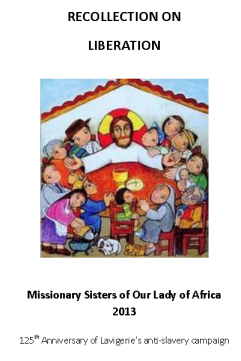
Fr. Serge St-Arneault, M.Afr Dear Confreres, To all of you: a good continuation of the celebration of Easter. May this feast be for us and for the whole Church, under the guidance of the new Pope Francis, a nice occasion to renew our faith in Him, who offers us his New Life and who sends us with a Mission of bringing this Joyful News to all those whom we meet in our apostolate. This year our Lavigerie family commemorates the Antislavery Campaign of Cardinal Lavigerie. We have now reached the half-way point of this celebration. Carmen, the Superior General of the MSOLA and Richard, our Superior General, propose to us a recollection on this theme for this month of April. You find their letter and the text of this recollection attached to this e-mail. They can also be found on our website mafrome.org This message is sent to all Provincials and the Delegate Superior. I invite you to let all communities of your Province or Delegation have a copy. It is equally sent to all Formation Houses. Fraternally, André Schaminée
By Claudio Zuccala, M.Afr
Our students from Lechaptois Formation House in Balaka put up a good show at the Crossroads Hotel in Lilongwe on March 26th. In front of a small but very keen audience our candidates presented two plays: “Cheap Labour” and “The Changes Identity of Slavery”. The first depicts a plantation owner in the States who is convinced to buy slaves by an unscrupulous slave trader but who is then convinced by a missionary into looking at them as human beings and eventually granting them their freedom. The second tackles the problem of modern day human trafficking: it’s the story of two young people, brother and sister, who are allured by promises made by an agent based in America only to be savagely exploited once they get to their destination.
After that we had a lively discussion on the broad issue of modern forms of slavery in Malawi with a panel made up by our confrere Jos Kuppens, Sister Florence Mwamba, the director of the Tikondane project (street children), Habiba Osman Norwegian Church Aid Programme Coordinator on Human Rights, and Raphael Sandram, voicing the concerns of the Malawi tobacco tenants. Leading the debate and weaving together the different parts of the evening was TV moderator and journalist Wisdom Chimgwede who did an excellent job.
The only disappointment was the late arrival of Luntha TV. There was some serious hiccup and the TV crew only turned up half way through the show so I don’t really know what will happen to the DVD which they were supposed to produce. Pity really for an otherwise well prepared event. A few minor details can be improved on but certainly not the enthusiasm, hard work and good will of our candidates (plus the staff at Balaka and another couple of confreres) who have given their best.


-

- Panel: Raphael Sandram, Habiba Osman, Jos Kuppens, M.Afr and Sister Florence Mwamba, MSOLA.
-

- Jos van Boxel, M.Afr, member of the General Council – Rome
Africa Must Not Forget
No discussion about the abolition of the African Slave Trade in the 19th century can make much sense without recalling the entire four or five hundred year history of the phenomenon itself. What seems to be a widespread, deliberate, though subtle, effort towards collective amnesia in this matter – the inclination to erase out of consciousness and from common memory the experience of slavery, particularly in Africa – makes the obligation to remember a fundamental one. Given the extent and depth of the experience and its consequences on the African continent and its peoples right up to the present, and definitely, as evidence seems to indicate, for the future as well, it baffles the mind, and is actually immoral, that people would suggest that the Slave Trade was merely as “an incident in history,” and that the quicker it is forgotten the better it will be for the continent. On the contrary, it appears much more logical and ethical to insist that the reality of the slave trade and slavery be accorded a more prominent part than has been the case so far, not only in the African civic education system, but also in the process of Christian evangelization and catechesis. READ MORE
by Laurenti Magesa, Hekima College Jesuit School of Theology
and from common memory the experience of slavery, particularly in Africa – makes the obligation to remember a fundamental one. Given the extent and depth of the experience and its consequences on the African continent and its peoples right up to the present, and definitely, as evidence seems to indicate, for the future as well, it baffles the mind, and is actually immoral, that people would suggest that the Slave Trade was merely as “an incident in history,” and that the quicker it is forgotten the better it will be for the continent. On the contrary, it appears much more logical and ethical to insist that the reality of the slave trade and slavery be accorded a more prominent part than has been the case so far, not only in the African civic education system, but also in the process of Christian evangelization and catechesis. READ MORE
by Laurenti Magesa, Hekima College Jesuit School of Theology
 and from common memory the experience of slavery, particularly in Africa – makes the obligation to remember a fundamental one. Given the extent and depth of the experience and its consequences on the African continent and its peoples right up to the present, and definitely, as evidence seems to indicate, for the future as well, it baffles the mind, and is actually immoral, that people would suggest that the Slave Trade was merely as “an incident in history,” and that the quicker it is forgotten the better it will be for the continent. On the contrary, it appears much more logical and ethical to insist that the reality of the slave trade and slavery be accorded a more prominent part than has been the case so far, not only in the African civic education system, but also in the process of Christian evangelization and catechesis. READ MORE
by Laurenti Magesa, Hekima College Jesuit School of Theology
and from common memory the experience of slavery, particularly in Africa – makes the obligation to remember a fundamental one. Given the extent and depth of the experience and its consequences on the African continent and its peoples right up to the present, and definitely, as evidence seems to indicate, for the future as well, it baffles the mind, and is actually immoral, that people would suggest that the Slave Trade was merely as “an incident in history,” and that the quicker it is forgotten the better it will be for the continent. On the contrary, it appears much more logical and ethical to insist that the reality of the slave trade and slavery be accorded a more prominent part than has been the case so far, not only in the African civic education system, but also in the process of Christian evangelization and catechesis. READ MORE
by Laurenti Magesa, Hekima College Jesuit School of Theology
 This new interview with Sarah Augustine opens our eyes to the current and historical harms fueled by the “Doctrine of Discovery”. We are invited to break the chains of all the oppressed, in this case the Indigenous Peoples. Sarah unveils with profound honesty how the Church, perhaps inadvertently, paved the way for the creation of unjust social structures still very much active in today’s world.
Just one month ago, African theologian Laurenti Magesa gave a prophetic conference at Tangaza College (Nairobi) on the occasion of the 125th anniversary of Charles Lavigerie’s anti-Slavery Campaign. In his speech Magesa said that “except for rare cases such as Cardinal Lavigerie, much of Christian evangelization within Africa itself was reluctant to pronounce and declare unequivocally that the Slave Trade and slavery were “intrinsically evil.” Magesa documents the words of Pope John Paul II recognizing and acknowledging this historical oversight in the history of the Church. In John Paul II’s Apostolic Letter of 1994, Tertio Millenio Adveniente (TMA), he openly apologized for what he describes as the “sinfulness” of the Church’s children on this matter. The Pope further noted that “acknowledging the weaknesses of the past is an act of honesty and courage which helps us to strengthen our faith, which alerts us to face today’s temptations and challenges and prepares us to meet them” (TMA 33). It is in this spirit that this interview takes place. We are invited to strengthen our faith as we openly name the “force without a face” behind the “Doctrine of Discovery.”
Sarah invites us to choose life. She says: “To choose Life is to decide with one’s whole being to work on the side of Life, promoting human dignity over financial gain, standing in the way of a juggernaut of endless growth at any cost that Western society defines as mundane, conventional, necessary. To choose life is to stand on the side of the oppressed day after day, even if it means becoming oppressed, because this is what will enable us to retain our humanity, or perhaps experience it for the first time, since all of us are dehumanized by the machines of death.” READ MORE
This new interview with Sarah Augustine opens our eyes to the current and historical harms fueled by the “Doctrine of Discovery”. We are invited to break the chains of all the oppressed, in this case the Indigenous Peoples. Sarah unveils with profound honesty how the Church, perhaps inadvertently, paved the way for the creation of unjust social structures still very much active in today’s world.
Just one month ago, African theologian Laurenti Magesa gave a prophetic conference at Tangaza College (Nairobi) on the occasion of the 125th anniversary of Charles Lavigerie’s anti-Slavery Campaign. In his speech Magesa said that “except for rare cases such as Cardinal Lavigerie, much of Christian evangelization within Africa itself was reluctant to pronounce and declare unequivocally that the Slave Trade and slavery were “intrinsically evil.” Magesa documents the words of Pope John Paul II recognizing and acknowledging this historical oversight in the history of the Church. In John Paul II’s Apostolic Letter of 1994, Tertio Millenio Adveniente (TMA), he openly apologized for what he describes as the “sinfulness” of the Church’s children on this matter. The Pope further noted that “acknowledging the weaknesses of the past is an act of honesty and courage which helps us to strengthen our faith, which alerts us to face today’s temptations and challenges and prepares us to meet them” (TMA 33). It is in this spirit that this interview takes place. We are invited to strengthen our faith as we openly name the “force without a face” behind the “Doctrine of Discovery.”
Sarah invites us to choose life. She says: “To choose Life is to decide with one’s whole being to work on the side of Life, promoting human dignity over financial gain, standing in the way of a juggernaut of endless growth at any cost that Western society defines as mundane, conventional, necessary. To choose life is to stand on the side of the oppressed day after day, even if it means becoming oppressed, because this is what will enable us to retain our humanity, or perhaps experience it for the first time, since all of us are dehumanized by the machines of death.” READ MORE