
 Yesterday we just celebrated Zambia’s 49 Independence Day. Though very far, I was able to celebrate the Day along the Dead Sea with Session participants. I had a vanilla ice cream before going to take a bath in the salty Dead Sea. It seems it is the lowest point on earth, 400 meters below the sea level, and you can feel it. Along the sea, they also discovered scrolls and it is believed that John the Baptist lived there. What a marvel and wonder! Many people come to the sea for healing and bathing, but also for conversion. Before coming to the Dead Sea, we visited the Negev Wilderness and Beersheba, the Homeland. There you see how mighty our God and his providence is. Attached are some photos for 24th Independence day. It ended with a lovely cake in the evening with the St Anne’s community.
Have a joyful weekend,
Phelim Malumo, M.Afr
Yesterday we just celebrated Zambia’s 49 Independence Day. Though very far, I was able to celebrate the Day along the Dead Sea with Session participants. I had a vanilla ice cream before going to take a bath in the salty Dead Sea. It seems it is the lowest point on earth, 400 meters below the sea level, and you can feel it. Along the sea, they also discovered scrolls and it is believed that John the Baptist lived there. What a marvel and wonder! Many people come to the sea for healing and bathing, but also for conversion. Before coming to the Dead Sea, we visited the Negev Wilderness and Beersheba, the Homeland. There you see how mighty our God and his providence is. Attached are some photos for 24th Independence day. It ended with a lovely cake in the evening with the St Anne’s community.
Have a joyful weekend,
Phelim Malumo, M.Afr
Yesterday we just celebrated Zambia’s 49 Independence Day. Though very far, I was able to celebrate the Day along the Dead Sea with Session participants. I had a vanilla ice cream before going to take a bath in the salty Dead Sea. It seems it is the lowest point on earth, 400 meters below the sea level, and you can feel it. Along the sea, they also discovered scrolls and it is believed that John the Baptist lived there. What a marvel and wonder! Many people come to the sea for healing and bathing, but also for conversion. Before coming to the Dead Sea, we visited the Negev Wilderness and Beersheba, the Homeland. There you see how mighty our God and his providence is. Attached are some photos for 24th Independence day. It ended with a lovely cake in the evening with the St Anne’s community.
Have a joyful weekend,
Phelim Malumo, M.Afr
Yesterday we just celebrated Zambia’s 49 Independence Day. Though very far, I was able to celebrate the Day along the Dead Sea with Session participants. I had a vanilla ice cream before going to take a bath in the salty Dead Sea. It seems it is the lowest point on earth, 400 meters below the sea level, and you can feel it. Along the sea, they also discovered scrolls and it is believed that John the Baptist lived there. What a marvel and wonder! Many people come to the sea for healing and bathing, but also for conversion. Before coming to the Dead Sea, we visited the Negev Wilderness and Beersheba, the Homeland. There you see how mighty our God and his providence is. Attached are some photos for 24th Independence day. It ended with a lovely cake in the evening with the St Anne’s community.
Have a joyful weekend,
Phelim Malumo, M.Afr


 Last week was a particularly bad week for the Diepsloot community, a sprawling township of tin shacks and hunger on the outskirts of Johannesburg. Two toddlers aged three and two had been found murdered and raped and the community was rightly enraged. This was the Missionary of Africa parish where Fr. Louis Blondel was brutally murdered some four years ago, by a group of teenage tugs. At that time Louis had a vision of building a Community Centre with the particular intention of taking care of the very youth who murdered him.
The violent scenes in Diepsloot were offset by celebrations in another part of the township where a life was celebrated and love and hope enkindled. This Centre is a gift from the Blondel family to the youth of Diepsloot and will make them realise they are not alone in their poverty, there are those who care and those that want them to have a better chance in life. The Archbishop of Pretoria William Slattery asked the community to accept the gift there were been given in memory of Louis, and said they should care for it as it was their centre. He assured the community that Louis’s spirit would always be there with them, watching over them and encouraging their efforts towards a better life.
His sister Francoise and her husband Alphonse had travelled from France to be there for the opening. His sister described the opening as emotional but also a happy one because it kept his legacy alive. She said the realis
Last week was a particularly bad week for the Diepsloot community, a sprawling township of tin shacks and hunger on the outskirts of Johannesburg. Two toddlers aged three and two had been found murdered and raped and the community was rightly enraged. This was the Missionary of Africa parish where Fr. Louis Blondel was brutally murdered some four years ago, by a group of teenage tugs. At that time Louis had a vision of building a Community Centre with the particular intention of taking care of the very youth who murdered him.
The violent scenes in Diepsloot were offset by celebrations in another part of the township where a life was celebrated and love and hope enkindled. This Centre is a gift from the Blondel family to the youth of Diepsloot and will make them realise they are not alone in their poverty, there are those who care and those that want them to have a better chance in life. The Archbishop of Pretoria William Slattery asked the community to accept the gift there were been given in memory of Louis, and said they should care for it as it was their centre. He assured the community that Louis’s spirit would always be there with them, watching over them and encouraging their efforts towards a better life.
His sister Francoise and her husband Alphonse had travelled from France to be there for the opening. His sister described the opening as emotional but also a happy one because it kept his legacy alive. She said the realis ation of this dream could be the first step towards reconciliation. She went onto say “we are not angry and there is no vengeance in our hearts, and this could lead to full forgiveness”.
With Louis’s sudden death and the remaining confreres Guy Bourgeois suffering a stroke six months later, the Missionaries of Africa were forced to hand over the parish to the Archdiocese. The Centre now remains a fitting legacy to a wonderful man and our short presence in Diepsloot.
Seán O’Leary M.Afr
ation of this dream could be the first step towards reconciliation. She went onto say “we are not angry and there is no vengeance in our hearts, and this could lead to full forgiveness”.
With Louis’s sudden death and the remaining confreres Guy Bourgeois suffering a stroke six months later, the Missionaries of Africa were forced to hand over the parish to the Archdiocese. The Centre now remains a fitting legacy to a wonderful man and our short presence in Diepsloot.
Seán O’Leary M.Afr


 See also one article written by Michel Meunier, M.Afr for MISSION MONTH (one for the Archdiocesan newspaper (ADnews) and two for the weekly national newspaper (The Southern Cross).
 From a Mission Church to a Missionary Church
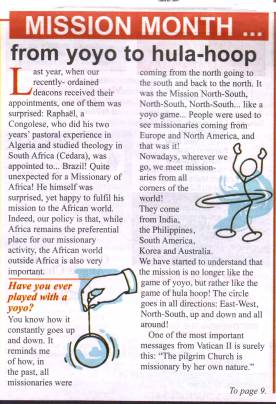 From yoyo to hula hoop
 MISSION IMPOSSIBLE 2013
See also the following link:
MISSION IMPOSSIBLE 2013
See also the following link:
Father Louis Blondel Centre
 In this part Carl shares with us about his own way to deconstruct and to process systemic violence. He introduces the term “new historicities” as a tool to question oppressive dominant discourses in history. He gives us insights from attachment theory in order to understand the dynamics between child soldiers and their commanders. He creates awareness on the demands of being exposed to traumatize people and living in traumatized societies. Finally, he shares about the role of imagination and the new understandings of power. READ MORE
See also the first part of the interview: Interview with Carl Stauffer

Standing (from left to right): Jean-Baptiste HABONIMANA, with spectacles (Burundi), Lema Eshetu DADI (Ethiopia), Levison Wallard Joseph GOODWELL (Malawi), Audace NIYONSABA, with a blue tie (Burundi), Bimal LAKRA (India), Mubalama Marcellin IRENGE, with a smile (DR Congo), Cirimwami Romain CUBAKA, with a blue collar pollo (DR Congo), Jacan Vincent de Paul WANOK (DR Congo), Justin Barera SEBAKUNZI (staff member ), Francis BOMANSAAN (novices master), Anthony Ifeanyichukwu EZENWEKE (Nigeria), Leonard HATEGEKIMANA (Staff member), Oswald MALYA (Delegate superior), Alvin ESCABUSA (Philippines), Jean-Louis GODINOT, “Mpundu” with a blue cap (staff member), John William NKHOMA (Malawi), Timoteo Jose CHOE, (Mozambique), Jean Paul MUNYANEZA (Rwanda), Geoffrey Mugeni MUCANI (Kenya).
Squatting position (from left to right): John Modrings, GONDWE (Malawi), Endale Nigusse, ABIDISA (Ethiopia), Armand BAMOUNI (Burkina Faso), Kokou Alain SOSSOU (Republic of Côte d’Ivoire-RCI), Niteesh EKKA (India), Lini AGABA (Uganda), Munga François NYEMBO


 By Masuzyo Chakwe, Saturday 10 Oct. 2013
The Independent Broadcasting Authority (IBA) has awarded a nationwide television construction permit to Catholic Television, as well as nationwide radio broadcasting licences to Christian Voice and Radio Phoenix.
IBA board chairman Emmanuel Mwamba yesterday said radio and television licencing committee has also awarded licences to Mungu FM Radio (Mongu) – Full broadcast licence, Lukulu Community Radio (Lukulu) – Full broadcast licence, Radio Phoenix – nationwide coverage, Radio Christian Voice – Nationwide , Hot Fm Radio – Repeater stations in Kabwe, Kapiri Mposhi and the Copperbelt.
Mwamba stated that others that were awarded test transmission licences were Valley FM Radio – Nyimba and Serenje Community Radio – Serenje.
He said committee had also allowed Kokoliko Radio to begin constructing their commercial radio station in Chingola. Mwamba also announced that the licencing procedures for applying for radio and television broadcasting licences had changed, in accordance with the IBA Act (2002) and Amendment Act (2010).
He said IBA board will soon be announced that since the IBA was now in place. Mwamba said it was desirous that the procedures for applying for a radio or television licence be changed to follow provisions of the IBA Act.
He also said the digital migration policy had been submitted to Cabinet office for review and that the Independent Broadcasting Authority had received a number of applications for various kinds of licences including national, commercial, community and religious, as well as television. Mwamba further said that IBA would advise all prospective radio or television applicants on the next available frequencies and areas where broadcast services will be required. This is according to a statement by IBA director general Josephine Mapoma.
On October 6, 2013, SAP Blog published also similar news about Malawi.
See: Preparations to Roll out New Catholic Radio Station Underway in Malawi
By Masuzyo Chakwe, Saturday 10 Oct. 2013
The Independent Broadcasting Authority (IBA) has awarded a nationwide television construction permit to Catholic Television, as well as nationwide radio broadcasting licences to Christian Voice and Radio Phoenix.
IBA board chairman Emmanuel Mwamba yesterday said radio and television licencing committee has also awarded licences to Mungu FM Radio (Mongu) – Full broadcast licence, Lukulu Community Radio (Lukulu) – Full broadcast licence, Radio Phoenix – nationwide coverage, Radio Christian Voice – Nationwide , Hot Fm Radio – Repeater stations in Kabwe, Kapiri Mposhi and the Copperbelt.
Mwamba stated that others that were awarded test transmission licences were Valley FM Radio – Nyimba and Serenje Community Radio – Serenje.
He said committee had also allowed Kokoliko Radio to begin constructing their commercial radio station in Chingola. Mwamba also announced that the licencing procedures for applying for radio and television broadcasting licences had changed, in accordance with the IBA Act (2002) and Amendment Act (2010).
He said IBA board will soon be announced that since the IBA was now in place. Mwamba said it was desirous that the procedures for applying for a radio or television licence be changed to follow provisions of the IBA Act.
He also said the digital migration policy had been submitted to Cabinet office for review and that the Independent Broadcasting Authority had received a number of applications for various kinds of licences including national, commercial, community and religious, as well as television. Mwamba further said that IBA would advise all prospective radio or television applicants on the next available frequencies and areas where broadcast services will be required. This is according to a statement by IBA director general Josephine Mapoma.
On October 6, 2013, SAP Blog published also similar news about Malawi.
See: Preparations to Roll out New Catholic Radio Station Underway in Malawi
 I just finished the Pilgrimage in Galilee. What an interesting, fascinating and renewing experience. Visiting and walking in the places Jesus lived. It was indeed a time of discovery and growth in faith; a moment of appreciation and revelation for me. Praying on the boat on the Sea of Galilee, bathing in the Jordan and relaxing on the Mountain of the Beatitudes. I had the privilege to visit the following places: the land of Dan and Naphtali; Lebanon border; Syrian border; Jordan border; the town of Nazareth; the Jordan River sources; the wilderness experience; lake side Eucharist along Lake Tiberias; mount Tabor of the transfiguration; Jesus baptismal place in the Jordan; Jericho. I met many pilgrims from Africa, Europe, Asia, America and some even from South Africa, to mention but a few. This weekend, I am trying to integrate this one week experience. We are at about half way through the Pilgrimage. Very historical and divine experience for me!
Receive my Greetings from the Holy Land. Shalom!
Phelim Malumo, M.Afr
I just finished the Pilgrimage in Galilee. What an interesting, fascinating and renewing experience. Visiting and walking in the places Jesus lived. It was indeed a time of discovery and growth in faith; a moment of appreciation and revelation for me. Praying on the boat on the Sea of Galilee, bathing in the Jordan and relaxing on the Mountain of the Beatitudes. I had the privilege to visit the following places: the land of Dan and Naphtali; Lebanon border; Syrian border; Jordan border; the town of Nazareth; the Jordan River sources; the wilderness experience; lake side Eucharist along Lake Tiberias; mount Tabor of the transfiguration; Jesus baptismal place in the Jordan; Jericho. I met many pilgrims from Africa, Europe, Asia, America and some even from South Africa, to mention but a few. This weekend, I am trying to integrate this one week experience. We are at about half way through the Pilgrimage. Very historical and divine experience for me!
Receive my Greetings from the Holy Land. Shalom!
Phelim Malumo, M.Afr


 New global index exposes ‘modern slavery’ worldwide
17 October 2013
Nearly 30 million people around the world are living as slaves, according to a new index ranking 162 countries.
New global index exposes ‘modern slavery’ worldwide
17 October 2013
Nearly 30 million people around the world are living as slaves, according to a new index ranking 162 countries.
 The Global Slavery Index 2013 says India has the highest number of people living in conditions of slavery at 14 million.
Global Slavery Index 2013 PDF file
What is modern slavery?
In 2013, modern slavery takes many forms, and is known by many names. Whether it is called human trafficking, forced labour, slavery or slavery-like practices (a category that includes debt bondage, forced or servile marriage, sale or exploitation of children including in armed conflict) victims of modern slavery have their freedom denied, and are used and controlled and exploited by another person for profit, sex, or the thrill of domination
But Mauritania has the highest proportional figure with about 4% of its population enslaved. The report’s authors hope it will help governments tackle what they call a “hidden crime”.
‘Better measure’
The index was compiled by Australian-based rights organisation Walk Free Foundation using a definition of modern slavery that includes debt bondage, forced marriage and human trafficking.
“A lot of governments won’t like hearing what we have to say,” WFF chief executive Nick Grono told the French news agency Agence France-Presse.
“Those governments that want to engage with us, we will be very open to engaging and looking at ways in which we can better measure the issue of modern slavery.”
The organisation’s estimate of 29.8 million slaves worldwide is higher than other attempts to quantify modern slavery. The International Labour Organisation estimates that almost 21 million people are victims of forced labour.
India, China, Pakistan and Nigeria have the highest numbers of people enslaved, the charity said.
Proportional ranking
1: Mauritania 2: Haiti 3: Pakistan 4: India 5: Nepal 6: Moldova 7: Benin 8: Ivory Coast 9: The Gambia 10: Gabon
Together with five other countries, they account for three-quarters of the total estimated number of people in modern slavery worldwide.
The report said India’s ranking was mostly due to the exploitation of Indians citizens within the country itself.
While the highest proportion of slaves is in Mauritania, with many people inheriting slave status from their ancestors, Haiti is second in the index and Pakistan is third.
The new survey has the backing of world figures including former US Secretary of State Hillary Clinton, ex-British Prime Minister Tony Blair.
Mrs Clinton said that although the index was not perfect, it provided a starting point, according to the Associated Press.
“I urge leaders around the world to view this index as a call to action, and to stay focused on the work of responding to this crime.”
Estimated number of slaves
1: India; 13,956,010 – 2: China; 2,949,243 – 3: Pakistan; 2,127,132 – 4: Nigeria; 701,032 – 5: Ethiopia; 651,110 – 6: Russia; 516,217 – 7: Thailand; 472,811 – 8: DR Congo; 462,327 – 9: Burma; 384,037 – 10: Bangladesh; 343,192
This is the first edition of the Global Slavery Index. It is the first Index of its kind – providing an estimate, country by country, of the number of people living in modern slavery today.
The Global Slavery Index 2013 says India has the highest number of people living in conditions of slavery at 14 million.
Global Slavery Index 2013 PDF file
What is modern slavery?
In 2013, modern slavery takes many forms, and is known by many names. Whether it is called human trafficking, forced labour, slavery or slavery-like practices (a category that includes debt bondage, forced or servile marriage, sale or exploitation of children including in armed conflict) victims of modern slavery have their freedom denied, and are used and controlled and exploited by another person for profit, sex, or the thrill of domination
But Mauritania has the highest proportional figure with about 4% of its population enslaved. The report’s authors hope it will help governments tackle what they call a “hidden crime”.
‘Better measure’
The index was compiled by Australian-based rights organisation Walk Free Foundation using a definition of modern slavery that includes debt bondage, forced marriage and human trafficking.
“A lot of governments won’t like hearing what we have to say,” WFF chief executive Nick Grono told the French news agency Agence France-Presse.
“Those governments that want to engage with us, we will be very open to engaging and looking at ways in which we can better measure the issue of modern slavery.”
The organisation’s estimate of 29.8 million slaves worldwide is higher than other attempts to quantify modern slavery. The International Labour Organisation estimates that almost 21 million people are victims of forced labour.
India, China, Pakistan and Nigeria have the highest numbers of people enslaved, the charity said.
Proportional ranking
1: Mauritania 2: Haiti 3: Pakistan 4: India 5: Nepal 6: Moldova 7: Benin 8: Ivory Coast 9: The Gambia 10: Gabon
Together with five other countries, they account for three-quarters of the total estimated number of people in modern slavery worldwide.
The report said India’s ranking was mostly due to the exploitation of Indians citizens within the country itself.
While the highest proportion of slaves is in Mauritania, with many people inheriting slave status from their ancestors, Haiti is second in the index and Pakistan is third.
The new survey has the backing of world figures including former US Secretary of State Hillary Clinton, ex-British Prime Minister Tony Blair.
Mrs Clinton said that although the index was not perfect, it provided a starting point, according to the Associated Press.
“I urge leaders around the world to view this index as a call to action, and to stay focused on the work of responding to this crime.”
Estimated number of slaves
1: India; 13,956,010 – 2: China; 2,949,243 – 3: Pakistan; 2,127,132 – 4: Nigeria; 701,032 – 5: Ethiopia; 651,110 – 6: Russia; 516,217 – 7: Thailand; 472,811 – 8: DR Congo; 462,327 – 9: Burma; 384,037 – 10: Bangladesh; 343,192
This is the first edition of the Global Slavery Index. It is the first Index of its kind – providing an estimate, country by country, of the number of people living in modern slavery today.


 Dear confreres,
Since yesterday, I have been receiving messages from confreres, relatives and friends after our island was hit by an earthquake of magnitude 7.2. Many asked about the situation of my parents and siblings. Of course they panicked especially that people who are leaving the seashore have to evacuate as tsunami might follow. Few people came to our house to seek for an asylum. There was no electricity and a shortage of water. They were also disturbed by the aftershock which came repeatedly. According to the report, it came about 800 times. I thank the Lord that they are all safe as we are here in Cebu!
Dear confreres,
Since yesterday, I have been receiving messages from confreres, relatives and friends after our island was hit by an earthquake of magnitude 7.2. Many asked about the situation of my parents and siblings. Of course they panicked especially that people who are leaving the seashore have to evacuate as tsunami might follow. Few people came to our house to seek for an asylum. There was no electricity and a shortage of water. They were also disturbed by the aftershock which came repeatedly. According to the report, it came about 800 times. I thank the Lord that they are all safe as we are here in Cebu!
 In fact, I am supposed to go for my eight day retreat to Bohol but, when I went to the pier to take a boat, I found that the trips are canceled. The pier at the capital city of Bohol is also damaged. I could have gone to other piers but traveling by land on the island is very tricky at the moment. Many bridges, roads and houses are destroyed. Some of our historical churches are swept badly, around ten of them. Luckily, the church in the parish where I come from is not totally damaged but the bell tower and part of the infrastructure have fallen. We will see what the people can do. I believe that in due time life will be back to normal.
Let us join together to pray for all who are affected and that they may be united to build their churches again.
Dioscoro Malugao, M.Afr
In fact, I am supposed to go for my eight day retreat to Bohol but, when I went to the pier to take a boat, I found that the trips are canceled. The pier at the capital city of Bohol is also damaged. I could have gone to other piers but traveling by land on the island is very tricky at the moment. Many bridges, roads and houses are destroyed. Some of our historical churches are swept badly, around ten of them. Luckily, the church in the parish where I come from is not totally damaged but the bell tower and part of the infrastructure have fallen. We will see what the people can do. I believe that in due time life will be back to normal.
Let us join together to pray for all who are affected and that they may be united to build their churches again.
Dioscoro Malugao, M.Afr
 Lilongwe, Malawi, CISA N0 092, October 15, 2013
Preparations to roll out Tuntufye FM Radio for the new Karonga Diocese of the Roman Catholic Church are at an advanced stage, the Research and Communications Department at the Episcopal Conference of Malawi has confirmed.
According to Nyasa Times, Malawi’s local daily, the development was revealed barely after ECM’s Research and Communications Department visited the diocese to appreciate efforts made to enhance communication in all the church angles.
Karonga diocese successfully negotiated for a radio licence with the Malawi Communications Regulatory Authority (MACRA) and this was gazetted on July 26, 2013.
So far a lot has taken place to have the radio station hit the air waves by January next year.
“There is quite a lot that Karonga diocese has done to have this radio station in place. The diocese is trying to put things in place as regards opening a radio station and one of the achievements has been the negotiations with MACRA for a radio license which is finally in possession of the diocese.”
The diocese is currently holding sensitization sessions with Catholic Christians on different level s and various forums as a way of initiating and engaging them in the radio project so that they can own and support it.
Bishop Martin Mtumbuka of Karonga diocese is also working hard to have this radio station as evidenced from a number of written proposals that have been submitted to potential donors where the feedback has been positive and many have pledged funding.
“So far the diocese has receiving the first consignment of radio equipment from SIGNIS which is the World Catholic Association for Communication that brings together Catholic communications and media professionals from across the globe. Plans to renovate a building that will house radio studios are also there,” Research and Communications Officer at ECM, Prince Henderson said.
The Diocese of Karonga is a new one with 12 priests and over 65,000 Catholic.
The radio will primarily targeting Catholic Christians but still there will be an option for other denominations will be given a chance to interact and contribute to the radio station.
Apart from pastoral, the radio will also focus on development, economic, social and cultural issues that concern all groups of people.
Tuntufye FM Radio will add up to the already existing Catholic radio stations like Radio Maria in Mangochi, Radio Alinafe in Lilongwe and Radio Tigabane in Mzuzu.
Lilongwe, Malawi, CISA N0 092, October 15, 2013
Preparations to roll out Tuntufye FM Radio for the new Karonga Diocese of the Roman Catholic Church are at an advanced stage, the Research and Communications Department at the Episcopal Conference of Malawi has confirmed.
According to Nyasa Times, Malawi’s local daily, the development was revealed barely after ECM’s Research and Communications Department visited the diocese to appreciate efforts made to enhance communication in all the church angles.
Karonga diocese successfully negotiated for a radio licence with the Malawi Communications Regulatory Authority (MACRA) and this was gazetted on July 26, 2013.
So far a lot has taken place to have the radio station hit the air waves by January next year.
“There is quite a lot that Karonga diocese has done to have this radio station in place. The diocese is trying to put things in place as regards opening a radio station and one of the achievements has been the negotiations with MACRA for a radio license which is finally in possession of the diocese.”
The diocese is currently holding sensitization sessions with Catholic Christians on different level s and various forums as a way of initiating and engaging them in the radio project so that they can own and support it.
Bishop Martin Mtumbuka of Karonga diocese is also working hard to have this radio station as evidenced from a number of written proposals that have been submitted to potential donors where the feedback has been positive and many have pledged funding.
“So far the diocese has receiving the first consignment of radio equipment from SIGNIS which is the World Catholic Association for Communication that brings together Catholic communications and media professionals from across the globe. Plans to renovate a building that will house radio studios are also there,” Research and Communications Officer at ECM, Prince Henderson said.
The Diocese of Karonga is a new one with 12 priests and over 65,000 Catholic.
The radio will primarily targeting Catholic Christians but still there will be an option for other denominations will be given a chance to interact and contribute to the radio station.
Apart from pastoral, the radio will also focus on development, economic, social and cultural issues that concern all groups of people.
Tuntufye FM Radio will add up to the already existing Catholic radio stations like Radio Maria in Mangochi, Radio Alinafe in Lilongwe and Radio Tigabane in Mzuzu.
 Recent government’s position on the ATI bill: what‘s the real issue?
The Jesuit Centre for Theological Reflection (JCTR) welcomes Government’s recent announcement from the Ministry of Information that a consultant has been engaged to harmonise the Draft ATI Bill with “13 other existing pieces of legislation. This is, indeed a very necessary exercise if this important piece of legislation is to realise its intended purpose. As JCTR, we remain committed to championing the enactment of the law and to work collaboratively with the government to ensure that the law is passed without any further delays. We appreciate the government’s effort in updating the public on the status of the bill this far and we want to believe that every explanation we have received so far is valid. “The only challenge we have is that these explanations seem to be isolated and somehow not foreseen”, says Sr. Kayula Lesa. FULL TEXT
Recent government’s position on the ATI bill: what‘s the real issue?
The Jesuit Centre for Theological Reflection (JCTR) welcomes Government’s recent announcement from the Ministry of Information that a consultant has been engaged to harmonise the Draft ATI Bill with “13 other existing pieces of legislation. This is, indeed a very necessary exercise if this important piece of legislation is to realise its intended purpose. As JCTR, we remain committed to championing the enactment of the law and to work collaboratively with the government to ensure that the law is passed without any further delays. We appreciate the government’s effort in updating the public on the status of the bill this far and we want to believe that every explanation we have received so far is valid. “The only challenge we have is that these explanations seem to be isolated and somehow not foreseen”, says Sr. Kayula Lesa. FULL TEXT