
 “The essence of African morality is that it is more societary than spiritual; it is a morality of conduct rather than a morality of being. It defines what a person does rather than what he is. Kindness is not a virtue unless someone is kind; murder is not evil until someone kills another person in his community. Man is not by nature either good or evil except in terms of what he does or does not do. (J.S. Mbiti in “African Religions & Philosophy” Heinemann 1969:213)
Readings for Religious Education Teachers
Compiled by J. Henze, Published by the Copperbelt Religious Education Development Unit, Mission Press, Ndola, Zambia, 2000, 106 pages.
This book in on sales at Woodlands, Lusaka.
“The essence of African morality is that it is more societary than spiritual; it is a morality of conduct rather than a morality of being. It defines what a person does rather than what he is. Kindness is not a virtue unless someone is kind; murder is not evil until someone kills another person in his community. Man is not by nature either good or evil except in terms of what he does or does not do. (J.S. Mbiti in “African Religions & Philosophy” Heinemann 1969:213)
Readings for Religious Education Teachers
Compiled by J. Henze, Published by the Copperbelt Religious Education Development Unit, Mission Press, Ndola, Zambia, 2000, 106 pages.
This book in on sales at Woodlands, Lusaka.
Category: Publications Page 36 of 41
Various publications; Bulletins, magazines
“Here is a selection of useful quotations about various aspects of Religious Education, both for those studying for a certificate, diploma or degree and for those already in the classroom. This is not a course, but a handful of hints.
This book is a timely addition to the Religious Education materials available in Zambia. It allows us to draw on the wisdom of others.”
Contents: spirituality, religion (including African Traditional Religion, inculturation – contextualisation, pluralism), education (including commitment and faith) religious education (including maturity and concepts), attitudes and skills of students, special skills (including critical thinking, symbolism and Ecumenical empathy), teaching strategies ( including attitude for creativity and motivation), morality (including teacher’s role), assessment (including knowledge as understanding), cross fertilization (history, geography, science, literature, sport and arts).
 “The essence of African morality is that it is more societary than spiritual; it is a morality of conduct rather than a morality of being. It defines what a person does rather than what he is. Kindness is not a virtue unless someone is kind; murder is not evil until someone kills another person in his community. Man is not by nature either good or evil except in terms of what he does or does not do. (J.S. Mbiti in “African Religions & Philosophy” Heinemann 1969:213)
Readings for Religious Education Teachers
Compiled by J. Henze, Published by the Copperbelt Religious Education Development Unit, Mission Press, Ndola, Zambia, 2000, 106 pages.
This book in on sales at Woodlands, Lusaka.
“The essence of African morality is that it is more societary than spiritual; it is a morality of conduct rather than a morality of being. It defines what a person does rather than what he is. Kindness is not a virtue unless someone is kind; murder is not evil until someone kills another person in his community. Man is not by nature either good or evil except in terms of what he does or does not do. (J.S. Mbiti in “African Religions & Philosophy” Heinemann 1969:213)
Readings for Religious Education Teachers
Compiled by J. Henze, Published by the Copperbelt Religious Education Development Unit, Mission Press, Ndola, Zambia, 2000, 106 pages.
This book in on sales at Woodlands, Lusaka.
“The essence of African morality is that it is more societary than spiritual; it is a morality of conduct rather than a morality of being. It defines what a person does rather than what he is. Kindness is not a virtue unless someone is kind; murder is not evil until someone kills another person in his community. Man is not by nature either good or evil except in terms of what he does or does not do. (J.S. Mbiti in “African Religions & Philosophy” Heinemann 1969:213)
Readings for Religious Education Teachers
Compiled by J. Henze, Published by the Copperbelt Religious Education Development Unit, Mission Press, Ndola, Zambia, 2000, 106 pages.
This book in on sales at Woodlands, Lusaka.
Aujourd’hui, les Missionnaires d’Afrique de l’Ouest vous proposent de visiter de nouvelles pages sur leur site www.mafrwestafrica.net :
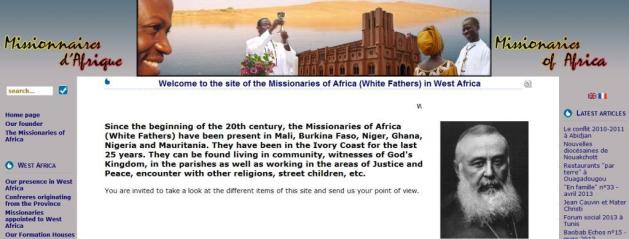 Dans la rubrique « Actualités » :
« Une médaille pour les M.Afr.», la reconnaissance de l’Eglise Burkinabè lors d’une célébration à Koupèla, à l’occasion du 112ème anniversaire de la création de la première école. (lire la suite) « Ressourcement pour la mission », une brève description de la première session donnée par le Père Bernard Ugeux pour 19 missionnaires de la Province d’Afrique de l’Ouest. (lire la suite) Dans la rubrique « Justice et Paix» : « Tensions et menaces à Gao au Nord-Mali », le témoignage de notre confrère Jean Jacques Mukanga, à partir de son expérience dans cette région de notre Province. (lire la suite) Dans la rubrique « Vu au sud, vu du sud » : « Un savon contre le paludisme » : comment deux étudiants, un Burkinabè et un Burundais, ont « inventé » un savon qui repousse les moustiques. (lire la suite) Dans la rubrique « Dialogue interreligieux » :
Dans la rubrique « Actualités » :« Une médaille pour les M.Afr.», la reconnaissance de l’Eglise Burkinabè lors d’une célébration à Koupèla, à l’occasion du 112ème anniversaire de la création de la première école. (lire la suite) « Ressourcement pour la mission », une brève description de la première session donnée par le Père Bernard Ugeux pour 19 missionnaires de la Province d’Afrique de l’Ouest. (lire la suite) Dans la rubrique « Justice et Paix» : « Tensions et menaces à Gao au Nord-Mali », le témoignage de notre confrère Jean Jacques Mukanga, à partir de son expérience dans cette région de notre Province. (lire la suite) Dans la rubrique « Vu au sud, vu du sud » : « Un savon contre le paludisme » : comment deux étudiants, un Burkinabè et un Burundais, ont « inventé » un savon qui repousse les moustiques. (lire la suite) Dans la rubrique « Dialogue interreligieux » :
« Jésus, l’homme de la rencontre », la présentation du livre de Mgr Claude Rault, évêque de Ghardaia, qui relie l’évangile de Jean dans cette perspective de dialogue. (lire la suite)
 Moved by the Love of Christ – serving the suffering Christ
Aid to the Church in Need is an international charity of and for the Catholic Church. We give a voice and render relief to Catholics persecuted and oppressed for their Faith. We firmly believe the world needs a living Faith in God. Through our work we nurture a family of benefactors and project partners united in prayer and solidarity.
Robert Lalonde, Head of information, Aid to the Church in Need
Moved by the Love of Christ – serving the suffering Christ
Aid to the Church in Need is an international charity of and for the Catholic Church. We give a voice and render relief to Catholics persecuted and oppressed for their Faith. We firmly believe the world needs a living Faith in God. Through our work we nurture a family of benefactors and project partners united in prayer and solidarity.
Robert Lalonde, Head of information, Aid to the Church in Need
 Radio Tigabane: pastoral and social programmes for northern Malawi
 by Reinhard Backes, Aid to the Church in Need (CAN) International / Amanda Bridget Griffin, Canada
Malawi is one of the world’s poorest countries. On the United Nations Development Programme’s 2011 human development index, this south-east African state ranks 171 out of 187. In addition Malawi is one of Africa’s most densely populated countries. More than 80 per cent of Malawians are Christians, including about one quarter Catholics. According to statistics the proportion of Muslims is 13 per cent.
The diocese of Mzuzu in northern Malawi is the fastest growing Catholic diocese in the country, according to its own figures. A letter from the diocese to the international Catholic pastoral charity “Aid to the Church in Need” states: “Every year more than 6,000 adults are taken into the Catholic Church. Most are converts from other Christian denominations.” To reach as many of the faithful as possible, the diocese maintains its own broadcasting station, “Radio Tigabane”. The name comes from the local Tumbuka language and means “share”.
The programmes on “Radio Tigabane” are, according to the director, Father Eugene W. Ngoma, geared to the needs of the population in this rural area: “Alongside the weekly religious programmes – broadcast of the Sunday mass, prayers and the rosary – we offer programmes on health, education, justice and peace as well as on socio-economic development. In doing this we are adhering to an ecumenical principle because our listeners include not only Catholics, but also Christians of other denominations and Muslims.”
And according to Father Ngoma other beneficiaries are the Diocesan Commissions for Education, Development, Health, Justice and Peace as well as Pastoral Work, who address primarily socially disadvantaged groups through a wide range of initiatives.
by Reinhard Backes, Aid to the Church in Need (CAN) International / Amanda Bridget Griffin, Canada
Malawi is one of the world’s poorest countries. On the United Nations Development Programme’s 2011 human development index, this south-east African state ranks 171 out of 187. In addition Malawi is one of Africa’s most densely populated countries. More than 80 per cent of Malawians are Christians, including about one quarter Catholics. According to statistics the proportion of Muslims is 13 per cent.
The diocese of Mzuzu in northern Malawi is the fastest growing Catholic diocese in the country, according to its own figures. A letter from the diocese to the international Catholic pastoral charity “Aid to the Church in Need” states: “Every year more than 6,000 adults are taken into the Catholic Church. Most are converts from other Christian denominations.” To reach as many of the faithful as possible, the diocese maintains its own broadcasting station, “Radio Tigabane”. The name comes from the local Tumbuka language and means “share”.
The programmes on “Radio Tigabane” are, according to the director, Father Eugene W. Ngoma, geared to the needs of the population in this rural area: “Alongside the weekly religious programmes – broadcast of the Sunday mass, prayers and the rosary – we offer programmes on health, education, justice and peace as well as on socio-economic development. In doing this we are adhering to an ecumenical principle because our listeners include not only Catholics, but also Christians of other denominations and Muslims.”
And according to Father Ngoma other beneficiaries are the Diocesan Commissions for Education, Development, Health, Justice and Peace as well as Pastoral Work, who address primarily socially disadvantaged groups through a wide range of initiatives.
 Outspoken Catholic Priest Fr. Frank Bwalya who has been recently urged to stop criticizing the PF government in the media, has announced this morning that he’s serious about funding a new political party with him as its President. The name of the party should be revealed in the next few days. READ MORE
Stamattina mentre ascoltavo una trasmissione su una delle stazioni locali, Radio Phoenix, ho sentito padre Frank Bwalya annunciare pubblicamente che, oltre alla sua campagna di “cartellini gialli” al presente governo per misfatti di vario tipo, intende fondare un nuovo partito politico di cui sarà il presidente.
Frank Bwalya, il cui status clericale non è molto chiaro al sottoscritto, è senz’altro un personaggio carismatico e controverso. Dopo aver appoggiato apertamente il governo in carica contro quello uscente di Rupiah Banda, accusato di ogni forma di corruzione sotto il cielo, da qualche tempo critica apertamente alcune decisioni dell’esecutivo e ne castiga alcune derive.
Una storia da seguire con interesse e attenzione.
READ ALSO:
The Sata we supported died long time ago, but Kambwili says Fr. Bwalya is getting mad
Fr Bwalya, Kambwili in bitter exchange
Bwalya no longer priest – Fr Mpasa
Outspoken Catholic Priest Fr. Frank Bwalya who has been recently urged to stop criticizing the PF government in the media, has announced this morning that he’s serious about funding a new political party with him as its President. The name of the party should be revealed in the next few days. READ MORE
Stamattina mentre ascoltavo una trasmissione su una delle stazioni locali, Radio Phoenix, ho sentito padre Frank Bwalya annunciare pubblicamente che, oltre alla sua campagna di “cartellini gialli” al presente governo per misfatti di vario tipo, intende fondare un nuovo partito politico di cui sarà il presidente.
Frank Bwalya, il cui status clericale non è molto chiaro al sottoscritto, è senz’altro un personaggio carismatico e controverso. Dopo aver appoggiato apertamente il governo in carica contro quello uscente di Rupiah Banda, accusato di ogni forma di corruzione sotto il cielo, da qualche tempo critica apertamente alcune decisioni dell’esecutivo e ne castiga alcune derive.
Una storia da seguire con interesse e attenzione.
READ ALSO:
The Sata we supported died long time ago, but Kambwili says Fr. Bwalya is getting mad
Fr Bwalya, Kambwili in bitter exchange
Bwalya no longer priest – Fr Mpasa
 Dear confreres,
One thing that the new Pope feels he is called upon to do as Bishop of Rome is to bring hope to the world. “Let the star of hope shine out”, he says. We all need hope, and we should all bring hope. Speaking at his inaugural Mass on the 19th of March, Pope Francis explains how this can be done: by becoming guardians of Creation and by seeing every man and every woman with an eye of goodness and tenderness. Yes, he says, with tenderness and we ought not to be afraid of tenderness. Far from being an attitude of weakness, tenderness denotes strength of soul and the capacity for attention, compassion, and a true openness to one another. READ MORE
Dear all,
Kindly receive a timely Press Statement issued by Caritas Zambia on the continued, wasteful and unwarranted by-elections being caused by MPs who are behaving like political prostitutes.
Fraternally Yours in Christ,
Fr. Cleophas
 … As we have already done on many occasions, we appeal to government to stop encouraging MP resignations through promises of jobs and other privileges. Where is the lean government the people of Zambia were promised if ministerial jobs are open for purchasing political patronage? It is shameful to see very high ranking government officials dancing and jubilating at MP resignation forums with full knowledge of the harm by-elections are causing on the weakest of our society. This is immoral and an act of inconsistency for a government that has proclaimed an option for the poor as a cornerstone of its governance values. The Zambian society must treat this behaviour with scorn and strong condemnation. READ MORE
 Chers confrères,
Le Pape François, dans son homélie du 19 mars, parle d’un service qu’il se sent appelé à rendre en tant qu’évêque de Rome et auquel, dit-il, nous sommes tous appelés : faire resplendir l’étoile de l’espérance. Nous avons besoin, dit-il, de voir la lumière de l’espérance et de donner nous-mêmes espérance. Il indique comment nous pouvons nous y prendre en parlant d’être gardiens de la création, en posant sur tout homme et toute femme un regard de bonté et de tendresse. Oui, dit le Pape, n’ayons pas peur de la tendresse. La tendresse n’est pas la vertu du faible mais dénote une force d’âme et de capacité d’attention, de compassion, de vraie ouverture à l’autre, d’amour. SUITE
 Press Release, 5th April 2013
The affordability and accessibility of mealie-meal has been a topical issue for sometime. This is not surprising given that mealie-meal is a staple food for the majority Zambians. It is therefore not surprising that the commodity of such strategic importance continues to attract attention from various stakeholders. READ MORE


Eugénie Lacoursière Mgr François-Xavier Lacoursière
-

- Cover of the La Missive
-

- Sister Eugénie Lacoursière in Uganda
-

- From the archives of the MSOLA

-

- First local Sisters, MSOLA, Bannabikiri, Fr Mischler, Mgr Lacoursière and Fr. Léopold Bélanger
-

- The New Convent in 1942
-

- The last days of Mgr. Lacoursières
 Lisa shares with us her wisdom on the peacebuilding field. She experiences it as an art. On this regard she develops three key concepts: design, improvisation and healing. She talks about the challenge of working as a peacebuilder within the US Military. She is witnessing the inner enslavement of many soldiers, she says: “I think the recent news that more US soldiers died from suicide than in battle in the last year is evidence that there is a lot of internal wrestling going on with people in the military. And they have been asked to do things that go against the human nature and what people are taught; and when you are asked to do something that goes against your human nature it is very hard to live with yourself.”
