Category: News Page 72 of 79

News from Sectors and Rome

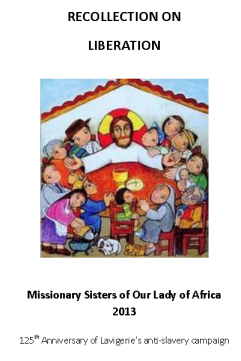
Recollection on liberation – April 2013

Dear missionaries,
We have just received a document from André Schaminée which you can read below. As attachments, you can also open a letter from Fr. Richard K. Baawobr, M.Afr and Sr. Carmen Sammut, MSOLA inviting us to share a common retreat on the 30th April, feast of Our Lady of Africa. A PDF file of 8 pages will guide you through this recollection. Please, let me know if you prefer a hard copy of this PDF files, as some of you might find it difficult to download it because of poor Internet network. Your Sector Superior may also help you.
Fr. Serge St-Arneault, M.Afr
Dear Confreres,
To all of you: a good continuation of the celebration of Easter. May this feast be for us and for the whole Church, under the guidance of the new Pope Francis, a nice occasion to renew our faith in Him, who offers us his New Life and who sends us with a Mission of bringing this Joyful News to all those whom we meet in our apostolate.
This year our Lavigerie family commemorates the Antislavery Campaign of Cardinal Lavigerie. We have now reached the half-way point of this celebration. Carmen, the Superior General of the MSOLA and Richard, our Superior General, propose to us a recollection on this theme for this month of April. You find their letter and the text of this recollection attached to this e-mail. They can also be found on our website mafrome.org
This message is sent to all Provincials and the Delegate Superior. I invite you to let all communities of your Province or Delegation have a copy. It is equally sent to all Formation Houses.
Fraternally,
André Schaminée
Recollection for the 125 Antislavery campaign - MSOLA & M.Afr note from Sup GenRecollection on liberation - April 2013

Forth Phase Theological Studies in Merrivale, South Africa

Based in South Africa, Merrivale is our Forth Phase Theological Studies aiming at the formation of newTomasz Podrazik missionaries. Time is distributed between studies at St. Joseph’s Theological Institute in Cedara, personal and community prayer, apostolate and various community activities. Here is how Tomasz Podrazik is witnessing his life experience.
I appreciate the fact that our studies are taking place in the context of adaptation into a new milieu, a new country and culture. We get to know people through our apostolates, by reading newspapers, watching news and meeting personal friends. In this way, we begin to see the situation of the people from a different angle. Their life story marks their hearts deeply. As a missionary candidate, I see the importance to learn from the people. A confrere who went back to his native country told us recently that he was still searching for a deeper understanding of the local culture up to his final departure. Indeed, the mission of Jesus Christ is an unending one. No matter how little my contribution might be, it is precious because of being part of a global mission which is the establishment of the Kingdom of God.
At the moment, we are unable to foresee the future of our missionary life. Few days ago, someone showed me two photos. One was taken in 2005 in St Peter’s Square after the election of Benedict XVI. The other one was taken last month after the election of Pope Francis. The first photo portrayed the people waiting for the announcement of the new Pope. But, on the second one, every person had a stretched arm trying to take a picture using a mobile phone. It was a crowd of cell phones. Technology is only one example of changes which is taking place. Similarly, in a fluctuating world, we have to make an effort to be ready to adjust to unforeseen situations. Every possible future appointment will bring challenges which we are not able to anticipate.
In that regard, life at Merrivale can be stressful as we are precisely exercising in a spirit of openness our capacity of adaptation by facing for instance new commitments related to swooping duties within the community. The question is not only about being open towards future challenges but also about exercising the ability to leave the past behind and move forward right here in our formation house.
Tomasz Podrazik
St. Joseph’s Theological Institute has been registered with the South African Department of Higher Education and Training as a private higher education institution under the Higher Education Act, 1977 (Act No 101 of 1977). The Institute is home to more than 200 students and 40 staff members, comprising a mosaic of different cultures from more than 20 African countries, with frequent representation from Asia, Europe, South and North America. Apart from the cultural richness of our members, we are also blessed with the rich diversity of charisms with most students coming from more than 20 male and female religious congregations within the Catholic Church.

Forth Phase Theological Studies - Merrivale 2013

Below from the left: Edward Saguti /Tanzania; Paul Kikenge /DRC; Albert Kondomodre /Burkina Faso; Robin Simbeye /Zambia; Damian Ahimbisibwe /Uganda.
Standing from the left: Fr. Raphael Gasimba /DRC; Douglas Momanyi Ogato /Kenia; Fr. Francis Novienyeku /Togo; Br. James Calder/Canada; Konrad Millanzi /Tanzania; Ryan Contamina /Philipines; Alphonce Byishimo /Rwanda; Amani Bulambo Dieudonné /DRC; Fr. Quinbert Kinunda /Tanzania; Harrison Banda /Zambia; Tomasz Podrazik /Pooland; Antony Alckias /India; Claver Mutombo /DRC.

Lechaptois Formation House in Balaka put up a good show at the Crossroads Hotel: Lilongwe, March 26th

By Claudio Zuccala, M.AfrClaudio Zuccala 2013

Our students from Lechaptois Formation House in Balaka put up a good show at the Crossroads Hotel in Lilongwe on March 26th. In front of a small but very keen audience our candidates presented two plays: “Cheap Labour” and “The Changes Identity of Slavery”. The first depicts a plantation owner in the States who is convinced to buy slaves by an unscrupulous slave trader but who is then convinced by a missionary into looking at them as human beings and eventually granting them their freedom. The second tackles the problem of modern day human trafficking: it’s the story of two young people, brother and sister, who are allured by promises made by an agent based in America only to be savagely exploited once they get to their destination.

After that we had a lively discussion on the broad issue of modern forms of slavery in Malawi with a panel made up by our confrere Jos Kuppens, Sister Florence Mwamba, the director of the Tikondane project (street children), Habiba Osman Norwegian Church Aid Programme Coordinator on Human Rights, and Raphael Sandram, voicing the concerns of the Malawi tobacco tenants. Leading the debate and weaving together the different parts of the evening was TV moderator and journalist Wisdom Chimgwede who did an excellent job.

The only disappointment was the late arrival of Luntha TV. There was some serious hiccup and the TV crew only turned up half way through the show so I don’t really know what will happen to the DVD which they were supposed to produce. Pity really for an otherwise well prepared event. A few minor details can be improved on but certainly not the enthusiasm, hard work and good will of our candidates (plus the staff at Balaka and another couple of confreres) who have given their best.

Spectacular accident on the road between Dedza and Tete

Incid_spettacolarePicture sent by Claudio Zuccala, M.Afr

Good Friday in pictures at St. Lawrence Parish, Lusaka

Fighting Genocide and a Crime against Humanity: Cardinal Lavigerie and the African Slave Trade

Africa Must Not Forget
No discussion about the abolition of the African Slave Trade in the 19th century can make much sense without recalling the entire four or five hundred year history of the phenomenon itself. What seems to be a widespread, deliberate, though subtle, effort towards collective amnesia in this matter – the inclination to erase out of consciousnessLaurenti Magesa and from common memory the experience of slavery, particularly in Africa – makes the obligation to remember a fundamental one. Given the extent and depth of the experience and its consequences on the African continent and its peoples right up to the present, and definitely, as evidence seems to indicate, for the future as well, it baffles the mind, and is actually immoral, that people would suggest that the Slave Trade was merely as “an incident in history,” and that the quicker it is forgotten the better it will be for the continent. On the contrary, it appears much more logical and ethical to insist that the reality of the slave trade and slavery be accorded a more prominent part than has been the case so far, not only in the African civic education system, but also in the process of Christian evangelization and catechesis. READ MORE
by Laurenti Magesa, Hekima College Jesuit School of Theology


Interview with Sarah Augustine

Sarah AugustineThis new interview with Sarah Augustine opens our eyes to the current and historical harms fueled by the “Doctrine of Discovery”.  We are invited to break the chains of all the oppressed, in this case the Indigenous Peoples. Sarah unveils with profound honesty how the Church, perhaps inadvertently, paved the way for the creation of unjust social structures still very much active in today’s world.
Just one month ago, African theologian Laurenti Magesa gave a prophetic conference at Tangaza College (Nairobi) on the occasion of the 125th anniversary of Charles Lavigerie’s anti-Slavery Campaign. In his speech Magesa said that “except for rare cases such as Cardinal Lavigerie, much of Christian evangelization within Africa itself was reluctant to pronounce and declare unequivocally that the Slave Trade and slavery were “intrinsically evil.” Magesa documents the words of Pope John Paul II recognizing and acknowledging this historical oversight in the history of the Church. In John Paul II’s Apostolic Letter of 1994, Tertio Millenio Adveniente (TMA), he openly apologized for what he describes as the “sinfulness” of the Church’s children on this matter. The Pope further noted that “acknowledging the weaknesses of the past is an act of honesty and courage which helps us to strengthen our faith, which alerts us to face today’s temptations and challenges and prepares us to meet them” (TMA 33). It is in this spirit that this interview takes place. We are invited to strengthen our faith as we openly name the “force without a face” behind the “Doctrine of Discovery.”  
Sarah invites us to choose life. She says: “To choose Life is to decide with one’s whole being to work on the side of Life, promoting human dignity over financial gain, standing in the way of a juggernaut of endless growth at any cost that Western society defines as mundane, conventional, necessary. To choose life is to stand on the side of the oppressed day after day, even if it means becoming oppressed, because this is what will enable us to retain our humanity, or perhaps experience it for the first time, since all of us are dehumanized by the machines of death.” READ MORE

Holy Thursday in pictures at St. Lawrence Parish, Lusaka

Short presentation of Kasamba Community, Zambia

11 KasambaBeing part of Mansa diocese, Kasamba was started as a parish in April 1997 with 28 outstations. Before it, Kasamba was periodically visited by three confreres who resided temporarily in Lubwe: Jean-Louis Godinot, Bernhard Udelhoven and Martin Grenier. Between 2001 and 2009, pastoral life saw ups and downs due to the lack of personnel. This is the reason why Father Nicolas Mumbi, diocesan priest, was appointed to Kasamba to boost the pastoral team from September 2009 to January 2011. The Missionaries of Africa arrived in Kasamba in 2010.
Jules Roy was Parish Priest up to recently when he moved to Ndola. At the moment, we have two confreres ministering in Kasamba; Dieudonné Rizinde and Patrice Sawadogo. Two stagiaires are also helping the community; Emmanuel Rulinyuma, who is ending his second year, and Jean-Paul Basikaba Evi. All of them are Congolese except Patrice who is from Burkina Faso.
 

Ecumenical Palm Sunday 2013 – Misisi compound, Lusaka

The procession of Palm Sunday started from the UCZ Church within Misisi compound to end at St. Lawrence Parish. Thousands of Christians from eight Churches attended the prayer and followed the procession moving through the main but narrow street of the slum of Misisi. The final blessing ended an improvised choir festival from various choirs, some of which gathered 30 singers.

Page 72 of 79

Powered by WordPress & Theme by Anders Norén