
 ISTANBUL – Hürriyet Daily News
United Nations Office on Drugs and Crime says almost every country in the world is complicit in human trafficking, urging them to fight against it
Almost every country in the world is complicit in human trafficking, as each one is an origin, transit or destination country for the trade, the executive director of the United Nations Office on Drugs and Crime (UNODC), Yury Fedotov, has said, adding that the victims of the crime are being exploited in almost every part of the world. (…)
Turkey a transit route
However, Fedotov heralded some good news, as the number of countries criminalizing human trafficking increased from 78 to 95 percent of the total considered in the report between 2008 and 2012. “The improvements are encouraging, but they are coming too slowly to help the millions of victims. A catalyst is needed. We need an inspirational, but totally realistic goal: a decade of concrete action to try to end human trafficking. Action built on cooperation and coordination,” he said. READ MORE
ISTANBUL – Hürriyet Daily News
United Nations Office on Drugs and Crime says almost every country in the world is complicit in human trafficking, urging them to fight against it
Almost every country in the world is complicit in human trafficking, as each one is an origin, transit or destination country for the trade, the executive director of the United Nations Office on Drugs and Crime (UNODC), Yury Fedotov, has said, adding that the victims of the crime are being exploited in almost every part of the world. (…)
Turkey a transit route
However, Fedotov heralded some good news, as the number of countries criminalizing human trafficking increased from 78 to 95 percent of the total considered in the report between 2008 and 2012. “The improvements are encouraging, but they are coming too slowly to help the millions of victims. A catalyst is needed. We need an inspirational, but totally realistic goal: a decade of concrete action to try to end human trafficking. Action built on cooperation and coordination,” he said. READ MORE
ISTANBUL – Hürriyet Daily News
United Nations Office on Drugs and Crime says almost every country in the world is complicit in human trafficking, urging them to fight against it
Almost every country in the world is complicit in human trafficking, as each one is an origin, transit or destination country for the trade, the executive director of the United Nations Office on Drugs and Crime (UNODC), Yury Fedotov, has said, adding that the victims of the crime are being exploited in almost every part of the world. (…)
Turkey a transit route
However, Fedotov heralded some good news, as the number of countries criminalizing human trafficking increased from 78 to 95 percent of the total considered in the report between 2008 and 2012. “The improvements are encouraging, but they are coming too slowly to help the millions of victims. A catalyst is needed. We need an inspirational, but totally realistic goal: a decade of concrete action to try to end human trafficking. Action built on cooperation and coordination,” he said. READ MORE
ISTANBUL – Hürriyet Daily News
United Nations Office on Drugs and Crime says almost every country in the world is complicit in human trafficking, urging them to fight against it
Almost every country in the world is complicit in human trafficking, as each one is an origin, transit or destination country for the trade, the executive director of the United Nations Office on Drugs and Crime (UNODC), Yury Fedotov, has said, adding that the victims of the crime are being exploited in almost every part of the world. (…)
Turkey a transit route
However, Fedotov heralded some good news, as the number of countries criminalizing human trafficking increased from 78 to 95 percent of the total considered in the report between 2008 and 2012. “The improvements are encouraging, but they are coming too slowly to help the millions of victims. A catalyst is needed. We need an inspirational, but totally realistic goal: a decade of concrete action to try to end human trafficking. Action built on cooperation and coordination,” he said. READ MORE

 Dear C. Chileshe,
It is my hope that you are doing well and carrying on with your daily activities. I wish to invite you for my ordination to priesthood on the 25th July 2013 in Malya Parish, Mwanza Archdiocese in Tanzania by the Archbishop Jude Thadaeus Ruwa’ichi.
I understand it might not be possible for you to attend but, at least, I am assured of your prayer. Mwaiseni
Norbert Nkingwa, M.Afr
Dear C. Chileshe,
It is my hope that you are doing well and carrying on with your daily activities. I wish to invite you for my ordination to priesthood on the 25th July 2013 in Malya Parish, Mwanza Archdiocese in Tanzania by the Archbishop Jude Thadaeus Ruwa’ichi.
I understand it might not be possible for you to attend but, at least, I am assured of your prayer. Mwaiseni
Norbert Nkingwa, M.Afr
 David Pruett is the author of the book Reason and Wonder. A Copernican Revolution in Science and Spirit. This interview invites us to a journey of transcending human narcissism. As we deconstruct our egoic mechanisms of control we surrender to our real identity in Christ.
 The author says: A thesis of Reason and Wonder is that we humans have embarked upon a third great “Copernican” revolution, now in its infancy. The first, which originated with Copernicus, has redefined our physical place in the cosmos. Copernicanism exploded our perceptions of the physical extent of the universe. The second revolution, which originated with Darwin, redefined our biological place in the cosmos and exploded human perceptions of its temporal extent. I believe that the third “Copernican” revolution will ultimately redefine our psychical (or spiritual) place in the cosmos. Moreover, I believe that, like its predecessors, it will explode our perceptions of the depth and reach of consciousness within the cosmos.
The journey of transcending human narcissism: Awakening to our Real Identity (Part 1)
The journey of transcending human narcissism: Awakening to our Real Identity (Part 2)
The author says: A thesis of Reason and Wonder is that we humans have embarked upon a third great “Copernican” revolution, now in its infancy. The first, which originated with Copernicus, has redefined our physical place in the cosmos. Copernicanism exploded our perceptions of the physical extent of the universe. The second revolution, which originated with Darwin, redefined our biological place in the cosmos and exploded human perceptions of its temporal extent. I believe that the third “Copernican” revolution will ultimately redefine our psychical (or spiritual) place in the cosmos. Moreover, I believe that, like its predecessors, it will explode our perceptions of the depth and reach of consciousness within the cosmos.
The journey of transcending human narcissism: Awakening to our Real Identity (Part 1)
The journey of transcending human narcissism: Awakening to our Real Identity (Part 2)

 The Lord has done marvels, holy is his Name!
Coming to the end of my third year in theology, I remembered our favourite slogan when I was at Mlale Minor Seminary in Lilongwe Archdiocese, Malawi: “I run strait towards the goal.” It’s very surprising to see that many years have gone since I left Mlale but these words still remain engraved in me.
I made my final oath on the 2nd May followed by my ordination as a deacon two weeks after. Nevertheless, I continue meditating upon the same slogan: “I run strait towards the goal.” Thanks to you all who accompany me up to where I am today : my parents, my brothers and sisters, the members of the entire Nyengere family, my formators starting from the moment I was aspiring up to the moment I made my final oath and all the family friends who kept me in their prayers. My missionary life has just begun. Therefore, I continue imploring for your prayers so as to remain strong in my drive to discover how best to serve the Lord.
Remi Nyengere, M.Afr
The ordination took place at Marie Auxiliatrice Parish, Commune de Masina, Kinshasa, by Mgr Edouard Kisenga, auxiliary Bishop of Kinshasa.
The Lord has done marvels, holy is his Name!
Coming to the end of my third year in theology, I remembered our favourite slogan when I was at Mlale Minor Seminary in Lilongwe Archdiocese, Malawi: “I run strait towards the goal.” It’s very surprising to see that many years have gone since I left Mlale but these words still remain engraved in me.
I made my final oath on the 2nd May followed by my ordination as a deacon two weeks after. Nevertheless, I continue meditating upon the same slogan: “I run strait towards the goal.” Thanks to you all who accompany me up to where I am today : my parents, my brothers and sisters, the members of the entire Nyengere family, my formators starting from the moment I was aspiring up to the moment I made my final oath and all the family friends who kept me in their prayers. My missionary life has just begun. Therefore, I continue imploring for your prayers so as to remain strong in my drive to discover how best to serve the Lord.
Remi Nyengere, M.Afr
The ordination took place at Marie Auxiliatrice Parish, Commune de Masina, Kinshasa, by Mgr Edouard Kisenga, auxiliary Bishop of Kinshasa.
 From left to right, on the picture:
Deacon David Doo Songo from Nigeria, Deacon Michel Ouedraogo from Burkina Fasso, Father Tshibangu Fortunat, Deacon Emmanuel Imani Mwanga Mwanga from DRC, Deacon Remi Nyengere from Zambia and Deacon Bernard Ndiritu Gachuru from Kenya.
From left to right, on the picture:
Deacon David Doo Songo from Nigeria, Deacon Michel Ouedraogo from Burkina Fasso, Father Tshibangu Fortunat, Deacon Emmanuel Imani Mwanga Mwanga from DRC, Deacon Remi Nyengere from Zambia and Deacon Bernard Ndiritu Gachuru from Kenya.


-

- Family members of Remi Nyengere
-

- Friends of Remi Nyengere

-

- David Doo Songo from Nigeria, Michel Ouedraogo from Burkina Fasso, Father Tshibangu Fortunat, Emmanuel Imani Mwanga Mwanga from DRC, Remi Nyengere from Zambia and Bernard Ndiritu Gachuru from Kenya.
Missionary Oath of Remi Nyengere Ziffa, Malawian, in Kinshasa
 Some time this year Serge presented on this blog my book: A Woman Like Mum, which is the second book after We Fought Wrong Fight, published in 2008. He asked me if there is another book coming, to write a few lines about it. Indeed, another one is coming and I want to present it here.
The working title is Rule of the Boorish. In this book I reflect on some elements that constitute our democracy in Zambia, concentrating especially on abuses, misconceptions that keep our Democracy immature and barren. There are five chapters.
In the first chapter I pose a question: Is Democracy the system of government best suited for Zambia today? We would also say, are Zambians ready for democracy? Here I make some reflections on events or cases that have made and are still making mockery of our democracy, from the point of view of politicians and also from that of the Zambian general public.
The second chapter, The sickness of our democracy, deals with our today’s crop of politicians, formation of political parties, Elections, Candidates, Campaigns, and voters: how do these elements, as we experience them in Zambia, render our democracy a sham?
Tribes as chronic Ulcer of Zambia, in this third chapter I dare to accuse our tribal identities as a rot in our democracy. The tribal organisation and its dynamics are an opposing force to national identity, and certainly do not render a good service to democracy. Here, I tackle also the question o f tribalism.
The fourth chapter: Perhaps It’s Time to Say Goodbye to Chiefs. Traditional authority is one institution that feeds on tribal identity and sometimes opposed to democracy by its character and manner of operation. Thus, either this institution accepts a thorough transformation or loses its place in today’s society.
In the fifth chapter I deal with something a bit off the line of democracy, Development. Here I propose a perspective of development in which everyone finds one’s place regardless of the work, business involvement or place. It is a people-propelled kind of development, and not the one brought by the government and often from without. Here, the government has only the role of facilitator, animator and motivator. Hence, it is not development or economic growth known only by intellectuals on paper but rather a development in the life of the people themselves based on local resources both material and human.
By the Rule of Boorish I am essentially proposing a forum, a debate, on our democracy in order to shape it ourselves in the manner that it answers our Zambian needs. With such background, I feel great liberty to throw out ideas without much inhibition for it is all about soliciting debate and exchange of ideas.
Well, Serge, this is the book project I’m working on. I cannot say when it will come out for there is still a rework to be done and as well as finding the funds for publishing.
Evans K. Chama, M.Afr
Some time this year Serge presented on this blog my book: A Woman Like Mum, which is the second book after We Fought Wrong Fight, published in 2008. He asked me if there is another book coming, to write a few lines about it. Indeed, another one is coming and I want to present it here.
The working title is Rule of the Boorish. In this book I reflect on some elements that constitute our democracy in Zambia, concentrating especially on abuses, misconceptions that keep our Democracy immature and barren. There are five chapters.
In the first chapter I pose a question: Is Democracy the system of government best suited for Zambia today? We would also say, are Zambians ready for democracy? Here I make some reflections on events or cases that have made and are still making mockery of our democracy, from the point of view of politicians and also from that of the Zambian general public.
The second chapter, The sickness of our democracy, deals with our today’s crop of politicians, formation of political parties, Elections, Candidates, Campaigns, and voters: how do these elements, as we experience them in Zambia, render our democracy a sham?
Tribes as chronic Ulcer of Zambia, in this third chapter I dare to accuse our tribal identities as a rot in our democracy. The tribal organisation and its dynamics are an opposing force to national identity, and certainly do not render a good service to democracy. Here, I tackle also the question o f tribalism.
The fourth chapter: Perhaps It’s Time to Say Goodbye to Chiefs. Traditional authority is one institution that feeds on tribal identity and sometimes opposed to democracy by its character and manner of operation. Thus, either this institution accepts a thorough transformation or loses its place in today’s society.
In the fifth chapter I deal with something a bit off the line of democracy, Development. Here I propose a perspective of development in which everyone finds one’s place regardless of the work, business involvement or place. It is a people-propelled kind of development, and not the one brought by the government and often from without. Here, the government has only the role of facilitator, animator and motivator. Hence, it is not development or economic growth known only by intellectuals on paper but rather a development in the life of the people themselves based on local resources both material and human.
By the Rule of Boorish I am essentially proposing a forum, a debate, on our democracy in order to shape it ourselves in the manner that it answers our Zambian needs. With such background, I feel great liberty to throw out ideas without much inhibition for it is all about soliciting debate and exchange of ideas.
Well, Serge, this is the book project I’m working on. I cannot say when it will come out for there is still a rework to be done and as well as finding the funds for publishing.
Evans K. Chama, M.Afr
 Most of the important things in the world have been accomplished by people who have kept on trying when there seemed to be no hope at all. This is to say Ghana-Nigeria JPIC-ED continues to seek the best ways to contribute towards a peaceful and just society living in a clean and suitable environment and evaluating our peaceful coexistence among regions, tribes and nations. With this in mind, we present today our Newsletter focussing on the 125th anniversary of Lavigeries’ involvement in his antislavery campaign. BULLETIN
Clenerius Mutale Chimpali, M.Afr
 In line with its programmed series of conferences for the year 2013, FENZA organized its second conference on Saturday 22 June. The topic of the conference was: Challenges of Implementing Shari’ah Law in Modern Times. To present the theme were Dr Pamela Towela Sambo, Lecturer at UNZA in the Faculty of law, whose well-appreciated talk provided the general framework for understanding law in secular modern times. To present the Muslim self-understanding of Shari’ah law were Sheikh Twaha O. Chiwala and Sheikh Derrick Musa Zemba, Zambian graduate scholars of Medina University in Saudi Arabia, specialized in Shari’ah law and Prophetic Traditions (Hadiths), respectively. Finally, Fr. Felix J. Phiri, a scholar in Islamic studies and a former Lecturer of the Pontifical Institute for Arabic and Islamic Studies in Rome, made a synthesis of the two preceding presentations, highlighting the challenges underlying the efforts of implementing Shari’ah law in modern times. The talks will soon be rendered available on the FENZA website, www.fenza.org .
 The conference started at 14.30hrs and ended at 17.00hrs. After the three presentations, the audience, relatively smaller than usual, about 30 people, joined into the debate opened and moderated by Fr. Romaric Bationo, the new director of FENZA. The presence of Muslims in the audience was noticed and highly appreciated by the Christian participants. The debate had to be cut short due to time limit, leaving some participants still thirsty for more discussion. This conference may have opened the door for more encounters with Moslems around Lusaka
The next conference will be on Modern Slavery at a date to be later determined.
The conference started at 14.30hrs and ended at 17.00hrs. After the three presentations, the audience, relatively smaller than usual, about 30 people, joined into the debate opened and moderated by Fr. Romaric Bationo, the new director of FENZA. The presence of Muslims in the audience was noticed and highly appreciated by the Christian participants. The debate had to be cut short due to time limit, leaving some participants still thirsty for more discussion. This conference may have opened the door for more encounters with Moslems around Lusaka
The next conference will be on Modern Slavery at a date to be later determined.
 Aujourd’hui, les Missionnaires d’Afrique de l’Ouest vous proposent de visiter de nouvelles pages sur leur site www.mafrwestafrica.net :
– Dans la rubrique « Témoignages » :
« Expérience d’un étudiant à Abidjan », une lettre de Simplice Traore, originaire du Mali, et qui vient de terminer sa première année de théologie. (lire la suite)
– Dans la rubrique « Actualités » :
« Fin d’année à Abidjan » : un article envoyé par le Père Wilbert Gobbo, qui termine cette année son séjour à Abidjan dans notre maison de formation. (lire la suite)
« Le billet du diocèse de Laghouat-Ghardaia, juin 2013 », aussi disponible en allant sur « Maghreb – dernières nouvelles » (lire la suite)
« Le premier évêque Nigérien» un article pris sur le site de l’agence FIDES, à propos de l’ordination d’évêque auxiliaire de Niamey, le 9 juin 2013. (lire la suite)
– Dans la rubrique « Vu au sud, vu du sud » :
« L’arbre de vie, le moringa » un article tiré de la revue « Voix d’Afrique » du mois de juin 2013. (lire la suite)
« La Province du Sud de l’Afrique », une invitation à aller visiter le blog de cette province des Missionnaires d’Afrique, qui publie d’ailleurs les informations données sur notre site www.mafrwestafrica.net. (lire la suite)
– Dans la rubrique « Justice et Paix » :
Aujourd’hui, les Missionnaires d’Afrique de l’Ouest vous proposent de visiter de nouvelles pages sur leur site www.mafrwestafrica.net :
– Dans la rubrique « Témoignages » :
« Expérience d’un étudiant à Abidjan », une lettre de Simplice Traore, originaire du Mali, et qui vient de terminer sa première année de théologie. (lire la suite)
– Dans la rubrique « Actualités » :
« Fin d’année à Abidjan » : un article envoyé par le Père Wilbert Gobbo, qui termine cette année son séjour à Abidjan dans notre maison de formation. (lire la suite)
« Le billet du diocèse de Laghouat-Ghardaia, juin 2013 », aussi disponible en allant sur « Maghreb – dernières nouvelles » (lire la suite)
« Le premier évêque Nigérien» un article pris sur le site de l’agence FIDES, à propos de l’ordination d’évêque auxiliaire de Niamey, le 9 juin 2013. (lire la suite)
– Dans la rubrique « Vu au sud, vu du sud » :
« L’arbre de vie, le moringa » un article tiré de la revue « Voix d’Afrique » du mois de juin 2013. (lire la suite)
« La Province du Sud de l’Afrique », une invitation à aller visiter le blog de cette province des Missionnaires d’Afrique, qui publie d’ailleurs les informations données sur notre site www.mafrwestafrica.net. (lire la suite)
– Dans la rubrique « Justice et Paix » :
« Le Pape contre le travail des enfants », des extraits de la déclaration du Pape François le 12 juin 2013, journée mondiale pour protéger les enfants de l’exploitation. C’est en même temps l’occasion pour nous de donner plus de détails sur la campagne antiesclavagiste du cardinal Lavigerie, et la célébration de son 125ème anniversaire. (lire la suite)
 … the attack, at about 03.30 on Monday morning, against an arsenal of the Mozambican Armed Forces (FADM) at Savane, in Sofala. At least six Mozambican soldiers were murdered in the raid.
No-one has claimed responsibility for the attack… According to a report in the Maputo daily “Noticias”, there were about 30 FADM troops at the arsenal, who were taken completely off their guard by the pre-dawn raid. The attackers made off with an unknown amount of weaponry.
The paper’s report says that five soldiers were killed on the spot, and a sixth died later in Beira Central Hospital. Another is unaccounted for and may also be dead. A wounded soldier is still undergoing treatment at the hospital.
The head of the Savane administrative post, Rosa Bia Luis, had no doubt that the raiders, who wore uniforms, were members of Renamo. She said the attack had caused great tension in Savane, and that some public institutions, including schools and health units had closed their doors because of it.
The wounded soldier told reporters that the attackers had also suffered casualties, but had carried their dead and wounded away with them.
READ MORE
… the attack, at about 03.30 on Monday morning, against an arsenal of the Mozambican Armed Forces (FADM) at Savane, in Sofala. At least six Mozambican soldiers were murdered in the raid.
No-one has claimed responsibility for the attack… According to a report in the Maputo daily “Noticias”, there were about 30 FADM troops at the arsenal, who were taken completely off their guard by the pre-dawn raid. The attackers made off with an unknown amount of weaponry.
The paper’s report says that five soldiers were killed on the spot, and a sixth died later in Beira Central Hospital. Another is unaccounted for and may also be dead. A wounded soldier is still undergoing treatment at the hospital.
The head of the Savane administrative post, Rosa Bia Luis, had no doubt that the raiders, who wore uniforms, were members of Renamo. She said the attack had caused great tension in Savane, and that some public institutions, including schools and health units had closed their doors because of it.
The wounded soldier told reporters that the attackers had also suffered casualties, but had carried their dead and wounded away with them.
READ MORE

From Google Map
 New interview of the antislavery campaign with the Iranian Muslim scholar Seyed Amir Akrami
Amir shares with us his understanding of how Islam faces the challenge of slavery in its old and modern force. He says that “Muhammad was not able to eradicate or abolish the institution of slavery because that was tantamount to making such a radical revolution in his society that his time was not prepared for it. (…) It would be anachronistic to expect the Prophet of Islam to abolish slavery in his time. Drastic social or political changes need time and the confluence of many historical factors and elements to make it possible for them to occur (…) To me the fact that the Prophet of Islam was not able to abolish slavery is not problematic at all but what is problematic is for a Muslim individual or society in our time to argue from that historical fact for the impossibility or undesirability of abolishing slavery in Muslim societies now.”
Amir talks about the challenge faced by religious minorities in Muslim countries, also the situation of women when saying that “injustice or discrimination against women in many societies, and especially in Muslim countries, are modern forms of slavery that we need to be abolished.” He invites us to welcome the mystical tradition of Islam so to be enriched again by its core values.
READ MORE
New interview of the antislavery campaign with the Iranian Muslim scholar Seyed Amir Akrami
Amir shares with us his understanding of how Islam faces the challenge of slavery in its old and modern force. He says that “Muhammad was not able to eradicate or abolish the institution of slavery because that was tantamount to making such a radical revolution in his society that his time was not prepared for it. (…) It would be anachronistic to expect the Prophet of Islam to abolish slavery in his time. Drastic social or political changes need time and the confluence of many historical factors and elements to make it possible for them to occur (…) To me the fact that the Prophet of Islam was not able to abolish slavery is not problematic at all but what is problematic is for a Muslim individual or society in our time to argue from that historical fact for the impossibility or undesirability of abolishing slavery in Muslim societies now.”
Amir talks about the challenge faced by religious minorities in Muslim countries, also the situation of women when saying that “injustice or discrimination against women in many societies, and especially in Muslim countries, are modern forms of slavery that we need to be abolished.” He invites us to welcome the mystical tradition of Islam so to be enriched again by its core values.
READ MORE
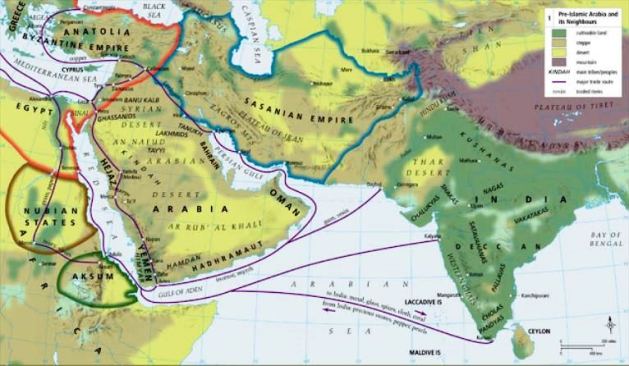 Pre-Islamic Arabia, including trade routes


Main slave trade routes in the Medieval Age

Slave Trade