My first missionary appointment in the Democratic Republic of Congo.

By Humphrey Mukuka, M.Afr

Humphrey Mukuka DRC 2015 01My journey to Aru.

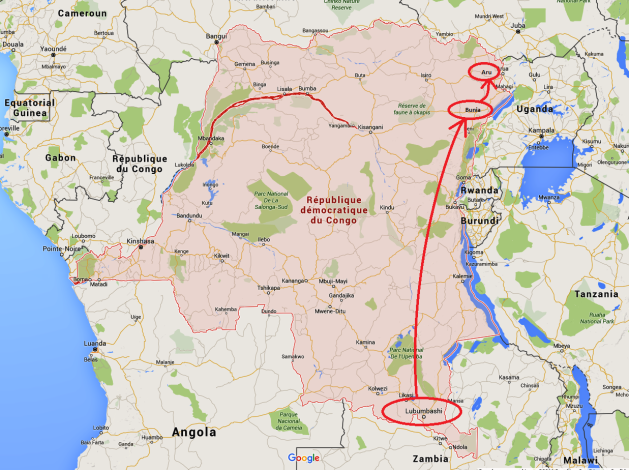
 My decision of passing by Lubumbashi, situated in the southern part of the country near Zambia, to go to Aru, next to Uganda in the North-East, was a bit adventurous. Everyone was advising me to pass through Kampala in Uganda and then enter to DRCongo by road. Being in Zambia, I wanted to go to Lubumbashi to see the families that had welcomed me and my friends Robbin Simbeye, Sylvestre Chimenge, Mathew Kalumba and Joseph Mulenga for a French course in 2008. One in particular, Papa Kabangu and Mama  Annie, came to witness my priestly Ordination in Kabwe last year on the 27th June, 2015. It was so nice to see them again.

I heard that flights from Lubumbashi to Bunia was risking due to negative experiences of local airlines. Anyhow, I thought to myself, “Let me accept it the way it will be. Besides, it will be a learning experience.” Guess what! I was very surprised to find a very well-organised airline called CAA. We travelled safely only that we had to stop over in many places.

République Démocratique du Congo - Carte GoogleUpon my arrival in Aru, I soon discovered deep tensions between some youth and the missionary community. I was wondering how I will integrate myself in such an environment. What will be my participation in the rebuilding mutual trust? Then, I remember what I learned during the Spiritual Year: “An ideal community does not exist but we try by all means to build our community according to the model of an ideal community where we are sent as missionaries.”

Fortunately, things have largely improved since my arrival. We have worked out our “community project”, meaning the way we wish to live as a missionary community. We have regular fraternal meetings and a monthly recollection.

Pastoral Activities

The Parish Notre Dame du Congo is a very dynamic one based on primary evangelisation focussing in visiting outstations in various villages. The warm hospitality the Christians help us to forget the bad roads. Those visits are more intensively made in November and December. I have already visited some outstations but still need much more time to know them all. This is really a wonderful experience.

I have been designated to look more closely to various parish groups such as the Mass servants, the Kizito-Anuarite association, the Bilenge ya mwinda or Youth of the light group, the “Mouvement Sacerdotal Marial”, “Les mamans catholiques” and the sick. For the later, I came to understand how deeply most of them are in need of the sacrament of reconciliation and receive the Holy Communion as quite a few have been waiting for a long time to welcome a Priest in their homes.

My difficulties and challenges.

The misunderstanding between some youth and our community is still being badly felt. But we are seriously working to rebuild confidence with a high sense of creativity so as to encourage everyone to remain joyfully active.

The state of poverty in Aru and its surroundings is unfortunately very high. Consequently, solicitation for financial assistance is constant and can become a form of harassment.

With so many spiritual needs to cover and leadership responsibilities, my time as much as my energy is running out quite often. However, I remain confident with the help of my fellow confreres and God.

Remember me in your prayer!         Click here to read the PDF file of this report.

Death of the mother of Marc Nsanzurwimo, M.Afr in Burundi

Marc Nsanzurwimo_2012_BFrom Marc Nsanzurwimo, M.Afr

With sadness and gratitude, I announce to you the passing over of our dear mother Monique Babonangenda last Friday morning (5th February 2016). She was 75 years of age. Since 2012, she was suffering from a light stroke which made difficult the movements of both the right leg and hand. She had given birth to ten of us (all of us are still alive), of whom I am the eldest, i.e., 6 ladies and 4 men, 21 grand daughters and grandsons and 1 great grandson. I thank the Lord for her exemplary life, her strong faith, her dedication to the family and her welcoming attitude to all who have shared the earthly pilgrimage. I am happy I was able to be near her the last months of her life especially to celebrate the Eucharist which accompanied her as she was crossing the threshold to heaven. May she enjoy peace and love with the Lord of life.

MIMSAF Calendar – February 2016

2016-MIMSAF-Calendar-6

2016 MIMSAF Calendar 7

Climaxing the Year Dedicated to Consecrated Life in Ghana.

John Mubanga in KumasiBy Fr. John C. Mubanga (M.Afr) – St. Benedict’s Parish – Wa.

From the 20th till 23rd January, 2016, John Mubanga, Dieudonné Amani, Dominic Apee, Gaspard Cirimwani, Gazena Haile, and Erus Tirkey celebrated the climax of the Year Dedicated to Consecrated Life on behalf of the Missionaries of Africa in Ghana/Nigeria Province in Kumasi, the second largest towns in Ghana. The theme was the one given by Pope Francis: “Wake up the World.” Views and sharing helped the participants to find ways to bring peace, joy and love to our contemporary world as religious men and women.

Gabriel Justice Yaw AnokyeThe celebration was organised by the conference of Major Superiors of Religious in Ghana whose president is Dominic Apee (Provincial of M.Afr Ghana/Nigeria). In his opening remarks, he welcomed everybody and most especially Most Rev. Emmanuel Kofi Fianu, SVD, Bishop of Ho Diocese, and Archbishop Gabriel Justice Yaw Anokye of the Archdiocese of Kumasi. Dominic reminded each one of us that “consecrated life is a gift given by Christ who chooses a person to respond to his great love in a special relationship. Consecrated life is a vocation in which men and women give witness to Christ by following his teaching. Consecrated life is most often shared in a community which is united in living out a common mission.” Indeed, as Dominic pointed out, we are called to imitate our Lord Jesus Christ without remaining at that level of imitation by allowing him to penetrate our lives in order to “Wake up the World!”

As consecrated men and women, we are called upon to wake up ourselves first by having faith, holiness and hope. Looking at us, people expect holiness. However, we know too well that we are sinners. Hence, we need to keep on striving to be holy. Archbishop Gabriel called each one of us to find time to “bisect and digest the challenges of discerning our vocation as Christians with the help of good and educated formators in cognitive true love through sincere joy”.

Bishop Emmanuel Kofi Fianu pdfIn his presentation, Most Rev. Bishop Emmanuel Kofi Fianu recognised the fact that our diversity in the Church is very rich. “Hope is deeply rooted in our lives. (Thus), if only we live in despair, we will not be able to wake up the world. Three points are vital: encounter, communities of communion and religious creativity. God encounters us using our wounds, our brokenness, […] and our weaknesses. Still, God loves us. Consequently, loving our neighbour shows that we love God who loves us. If only we keep this spirit of loving one another as consecrated men and women, at the end of the day we will come to realize that something is really deeply rooted in our lives.” The Bishop could not understand why consecrated leaving together could start “a third world war” among them. “The mission is not theirs but belongs to Christ.”

He added to say that there are “many forms of apostolate though we are all involved in similar apostolate; education, caring for the sick and pastoral work. We are called to be in the front line of imagination and creativity in order to carry out the inspiration of our founders.” Furthermore, Bishop Fianu called each one of us “to name what we see: ignorance, if so, instead of poverty. All over the world, people are crying in silence. We have to listen attentively if we want to bring some consolation. Let us share their cry and anguish. Waking up the world is possible through our given charism.” Otherwise, if we fail, as one Sister pointed out, we may end up “defeating the purpose of our community or congregation.”

Ghana map_modifié-1We had a good time in Kumasi. I kept one question: How can we then make ourselves visible in our places of apostolate? Our interaction and sharing with other Religious Congregations gave us eagerness to continue our ministry. We are not alone carrying out the mission of Jesus Christ.

We ended our celebration with the Holy Mass at the Immaculate Conception Parish located in South Suntreso, Kumasi. Mass started with a candle light procession by all consecrated people presided by Most Rev. Gabriel Justice Yaw Anokye, Archbishop of Kumasi. The day ended with a common meal.

Click on the right to read the PDF file: Climaxing the Year of Consecrated Life

ICOF Program – Joy-Filled Gospel Service

ICOF logoInter-Congregational Ongoing Formation Program

Founding Congregations: · Congregation of the Holy Spirit (Spiritans) · Missionaries of Africa (White Fathers) · Missionary Sisters of Our Lady of Africa (MSOLA) · Society of African Missions (SMA)

GENERAL INFORMATION (see attached brochure) + Founding Congregation

​For Catholic priests and religious in Africa. Two months of professionally facilitated sharing of experience, skills and practical knowledge, leading to enrichment of the participants’ professional, human, pastoral, spiritual and academic lives.

Place: Marian University College (MARUCO), Bagamoyo, Tanzania. Dates: June 1st – July 31st, 2016

COURSE CONTENTS: The program covers the four areas of formation: personal renewal (human), spiritual deepening, pastoral empowering, and academic update.

The program will cover the following: · Bearing joyful witness to the gospel through my particular vocation · Challenges of faith in contemporary Africa · Dangers of various addictions · Emotional intelligence and resilience · Ethical issues in ministry (boundary issues, financial administration) · Evangelii Gaudium: the Joy of the Gospel · Exploring different ways of meditating · Gender issues · Graceful Transitions in Life · Interreligious dialogue · Introduction to pastoral counseling skills · ‘Laudato si’ · Justice, peace and Christian responsibility towards the Integrity of creation · Appreciative Discernment · Leadership and Management · Ministering in a globalised world · Retreat (8 days) on the Joy of the Gospel · Scripture and mission · Signature Strengths for mission · Trauma awareness, bereavement, stress management & inner child work.

Vision: Integrated priests and religious in Africa giving joyful gospel witness in their personal, spiritual and pastoral lives.

Mission: To provide Catholic priests and religious in Africa with opportunity, space and time for personal renewal with a view of better service of the Gospel in the concrete reality of Africa today.

Objectives: 1. Provide skills and opportunity for addressing personal challenges. 2. Provide space and time for reflecting on and integrating their lived experiences. 3. Training in pastoral skills. 4. Academic updating on Scripture, current trends in mission in the context of Africa and on the latest magisterial documents.  

Methodology: The methodology includes input sessions, one-on-one accompaniment and working with growth groups. There will be multicultural community living and team working.

Fees and scholarships: The full cost of the program is 2136 US Dollars. Candidates who will qualify for scholarships will pay only 900 US Dollars. This covers: Full board, tuition, accompaniment fees, library and Wi-Fi for internet connection.

Qualifications for applicants: · Being Catholic priest or religious · Being approximately 10 · 20 years in ministry · Those in transition from one ministry to another will find it beneficial · Being recommended by one’s superior / bishop · Having a reasonable mastery of English · Willing to be open to share oneself with others for mutual enrichment and growth. 

Application deadline: April 30, 2016

CONTACTING US: Inter-Congregational Ongoing Formation (ICOF) Program, C/o Marian University College, P.O. Box 47 Bagamoyo, Tanzania. – Tel.  Tanzania: +255 787 795 033 / 766 075 219 – Kenya: +254 727 729 146 / 731 673 305 – Uganda: +256 752 508 284 /+256 786 842 292 – Email: icofprogram@gmail.com. Founding Congregation1                Blog:  http://icofprogram.blogspot.com

ICOF Logo Internet

Newsletter South Africa No 59 – 29th January, 2016

Newsletter South Africa no 59 titleMy dear Friends, Compliments of the season (as people say)! Happy New Year! Until the end of this month, I always take the liberty to wish people a Happy New Year; after all, there are still eleven months of it!

Merciful Father2I hope you have entered gracefully (or in a grace-filled way) in this Jubilee Year of Mercy! Yes, as you know, Pope Francis has declared this year, starting on 8th December last year until the 20th November this year (Feast of Christ the King), a special time to live by and with the mercy of God. “Jesus Christ is the face of the Father’s mercy”, says the Pope. The theme he gives to this yearlong celebration is “Merciful like the Father” (see Luke 6: 36). Very interestingly for us on the African continent is that on 29th November – 9 days before the official opening in Rome – Pope Francis opened the Holy Door of Mercy in the Central African Republic’s capital before the beginning of Sunday Mass. He decided to open the Holy Door in the cathedral of Bangui as a sign of prayer and solidarity with the country and the rest of the continent. This is the first time in history that a Jubilee year is opened outside of Rome! This gave a lot of courage to the people of the Central African Republic – not only Catholics – to go and vote in the presidential elections, in spite of the threats received from militias telling them not to vote!

The people just ignored their bullets and these terrorists felt powerless in front of God’s power: this was a miracle, a sign from God brought through Pope Francis!

From 4th to 7th January, we had our Sector Meeting in Haartbeesport Dam, at the Good Shepherd Centre. We had a good time of reflection, prayer, discussion and planning for our work in South Africa.

Our new deacons who went to Malawi, Mozambique and Zambia during their Christmas holidays (see last month’s Newsletter), came back on different days around mid-January. You should have seen the joy beaming from their eyes as they explained all what they had been doing during this short pastoral experience in their respective parishes. It reminded us of the return of the seventy disciples after Jesus had sent them on their first mission (See Luke 10: 17-20). They were really thrilled to have been able to proclaim the word of God in their own way. This was surely a great experience for them, awaiting their priestly ordination after this last year of theological studies.

On 16th January, in Pretoria Cathedral, with two of our deacons, we took part in the closing Mass of the Year of Consecrated Life. The Cathedral was full and the choir helped us wonderfully to sing the praises of God who has chosen so many Religious Sisters, Brothers and Priests to work in his vineyard. As this event took place just before the annual Episcopal Conference meeting, thirty one bishops from South Africa and as far as Botswana and Swaziland were present. Many lay people also joined in the celebration.

As you see, this month, this Newsletter comes to you a few days late. The main reason is that I was busy conducting the annual retreat for some of our seminarians of Merrivale. Indeed, from 21st to 27th January our five new deacons – the sixth one, Douglas, is already home in Kenya awaiting his priestly ordination -, plus eleven of the students and two of their formators (Fr. Réal, the rector, and Fr. Luigi) were with me in John Paul II Pastoral Centre of Bethlehem Diocese (Free State). For six full days, they were really praying and meditating on God’s word and sharing the daily Eucharist in an atmosphere of silence and reverence, listening to the Holy Spirit speaking in their hearts.

On 10th February, Ash Wednesday will launch us in the wonderful time of Lent. I therefore wish you a very good and fruitful time of following the Lord through his Passion, Death and Resurrection.

God bless you!

Fr. Michael Meunier, M.Afr

Newsletter South Africa No 59b2

Zambia Episcopal Conference Pastoral Statement – January 2016 (Summary)

ZEC Pastoral Statement LogoTo all Catholics and people of good will in Zambia!

We greet you in the name of our Lord Jesus Christ.

As is our tradition, we hold the first plenary meeting in January of every year. It is the moment of grace during which we reflect and deliberate on our task as shepherds of the flock of the Catholic faithful in Zambia. In addition, we seize the occasion to review and evaluate the context within which we exercise our ministry of evangelization in order to discern our relevance to society as a Church. As pastors of the Church and teachers in the matters of faith and morals, we always feel duty bound to teach on issues affecting our faithful and the people of good will, for “woe to us if we do not preach the word of God in and out of season” (I Cor 9:16; 2 Tim 4:2).

Our country is moving towards the 2016 tripartite elections. Zambians should be looking forward to this occasion with joy and great expectation. Ideally, elections are supposed to provide an opportunity of choosing our desired representatives in Councils, Parliament and a President of our choice in peace and tranquillity.

However the political culture that persistently clouds our election does not depict a maturing democracy and maturing democrats. Zambia is paying a great price through political hooliganism and apparently the leadership in all our political parties has failed to uproot political violence. In some cases they actually seem to encourage and fan it by inflammatory speeches. We also don’t see perpetrators of violence in political parties punished by their own leadership.

We appeal for a new political spirit and a democratic culture among our political leaders and their members. Let us make 2016 different in terms of providing a better and tolerant political environment. Political party leaders at all levels must commit themselves to a peaceful electoral process and the control of their members. Political parties must choose candidates of good standing who are committed to the promotion of the common good.

We urge our leaders in government to be the torch-bearers in the promotion of true reconciliation and peace. The role of the District Commissioner (DC) in this electoral process must be watched and seriously scrutinised. DCs should not act and work as party cadres wherever they are and using government resources.

We are very concerned about the selective application of the Public Order Act by the Police Service. In many cases, it is applied almost always in favour of the ruling party and those they favour. This disadvantages opposition political parties. Police must sternly but impartially apply the law to quell violence.

We advise the youths to claim their genuine political space in the electoral process. They should refuse to be used as mere tools of violence by politicians. We call upon the media to be professional by reporting truthfully, objectively and factually as they inform the public. We urge them to provide equitable coverage in the electoral process and avoid being fronts of partisan politics. Whichever media platform one uses, should not fuel hate speech or insults in the name of the right to freely express oneself. We also want a responsible use and reception of social media.

We urge all Christians to use their prophetic voice in their communities to promote unity in the country and to denounce all forms of fraud in the electoral process. We urge them to refuse any politician to use their churches and liturgical functions as campaign forums.

We call upon our fellow church leaders to remain non-partisan yet vigilant. They must also keep the prophetic voice alive and denounce all forms of electoral malpractice and political violence.

Likewise, we appeal particularly to our own catholic priests to remain non-partisan. It is morally wrong for the catholic priest to use the pulpit to campaign for, or de-campaign any political party or parties or to give politicians any platform to speak during liturgical celebrations.

After so many aborted processes and huge expenditure of public resources, the President took a bold step and assented to the amendments of our Republican Constitution on 5th January 2016. This was despite the unresolved contest with stakeholders on the process and mode of adoption. The question now arises as to what next?

Government has not given any road map for the post assenting period with respect to the application of the new Constitution. Even as we move towards August elections, the new Constitution has implications that impinge on the elections and this should be looked at.

Further, even when the constitution has been assented to, there have been no efforts to make it easily accessible and affordable to the majority Zambians. If the President made this constitutional assent in good faith, we appeal to him to prevail over relevant ministries and government departments to popularize the new constitution and publicise the post assent constitutional roadmap.

Prior to the enactment of the constitution, the government promised the public that those articles that would be left out shall be subjected to the referendum that would run concurrently with the tripartite elections.

Sadly, the Bill of Rights has been sidelined. Many of the constitutional changes we need to make that could improve the people’s quality of life and dignity hinge on reforming the bill of rights. It is imperative that a clear and well defined roadmap on the proposed referendum be presented to the nation.

A new dangerous phenomenon that has cropped up in the Zambian politics is that of regionalism and tribalism. We should all be proud of our ethnic roots and love each other as God’s children. No tribe is more valuable or important than the other. What makes us great is our unity in diversity and we should all thank God for it.

The transition from 2015 into 2016 can be classified as a challenging period in as far as livelihoods of Zambians is concerned. The cost of living has gone up due to escalation in inflation. We are experiencing massive loss of jobs for bread winners and households are being left with no income. Although the major cause in the slump of the economy has been attributed to external factors, and while appreciating what the government is doing to offset the challenge, this situation must be arrested locally. Government should demonstrate commitment to good stewardship of financial resources during this time.

We also strongly appeal to all companies and employers that before retrenchments are carried out, other measures to achieve financial solvency must be attempted.

Zambia is experiencing unfavourable rain pattern. This pattern shows that the country’s food security will be under extreme pressure. In the case of calamity such as this, we urge the Zambian Government to plan ahead so that no Zambian citizen should go without food this year. The relevant government ministries should mobilize resources to assist those who will be in dire need of help. However, food relief should be not used to gain political mileage.

The climate change calls us to re-examine the way we take care of our common home, the earth. Pope Francis cautions us that if we do not take personal as well as corporate responsibility for the earth which is our home, we will destroy the home for our future generation (Laudato si, 2015, #14).

We also urge the government to put in place strong measures to monitor the exploitation of natural resources in Zambia by investors, both foreign and local.

We call upon our brothers and sisters to take this year as the year of tolerance and love. In the words St. Paul the Apostle, we make a special appeal to you to “make [our] joy complete by being of a single mind, one in love, one in heart and one in mind. Nothing is to be done out of jealousy or vanity; instead, out of humility of mind everyone should give preference to others, everyone pursuing not self-interest but those of others” (Phi 2:2-4). Above all “do everything possible on your part to live in peace with everybody” (Rm 12:18).

We end with the prayer of St. Francis of Assisi: “Lord, make me an instrument of your peace. Where there is hatred, let me sow love; where there is injury, pardon; where there is doubt, faith; where there is despair, hope; where there is darkness, light; where there is sadness, joy.

O, Divine Master, grant that I may not so much seek to be consoled as to console; to be understood as to understand; to be loved as to love; For it is in giving that we receive; it is in pardoning that we are pardoned; it is in dying that we are born again to eternal life.”

May the peace of the Lord remain with you all!

Issued at Kapingila House, Lusaka, Zambia on 23rd January, 2016 and signed by: Most Rev. Telesphore-George Mpundu, Archbishop of Lusaka and ZEC President, Rt. Rev. Alick Banda – Bishop of Ndola and ZEC Vice-President. Most Rev. Ignatius Chama, Archbishop Kasama and Apostolic Administrator of Mpika, Rt. Rev. Raymond Mpezele – Bishop of Livingstone, Rt. Rev. George Cosmas Zumaile Lungu – Bishop of Chipata, Rt. Rev. Charles Kasonde, Bishop of Solwezi, Rt. Rev. Evans Chinyama Chinyemba, OMI – Bishop of Mongu, Rt. Rev. Clement Mulenga, SDB – Bishop of Kabwe, Rt. Rev. Patrick Chilekwa Chisanga, OFM Conv. Bishop of Mansa, Rt. Rev. Moses Hamungole, Bishop of Monze, Rt. Rev. Benjamin Phiri – Auxiliary Bishop of Chipata, Rt. Rev. Aaron Chisha – Bishop Emeritus of Mansa. Mons. Justin Mulenga – Bishop Elect of Mpika

Click here to read the FULL PDF DOCUMENT of the Zambia Episcopal Conference Pastoral Statement – January 2016

Declaration of Intent of Guelord Mahongole Luvuluholo, Kasama, Zambia

Guelord`s Declaration of Intent Jan 16 02bFr Michael Mawelera, M.Afr
Last Sunday, 24th January, 2016, at the 7.00 AM Mass, our stagiaire Guelord Mahongole Luvuluholo renewed his Declaration of Intent in the presence of Fr Francis Bomannsan who represented the Society of the Missionaries of Africa, Fr Michael Mawelera, animator of St. Charles’ Community to which Guelord belongs and Fr Luc Antaya, Parish Priest of St. Anne’s Parish in which Guelord does his ‘stage’ experience.
The ceremony itself was simple but prayerful, solemn and meaningful. In the evening the confreres of Lualuo Spiritual Formation Centre and those of St. Charles’ gathered together for supper at St. Charles in honour of Guelord.
The St. Anne’s Parish community and the confreres in Kasama are happy that Guelord has made this step in his formation process. We pray for, support and encourage him to continue pursuing his vocation in the Society of the Missionaries of Africa.

Pre-First Cycle Formation Centre, Chipata, January to June 2016 In-Take.

Propaedeutic 01_modifié-1By Fr. Camille Konkobo

The Southern African Province has made it possible to have their own ‘Propaedeutic’, meaning a Centre that welcomes young men of between 20 and 26 years of age. They have heard the call of God and want to confirm it through community, prayer and human life. The Centre is situated in Chipata, Eastern Province of Zambia along Malawi Road, about 6 Km from town.

We have received 18 students, 6 from Mozambique, 7 from Malawi and 5 from Zambia. We had our official opening Mass on the 17th January and have started our program.

Formators: Fr. Camille Konkobo, Fr. Timothée Bationo and Br. René Garand

The true size of Africa

The true size of AfricaAfrica is much bigger than you think. In fact, it is larger than the USA, China, India, Japan and all of Europe combined! The problem is that the world isn’t flat, but the maps we use are, and it is really difficult to flatten a sphere into a square. This means that our traditional maps are distorted, with countries artificially enlarged the closer we get to the poles, giving the impression that Africa is about the same size as Greenland. However, Africa is in fact 14 times larger than Greenland.

Our traditional maps are relics of Euro-centric colonial days. They are simply representations of the world through the lens of their creator. Why is Europe normally in the centre?

Why is north up, when there is no concept of up in space? South is associated with poverty and lack of development, and even our language is full of negative connotations for “down”, such as “down in the dumps”, while “up” has positive ones such as “on top of the world”, as pointed out by Africa Check.

The map shows how big Africa is. However, in the mental map of many non-Africans it occupies almost a single point, which probably contains features such as famine and disease; safari and animals; Nelson Mandela; the Lion King; genocide in Rwanda and Darfur and perhaps rape in the DR Congo; and Ebola.

See PDF file on the following link: The true size of Africa

Source: Zambia Weekly … for busy people, Week 4, 22 January 2016, Issue 260, Volume 7, www.zambia-weekly.com page 12.

Page 32 of 116

Powered by WordPress & Theme by Anders Norén