“Encontraram-se a misericórdia e a fidelidade, abraçaram-se a paz e a justiça” Salmo, 84,10

A Comissão de Justiça e Paz da Diocese da Beira, vem por este meio, convidar a cada um de vocês, a unir-se no dia Sábado 14 de Maio as 20:00 horas em um momento de Oração pela Paz, o Dialogo e a Reconciliação em Moçambique.

Como sinal, convidamos a que nas Vésperas de Pentecostes acendamos uma vela as 20:00 horas em todo Mocambique e alem fronteiras para “ Pedir a Deus que Iluminar Moçambique com as chamas do Espirro Santo”, “Peçamos a Deus que ilumine Moçambique com a Luz da Esperança de que outro Moçambique diferente e possível”. Um Mocambique justo, digno dos filhos e filhas de Deus.

Encontraram-se a misericórdiaOremos a Deus para que Deus Ilumine Moçambique nas vésperas de Pentecostes, unindo-nos em oração; em casa, na festa, na barraca, em qualquer lugar onde esteemos. Vamos unir nossa FE, nossa Esperanza e nosso desejo de um Moçambique que viva na Justiça e na Paz. Não a Guerra sim a Paz. Não a Morte, sim a Vida…

Convide seus amigos pelas redes sociais ou pessoalmente, no serviço, na Igreja… para estar todos em oração nas Vésperas de Pentecostes, a Vinda do Espirito Santo, o Espirito de Justiça e de Paz…

Fraternalmente, Pe Ciprisio (Fidel) Fidel_Salazardel Muro.

Coordenador da Comissão de Justiça e Paz e Integridade da Criação. Missionário de África. PB. Moçambique, Beira.

Book Review: Boucher, Claude (Chisale). When Animals Sing and Spirits Dance Gule Wamkulu: The Great Dance of the Chewa People of Malawi.

Journal of Retracing AfricaClaude Boucher’s When Animals Sing and Spirits Dance Gule Wamkulu: The Great Dance of the Chewa People of Malawi, with additional text from Gary J. Morgan, Director of Museum Studies at Michigan State University, and photographs by Arjen van de Merwe, offers a refreshing, insightful, and brilliant interlink between what could be regarded as artistic compendium and the fundamental spiritual cultural heritage of an African community, the Chewa people of Malawi, in the dynamic context of everyday paradigms of holistic life experiences. Through a drama-laced strategy, the book masterfully employs symbolic characters depicted in masks and woven structures in an analytical syringe of songs and dances to “play out” the realities of cultural philosophical values and communal expectations of the Chewa people.

The crux of the book is revealed in two major sections. The first is the introduction written by Gary Morgan. Here the reader is exposed to the historical background of Malawi in general, the historical origin of gule wamkulu, and the religion of the Chewa people. It also introduces the reader to the role, as well as the form of gule wamkulu characters. The history of the origin of the symbolic and ritual evolution and the eventual transition of the gule wamkulu characters are also extensively discussed. With the introduction, the reader is prepared for the subsequent intriguing and illuminating details to follow in the main section of the book.

The second presents the kernel of the book in seven major themes as “dramatized” through the performances of the gule wamkulu dancers. The themes vividly capture the Chewa people’s worldview on moral codes. The holistic nature of the themes is compelling. They strategically cover the existential instructions for the citizens of the community, such as history and politics; community, authority and ancestors; sexuality, fertility and marriage; childbirth and parenthood; health, food and death; witchcraft and medicines; and personal attributes. The author brilliantly portrays the interpretations and dramatic uses of these themes in ways that vividly represent the authentic voices of the local people that may be impossible to achieve in any other format. Perhaps more importantly, the Chewa people’s heritage of the spiritual linkage to the ancestral world, in which the ancestors continue to impact their living descendants as agents of societal moral standard, is substantially highlighted. This without any doubt constitutes a significant representation of the fundamental religious worldview of Africans on the circular nature of human existence and the “never ending” reciprocal obligations and privileges between the living and the living dead, i.e. the earthly and the spiritual domains.

I find the intellectual and communicative strengths of this book enormous. It is comprehensively researched and the author admirably subsumes his subjective considerations of the themes discussed and allows the voices of the Chewa people to be heard in their “undiluted” forms. The colorful illustration employed throughout the book definitely enhances the reader’s imaginative and empirical understanding. The images are compelling and make the reading of the book engaging and less cumbersome. Also, both the mask name and the theme indexes at the end of the book provide the much-needed information on the locations of prominent words and ideas. In addition, the glossary of Chichewa terms and the interpretations of the songs in Chichewa and English afford the reader, who may not speak the Chichewa language, the basic understanding of the contents.

Surprisingly, with the author having a background as a Catholic priest, I did not find an interfaith discourse that I believe would have positively linked the moral codes of instructions of the Chewa thematic worldviews with the Christian (Catholic) moral expectations in the inculturalization spirit of Vatican II. This I believe would have raised the profile of the book as a doctrinal literature in the promotion of African Christianity (perhaps I was looking for too much) given the focus, objectives, and scope of the book. Notwithstanding this critique, the book presents a formidable resource as a “hypothesis” ready for further scholarly research for those interested in the rich African spiritual heritage in the context of existential humanity. In this regard, the book attests to the 2005 UNESCO description of gule wamkulu as “a masterpiece of the oral and intangible heritage of humanity.” On the whole, Boucher deserves to be applauded for his scholarly endeavor in writing this book.

Ibigbolade Aderibigbe, Associate Professor of Religion and African Studies, University of Georgia, Athens, GA

CLICK HERE TO READ THE PDF FILE OF THIS ARTICLE

Journal of Retracing Africa web page

Mafrwestafrica – Lettre du 2 mai 2016

Mafrwestafrica logoAujourd’hui, les Missionnaires d’Afrique de l’Ouest vous proposent de visiter de nouvelles pages sur leur site www.mafrwestafrica.net :

Dans la rubrique « Actualités » :

« Lettre de Ghardaia, 27 avril 2016 » la dernière lettre rédigée par notre confrère Claude Rault, évêque de Laghouat Ghardaia au Sahara (lire la suite)

« Côte d’Ivoire le 1er mai ». Le président Alassane Ouattara s’est adressé aux ivoiriens ce dimanche 1er mai pour tenter de calmer la grogne (lire la suite)

Dans la rubrique « Témoignages » :

« Le clergé africain, essentiel » cet article paru dans Voix d’Afrique et écrit par le père Jean Claude Ceillier nous rappelle combien Lavigerie tenait à ce que l’Afrique soit évangélisée par les africains (lire la suite)

« Frère au milieu des Pères » : le frère Jan Heuft, hollandais, vivant en Algérie, témoigne que ce qui compte ce n’est pas d’être frère ou père, mais bien missionnaire (lire la suite)

« Des livres à découvrir », trois livres présentés sur le site de l’ARCRE, et portant surtout sur le dialogue interreligieux(lire la suite)

Dans la rubrique « Dialogue interreligieux » :

« Débats sur l’Islam extrémiste » : trois articles publiés sur le site de l’ARCRE le 22 avril 2016. (lire la suite)

« Le dialogue nécessaire », ce texte étant publié dans le numéro de Voix d’Afrique 110 par le père Jean Bipendo, formateur dans notre maison d’Abidjan (lire la suite)

« Tibéhirine 20 ans après » c’est le 21 mai 1996 qu’étaient assassinés ces sept moines trappistes qui avaient fait du dialogue le sens de leur vie (lire la suite)

Dans la rubrique « Justice et Paix » :

« Qui est Vincent Bolloré ? » un texte de l’émission « Complément d’enquête » du 7 avril 2016 donne un éclairage plus que mitigé au sujet de cette personne : l’Afrique serait-elle son nouveau « terrain de jeu » ? (lire la suite)

Dans la rubrique « Vu au sud, vu du sud » :

« Le coton Burkinabè perd son label » un article publié sur le site « abcburkina.net » du SEDELAN (lire la suite)

Newsletter South Africa No 62 – 29th April 2016

Newsletter South Africa No 62 titleGreetings! I hope you are keeping well and that this month has been an occasion to reflect and pray more on your vocation. On April 17, the fourth Sunday of Easter, the Church celebrated the 53rd World Day of Prayer for Vocations. This year’s theme was: “The Church, Mother of Vocations”. Pope Francis wrote: ‘Each vocation in the Church has its origin in the compassionate gaze of Jesus.’ The Church – and don`t forget: you/we are the Church – is where vocations take their root. Pope Francis also writes in his message for Vocation Sunday: Vocations are born within the Church… Vocations grow within the Church… and… Vocations are sustained by the Church. If you belong to a lively and prayerful parish, you can discover your vocation in the context of that community: get involved in it and have regular contacts with your priest. Are you active in your parish community? Are you committed in helping its growth in one way or the other? If you find that your parish is not lively enough, talk with your priest and with elders of your community, get other youths together and DO something about it! This is a good way to be a missionary!

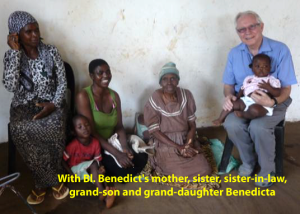
From 25th to 27th of this month, I went to Thohoyandou in Limpopo to enquire and learn more about the life and death of Blessed Benedict Daswa. Indeed, last year when he was beatified on 13th September 2015, I was not able to go. I was very lucky to stay over with Blessed Benedict’s cousin who knew him very well. On the second day, we were joined by Sister Claudette, who, with a team of lay people, worked very hard to promote Benedict’s beatification. With the two of them, I had the chance to visit all the places where Benedict lived, taught and became a headmaster. We celebrated Mass in the small church which he built with the help of his learners and the local Christians. I met also many members of his family, some of his children and especially his dear mother who is now 90 years old. Blessed Daswa left a very memorable souvenir in the minds and hearts of most people not only of his area, but also of the whole of South Africa. He was a real saint who lived his catholic faith to the end, even to accepting death. He always fought for truth, and we all know that he died for having opposed witchcraft which causes so much harm in society.

Newsletter South Africa No 62 picturebWhat is interesting about Benedict is that he was a very ordinary boy who grew up in a remote village of Limpopo in a very loving family; he was baptised as a catholic only when he was 17 years old he became a teacher, got married and fathered eight children. He became a real leader in his village, always guided by his catholic faith in action, and not only in words. He had a great love for all people, especially the youth whom he trained to become real good Christians and citizens. He can be a real inspiration and role model for each one of us. Pray through his intercession; ask him to help you discover your Christian vocation.

Keep well and keep smiling! God bless you! Fr. Michael Meunier, M.Afr

Eur-Echo May 2016

Euro-Echo May 2016Euro-Echo May b2016

EURO-ECHO SUMMER 2016 PDF FILE IN ENGLISH

EURO-ECHO ETE 2016 PDF FILE IN FRENCH

Seminar for couples over 25 years of marriage, St. Anne’s parish, Kasama, April 2016.

MARRIAGE SEMINAR 01b

By Lawrence Tukamushaba

“The Church is commissioned to proclaim the mercy of God, the beating heart of the gospel which in its own way must penetrate the heart and mind of every person,” Pope Francis (The Face of Mercy). What kind of pastoral initiatives can we implement to make the Jubilee Year of Mercy felt in our Parish? We reflected upon this question in our pastoral team meetings. Many initiatives were proposed such as organising seminars for different groups and encouraging people to deepen their sacramental life, especially the sacrament of reconciliation and matrimony.

Indeed, many marriages are in crisis. With the help of Marriage Encounter, the pastoral team put in place a seminar for couples who have been married for 25 years or more. The renewal of their matrimonial vows took place on the second Sunday of Easter or the Divine Mercy Sunday.

With great enthusiasm and excitement, over sixty couples from St. Anne’s Parish main Centre registered for the seminar which took place on the 2nd April. One couple celebrated its 64th years of marriage. For most of them, it was their first seminar ever as couples. They had a chance to share their life experience. It was also a time to look back with gratitude and look at the future with hope.

The renewal of their marriage vows took place at Mass presided by Luc Antaya, M.Afr. In view of everyone, they repeated their love and life commitment for each other. Some refreshments were provided after Mass and a few souvenir pictures taken. The “under 25” are waiting for their great day too. “May pastors [….] be diligent in calling back the faithful to the throne of grace, that they may receive mercy and find grace,” Pope Francis (The face of Mercy, No. 18).

Mafrwestafrica – Lettre du 17 avril 2016

Mafrwestafrica logoAujourd’hui, les Missionnaires d’Afrique de l’Ouest vous proposent de visiter de nouvelles pages sur leur site www.mafrwestafrica.net :

 Dans la rubrique « Actualités » :
« Wilbert Gobbo, docteur en théologie » le père Gobbo, Tanzanien, vient de réussir sa thèse en théologie et nous sommes heureux de publier quelques photos(lire la suite)
« Nouvelles de Mauritanie », publication de la dernière lettre du diocèse de Nouakchott(lire la suite)
« Lettre de Laghouat Ghardaia, mars 2016. » les dernières nouvelles de ce diocèse dont notre confrère Mgr Claude Rault est l’évêque(lire la suite)

Dans la rubrique « Témoignages » :
« Nouvelles de Tema Bokin » un texte envoyé par le curé de cette paroisse du diocèse de Kaya, paroisse qui va fêter son cinquantenaire (lire la suite)

Dans la rubrique « Dialogue interreligieux » :
« Islam et christianisme » la présentation de deux livres et une allusion au fait que Marie est vénérée par l’Islam et le christianisme comme Vierge et Mère de Jésus. (lire la suite)

Dans la rubrique « Justice et Paix » :
« Protection des enfants » le Père Stéphane Joulain, qui est maintenant à Rome, y est « Coordinateur à l’Intégrité du Ministère ».
 (lire la suite)
« Le Pape François et les migrants » tout particulièrement lors de sa visite toute récente en Grèce, le pape pose des gestes significatifs (lire la suite)

Dans la rubrique « Vu au sud, vu du sud » :
« Le Tchad » et les nouvelles prises sur le site de RFI au sujet des élections qui y sont contestées par une partie de la population. (lire la suite)
« Les premiers africains chez les Missionnaires d’Afrique » un article publié par le Père Dominique Arnauld dans Voix d’Afrique n° 110 (lire la suite)
« Eglise d’Afrique du Nord et Subsaharienne » les mouvements de population ne sont sans doute pas étrangers au fait que la prochaine conférence de la CERNA se tiendra au Sénagal (lire la suite)


Death of the brother of our confrere René Garand

My brother Claude Garand pass away on 6th April of a cardiac arrest, please remember him and his family in your prayers. Bro René Garand

Claude GarandÀ son domicile, le 6 avril 2016, est décédé à l’âge de 74 ans, Monsieur Claude Garand, époux de Claire Beaudet, domicilié à Victoriaville. Les funérailles auront lieu le lundi 11 avril 2016 à 11h à la chapelle du Salon funéraire. Monsieur Claude Garand laisse dans le deuil, son épouse Claire Beaudet, ses enfants : Alain Garand conjoint de Mélanie Tanguay, Jean Garand, Pierre Garand, François Garand, ses petits-enfants : Geneviève, Marie-Danielle, Ismael. Monsieur Claude Garand laisse également dans le deuil ses frères et ses sœurs, ses beaux-frères et belles-sœurs, ainsi que plusieurs autres parents et amis. Il était le frère de notre confrère René Garand

Invitation card for the Missionary Oath in Jerusalem, April 16, 2016.

Final Oath Jerusalem April 2016From Hervé Tougma.

I am sending you our invitation card for the Missionary Oath that is taking place next week on 16th April in Jerusalem in the presence of Fr Jos Van Boxtel, M.Afr. Thanks for your prayers and support!

Death of Archbishop Emeritus of Beira, Mgr Jaime Pedro Gonçalves

Jaime Pedro Gonçalves Archbishop Emeritus of Beira_JPEGOpening of the Sanctuary of Our Lady of Fatima MurraçaThis morning at 01:30 in a clinic in Beira, Jaime Pedro Gonçalves Archbishop Emeritus of Beira, died after a long illness. May he rest in peace.

Morreu esta noite às 01:30 na clínica Avicenna, Jaime Pedro Gonçalves, Arcebispo Emérito da Beira. Paz a Sua Alma.

Picture of the right: Opening of the Sanctuary of Our Lady of Fatima Murraça

By Hugh Seenan, M.Afr

Jaime Pedro Gonçalves died today 6th Abril at 79 years of age in hospital in Beira after a long illness. Born 26th November 1936 in Nova Sofala in Beira Province, he studied in Zobue in the Junior Seminary directed by the Missionaries of Africa. He then went to the Major Seminary in Lourenço Marques e Namaacha and made further studies in Canada (Antigonish) and Rome.

Jaime Pedro Gonçalves

He completed forty years as Bishop last week, Easter Monday, but was too sick to participate in the special mass. He was the major player in bringing the two sides to the negotiating table in Rome in the first Civil War which led to the signing of the Peace Accords of the 4th October 1992.  He was very involved in the preparations of the first Extraordinary Synod for Africa, as a Vice-President of SECAM for the Portuguese language.

With the Missionareis of Africa at the handing over of Murraça_2With the Missionaries of Africa at the handing over of Murraça.

Extract from the book entitled “Attracted to Conflict: Dynamic Foundations of Destructive Social Relations”:

Extract Attracted to ConflictExtract from Review Essay – Conflict in Southern Africa

“Mozambique’s peace agreement constitutes a rarity in conflict resolution, namely, as one of the few cases where the initiative, the pace, and the resolve of negotiations were determined not by diplomats but by the offices of the men and women of good will from Sant’Egidio, a Catholic lay order in Rome’s Trastever district and by the clairvoyance and determination of a formerly imprisoned Mozambican Catholic Bishop, Jamie Pedro Goncalves, Archbishop of Beira. Ending Mozambique’s War is a detailed account of the negotiations that led to peace and eventually to democratic elections in Mozambique in 1993.” READ MORE ON THIS PDF FILE

Page 28 of 116

Powered by WordPress & Theme by Anders Norén