SACBC Justice and Peace Commission in South Africa Calls for a More Effective Regulation of Banks.

sacbc-jnp-logobishop-a-gabuzaBishop Abel Gabuza, the chairperson of SACBC Justice and Peace Commission, has called on the Parliament’s Standing Committee on Finance to consider further regulation of banks if the banks are found guilty of collusion by the competition tribunal.

“If the tribunal confirms commission’s findings, we urge the treasury and the standing committee on finance to institute more effective regulation of banks, in furtherance of the common good, to prevent further market abuse.” Says Bishop Gabuza.

According to Bishop Gabuza, this should include efforts to speed up the finalisation of the Financial Regulation Bill. “We particularly insist on the establishment of the market conduct regulator.” 

Bishop Gabuza has commended the standing committee on finance for its efforts to appraise the concentration levels in the banking sector. 

“In any sector, when too much power is concentrated in too few hands, the biggest losers are often the poor and low income earners. In so far as it is undertaken in a manner which is consistent with international benchmarks and the interests of the poor, we support government efforts to break the dominance of South Africa’s largest banks and increase access to the economy.”

Bishop has also called for stronger culture of ethics in the banking sector. “The bank collusion is a reminder that we need to strengthen ethical infrastructure in the financial sector. We are often worried that, since the banking sector is important for increased investment and faster economic growth, it is often treated as if it is a sector that should be above ethics and the law. Just like other sectors, the banking sector should be subjected to ethical imperatives and regulatory frameworks that promote the common good. Profit making and greed should not be the only guiding principles.” Added Bishop Gabuza.

SACBC Justice and Peace Commission “shall continue to speak out against corruption in the financial sector, with the same vigour that we use when we condemn corruption in the public sector. Both private sector corruption and public sector corruption arise from the spirit of greed and the worship of money. Both constitute stealing from the poor. Both divert resources necessary to uplift the poor from poverty and destitution. We shall not therefore remain silent in the face of any corruption and fraud.”

Click here to open the PDF file of this document.

For further information, kindly contact:

Bishop Abel Gabuza. Cell number:  0825494324  –  Phone number: 053 831 1861 or 053 831 1862. Email: dagabuza@gmail.com

Archbishop William Slattery: Cell: 0834685473

Mafrwestafrica lettre du 21 février 2017

Mafrwestafrica logoAujourd’hui, les Missionnaires d’Afrique de l’Ouest vous proposent de visiter de nouvelles pages sur leur site http://www.mafrwestafrica.net.

Actualités

« Relais Pères Blancs Maghreb janvier 2017 » la dernière édition disponible de cette revue qui nous informe sur l’Eglise en Afrique du Nord (lire la suite)

« Les missionnaires d’aujourd’hui » même s’ils ont la même mission, ne se présentent plus de la même manière que par le passé (lire la suite)

Témoignages 

« Les congrégations missionnaires africanisent leurs structures », étant de plus en plus dirigées par des africains (lire la suite)

« Jubilaires 2017 chez les missionnaires d’Afrique », les noms de ceux qui célébreront cette année de 25 à 75 ans de serment missionnaire… (lire la suite)

« Nombre de migrants en évolution » le partage de l’expérience des migrants recueilli de par le monde et très enrichissant (lire la suite)

« Le pape pour la journée mondiale du malade » l’intégralité du message du pape François à ce propos (lire la suite)

Dialogue interreligieux

« Social et religieux chez les musulmans » Lire l’interview de Didier Leschi par Walid Mebarek : l’action de l’état a atteint ses limites (lire la suite)

« Nombre et répartition des musulmans dans le monde », un article de Marc Gaborieau, anthropologue auteur de ‘’ Un autre islam : Inde, Pakistan, Bangladesh’’ (lire la suite)

Justice et Paix

« Le pape contre la traite des enfants » tout particulièrement en cette date du 8 février, qui est aussi la fête de Sainte Bakhita (lire la suite)

« Devenir acteurs de notre vie » une invitation du Père Norbert Angibaud, référent Justice et Paix des Missionnaires d’Afrique de France (lire la suite)

« Migrants aux portes de l’Espagne » plusieurs centaines de migrants ont réussi à pénétrer à Ceuta, cette enclave espagnole au Maroc, malgré les murs et barbelés (lire la suite)

Vu au Sud – Vu du Sud

« Rénovation d’une école à Khartoum » un article d’un missionnaire Burkinabè y résidant et témoignant de l’aide apportée à ce projet (lire la suite)

« Autorités intérimaires Nord Mali » : les présidents de ces autorités ont été désignés et entrent en fonction le 18 février 2017 (lire la suite)

« Les casques bleus ont quitté la RCI » après quatorze ans de présence sur le sol ivoirien, dans l’espoir que la stabilité fera un retour durable dans ce pays (lire la suite)

Integrity of Creation in Kasamba, Zambia

integrity-of-creation-01blogBy Benjamin Itungabose, M.Afr

Like elsewhere the phenomenon of deforestation raises a lot of concerns in Zambia. People cut down trees for various reasons. Due to the current electricity problems in cities people use charcoal as their source of energy more than ever before. Hence burning charcoal has become the main source of income for people in rural areas. Thousands of bags of charcoal are taken to Lusaka and Copperbelt day and night. Luapula province which used to be a land of vegetation is gradually losing its identity.

As Missionaries of Africa working in Kasamba, we felt that we had to do something about this phenomenon. In view of raising awareness about the care of our environment, last year we undertook a tree planting project in our Parish. So far we have planted about 3,500 pine trees. We wish to extend this project to at least 10,000 trees in the coming years.

What is more encouraging is that the people of Kasamba are now becoming aware of the importance of planting trees. At the end of last year Caritas Mansa gave to each parish 200 seedlings of pine trees to give to their members.  Personally I was amazed to see how people literally fought over those seedlings. Because of this increasing interest in planting trees we are planning together with the Justice and Peace group of Kasamba to have a seminar about how to make nurseries in order to produce more seedlings. In this way we hope that our mission of caring for our environment will extend to the entire Parish and hopefully to the entire Diocese.

integrity-of-creation-02blogintegrity-of-creation-03blog

This article was translated into French on ‘Église & Écologie’ (E&E) blog. Please, click on the link or on the logo for more information.

eglise-ecologie-logo

FORETS – Donne nous nos pins quotidiens

Publié le 26 février 2017

La Zambie est, elle aussi, touchée par la déforestation. Des religieux missionnaires d’Afrique ont décidé de réagir, du côté de Kasamba. Ils témoignent de leur mobilisation sur leur site (en anglais)

« Les gens coupent les arbres pour différentes raisons. Du fait des coupures d’électricité dans les villes, les gens utilisent le charbon de bois comme source d’énergie plus que jamais. De plus, ce charbon de bois devient ainsi la principale source de revenus dans les zones rurales. Des milliers de chargements de charbon de bois sont emmenés vers Lusaka et Copperbelt, jour et nuit. Du coup, la province de Luapula qui était une terre de végétation, est en train de perdre son identité. Comme missionnaires d’Afrique travaillant à Kasamba, nous avons ressenti que nous devions faire quelque chose. Pour faire grandir la prise de conscience sur les défis de la protection de l’environnement, nous avons entrepris depuis un an un projet de reforestation dans notre paroisse. Nous avons déjà planté 3500 arbres et nous espérons arriver à 10 000 dans les années à venir. Ce qui est le plus encourageant, c’est que les gens de Kasamba commencent à comprendre notre démarche. A la fin de l’année dernière, l’association Caritas Mansa a donné 200 plants de pins à chaque paroisse, pour les distribuer à leurs membres. J’étais étonné de voir comment les gens se sont disputés pour en avoir. Nous envisageons maintenant d’organiser un colloque pour créer une pépinière pour produire davantage de plants. Nous espérons ainsi que notre soin de l’environnement sera repris pour toute la paroisse voire notre diocèse en entier. »

m-afr-logo-web-romeÉgalement disponible sur le site des Missionnaires d’Afrique à Rome :

Intégrité de la Création à Kasamba (Zambie)

Religious Extremism and Violence in Tanzania

translation-into-german-religioser-extremismus-missio-2By Elias O. Opongo, SJ and Felix J Phiri, M.Afr

In an extensive and critical research about the present religious situation in Tanzania our confrere Felix Phiri [1], the Director of the Islamic studies in the Tangaza University of Nairobi together with Elias Opongo, SJ, the Director of the Hekima Institute of Peace Studies in Nairobi have published a case study about the increasing religious extremism and violence in Tanzania which was proposed and financed by MISSIO Germany.

The authors analyse the situations of conflict in the country: their historical background which evolved into the recent increasing tensions between Moslems and Christians. Through their intensive interaction with Christian and Muslim believers the authors show the many causes of growing radicalism and violence on both sides and the various supports they get for their activities.

But they also outline possible solutions to a peaceful coexistence of the two main religions in the country where approximately 45% are Moslems, 35% Christians and 20% followers of Traditional Religion.

The findings of this research are to a large extent also relevant in looking for a peaceful and hoped for resolution in similar situations in other African countries.

The German edition of this Research is published under “Menschenrechte”, “Religióser Extremismus und Gewalt in Tanzania”. Both the German and the English editions are published by MISSIO Aachen 2016. (ISSN 1618-6222).

[1] Currently the new Provincial of the Southern Africa Province (SAP).

Silver Jubilee of Chimoio Diocese and the blessing of its new cathedral – Mozambique

silver-jubilee-of-chimoio-diocese-10bBy Boris Yabre, M.Afr

On Sunday 12th February, the Diocese of Chimoio celebrated its 25 years of existence by blessing the newly built cathedral. The Bishops of Beira, Maputo and Quelimane together with thousands of Christians who came to express their support to Bishop João Francisco Silota, the first Bishop of Chimoio Diocese and thanking God for this achievement.

In his homily, Bishop Silota presented a financial report of local and foreign contributions for the construction of the cathedral. Before the final blessing, he made public his last will to be buried in the cathedral. “If I died in or outside Mozambique or even in another continent, if nothing prevent it, I would like to be buried in this cathedral.” Then, leaving the altar and going down to the main entrance, he showed in a dramatic manner the place of his future resting place. The successor of Bishop Silota will be enthroned on 12th March 2017. We recommend him to your prayers.

Death of Father Pierre Lemoyne, M.Afr

lemoyne-pierre2-copieFather Gilles Barrette, Provincial of the Americas, informs you of the death o Father Pierre Lemoyne, M.Afr.

He died on February 17, 2017, in Asbestos (Canada), at the age of 90 years of which 63 of missionary life in Zambia and Canada.

Let us pray for the repose of his soul.

Some communities in Zambia where Father Lemoyne lived: Mbala, Kasama, Chipata, Lubushi, Lwena, Ipusukilo, Kapatu, Kantensha, Ilondola, Ndola, Mufulira.

Farewell of the MSOLA Sisters – Regiment Parish, Lusaka, Zambia.

farewell-zambia-feb-2017-22bA farewell Mass was celebrated at Regiment Parish on Sunday, February 12, 2017, to honour the  (MSOLA). Two Bishops were present, namely the Auxiliary Bishop of Chipata, Tr. Rev Benjamin S. Phiri and Bishop of Mpika, Tr. Rev Justin Mulenga together with the Archbishop of Lusaka, Most Rev Thelesphore-George Mpundu. Many Sisters of four Congregations, namely the Sisters of the Child Jesus, the Theresian sisters, the Daughters of the Redeemer and the Bethany Sisters were also present to thank them for the help and formation the MSOLA provided when they were established, like the Theresian Sisters in 1927.

100-years-in-zambia-msolabWere honoured: Sisters Marie-Ange Ndayishimiye, Vickness Nangogo Muleya, Flora Ridder, Victoire Niyonzima and Revocate Kabahuma.

This was the last chapter not written in a book published in 2002 to commemorate 100 years of the MSOLA in Zambia. Altogether, they have been in this country for 115 years. See below presentation of the MSOLA presented by Sister Vickness Nangogo Muleya at the beginning of the Mass which illustrates the variety of ministerial work they did over those years. We ask the blessing of the Lord upon them all as their mission will move to other African countries such as Uganda, Tanzania and Burundi.

Thanksgiving of Service of the Missionary Sisters of Our Lady of Africa in Zambia 12th February 2017.

Today we gather to celebrate the service and presence of the MSOLA in Zambia as well as bidding farewell to you and the country at large.We were founded by Cardinal Lavigerie in the year 1869 in Algeria, a year after founding the Society of Missionaries of Africa (White Fathers). We first arrived in Zambia in 1902 at Chilubula in the Northern Province of Zambia. We have worked in the dioceses of Kasama, Mansa, Chipata, Ndola, Mpika, Lusaka and Solwezi.

From 1902 to 2017 – 115 Years: The sisters have been involved in education, health and pastoral services such as:

  • St. Theresa Girls Secondary School in Chilubula
  • Santa Maria Health Centre in Chilubi Island
  • Minga Teachers Training College and Minga Hospital Eastern Province
  • Lubwe Mission Hospital in Luapula
  • Catechism and home craft centres to mention but a few.
  • We also concentrated on the formation of leaders in the Local Church such as
  • Formation of Small Christian Communities Leaders
  • Catechists
  • Coordinating of On-Going Formation e.g.  at Kalundu Centre
  • Facilitation of chapters for different congregations.

The development of women and youth through programs such as Youth Alive, literacy classes and carried out many other pastoral activities in parishes. We are glad for the privilege to have been part of the formators at the beginning of the:

  • Sisters of the Child Jesus,
  • The Theresian sisters
  • The Daughters of the Redeemer and
  • The Bethany Sisters

Lusaka Archdiocese:

We worked at national level at the Catholic secretariat and Zambia Association of Sisterhood. Apart from that, we initiated small Christian communities, taught at Kabulonga Girls Secondary School and schools of higher education such as University Teaching Hospital School of Nursing and Evelyn Hone College. We served as chaplains at Universities E.g. University Teaching Hospital, University of Zambia, Copperbelt University, etc.

Ministries at Regiment Parish (1966-2017)

We initiated the Xaverians youth movement, Catholic Family Movement, Catholic Action and Legion of Mary, taught religion and catechism in the parish and in the schools, visited the prisons, training of volunteers such as the Zambian Helpers Society, launching of the small Christian community movement in Chilenje and the home-based care.

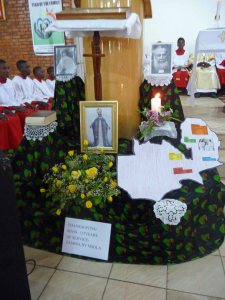
farewell-zambia-feb-2017-04Presentation of Symbols:

The Candle: the light of Christ that has been the guide to our sisters who lived and were missionaries in Zambia.

The Bible, the word of God is core to evangelisation; the word of God is our source of inspiration and strength to carry on the mission entrusted to us.

Cardinal Lavigerie, the founder of our congregation, was convinced that women have a very important role in evangelisation.

Mother Marie Salome, our first Superior General – stood firm in faith to the challenges of the time to see the congregation flourish.

Our Lady of Africa: from the beginning of the Congregation has entrusted itself under the guidance and protection of Mary Our Lady of Africa.

Zambia: Our land of missions – we have loved and still love Zambia with all its people, land, richness and its challenges; we have loved everything about Zambia.

Message to the Catholic Parishioners of Namushakende, Mongu, Zambia.

Final Farewell for Fr. Robert Lavertu in St. Gabriel’s Parish, Namushakende

Alfred_AwogyaBy Alfred Awogya, M.Afr, Namushakende.

Sunday, February 5, 2017, was an emotional day in St. Gabriel’s Parish, Namushakende, as parishioners gathered to bid farewell to their veteran priest, Fr. Robert Lavertu. After 54 gallant years of zealous service in different parts of Zambia Fr. Robert has been called back home to Canada to continue to serve as a missionary. He made his last missionary journey to the Lozi land on Saturday 04/02/2017 to goodbye the people he loves so much. This was his final farewell because a big farewell was organised for him in 2014 both at the diocese and parish levels when he was transferred to work in FENZA, Lusaka.

Robert presided the Sunday Mass in Namushakende, accompanied by Fr. Alfred Awogya and later went to celebrate Mass in the nearest outstation, St. Theresa’s, Namboata. After a few years out of the Lozi milieu, it’s amazing how he managed to celebrate Mass in Silozi and gave inspiring words to the Christians in his homily on his own missionary vocation and experience in Zambia. People had time to express their sentiments of gratitude to him in dramas, poems and songs. They blessed him in the Lozi traditional way by spitting water on him and offering him profound words of thanks and good wishes for the future.

robert-lavertu-mariage-encounter-cupRobert was part of the pioneer Missionaries of Africa group (together with Frs. Charles Obanya and Henry Byamukama) to arrive in Mongu in 2001 to start Namushakende Parish. He worked as pastoral coordinator of the Diocese for 10 years and later served as Parish Priest in Namushakende for two years. In all these years he has been very close to the people of Namushakende. The people remember him for his zeal and passion for the mission, for his closeness to the people and his simplicity, for his push for self-sustainability and for his passion for the Marriage Encounter Program.

Later on Sunday evening, we organised a small “last supper” for him. The Bishop of the Diocese, Evans Chinyemba and a few priests, sisters and church members joined in the celebration. Again, it was marked by deep sense of gratitude for the selfless work of Robert and his dedication to duty. We will miss him dearly. We pray for him and wish him well in his ministry in Canada. He goes but his words and actions lives on in the hearts and lives of the people of Namushakende and Mongu Diocese at large. Mu zamaye hande mutanga’ Mulena. Mulena a mi etelele shangwe.

With a very limited time left, Robert travelled back to Lusaka on Monday after the celebrations. Upon arrival, he sent the following inspiring words in an email addressed to the parishioners of Namushakende.

robert-lavertu-2014By Fr. Robert Lavertu, M.Afr

Being 80 years old with some health problems, the Superiors of the White Fathers in Canada have asked me to go back home. They will offer me some easier kind of work though I would have liked to continue to remain for a few more years in Zambia. That is why I came this weekend from Lusaka to pray with you here in Namushakende for a last time and offer you my farewell.

I am grateful to you and the Catholics of Namboata with whom we celebrated Mass together yesterday February 1st and could offer my goodbye. I would have liked to visit all the Christian communities of this beautiful parish, but it is not possible for lack of time. Indeed, I must prepare my journey home which will be on 14th February. To you all, dear Catholic parishioners, I offer my farewell and assure you of my prayers. I will always remember you and the happy times I was blessed to spend twelve years with you. May our loving God continue to bless you and help you to grow and give Him witness as His beloved children.

old-resident-permit-bNote: Father Lavertu came to Zambia in 1963 and spent most of his missionary life in the Bemba land speaking Chibemba. But he went to Namushakende in 2002 up to 2014 and learn the Silozi language. To say to least, Father Lavertu accomplished a remarkable life as a missionary and learnt in death local cultures making then an important contribution to denounce the vices of witchcraft. He will also be remembered for his great generosity. We wish him a fruitful mission back home to Canada.

2017 Annual Retreat and Sector Assembly, Lusaka, Zambia.

sector-assembly-2017-01c_pngBy Fr. Frederick Tusingire, Director of Lay Apostolate at Uganda Catholic Secretariat, Kampala, Uganda.

The Missionaries of Africa (M.Afr) are very special to me. They have always been. I was baptised by one of them, raised up spiritually and pastorally by them, did my minor and major seminary studies under their guidance and finally my postgraduate studies in their company and with their assistance. I think the M.Afr have been the most privileged missionaries in impacting my country Uganda and indeed the whole continent of Africa.

Their mission gave the Catholic Church the first African priests in modern times (in 1913), the first African bishop south of the Sahara (1939) and when the pope visited Africa for the first time (in 1969) all the four Ugandan bishops whom he ordained were from the M.Afr mission. I believe more of the 12 bishops were from territories evangelised by M.Afr. No doubt the M.Afr have had a very great impact on the Church in Africa.

sector-assembly-2017-14bSo when I was asked by their Zambia Sector to facilitate their Annual Retreat and preside over their Annual Sector Assembly, I came with mixed sentiments of respect and love. I shared as I could and went back to Uganda even more enriched. My two weeks’ stay in the midst of the members of the Zambia Sector gave me an unforgettable experience. The time I spent with them in the retreat at Kasisi Retreat Centre was a great moment of spiritual renewal. The second part with them was the Annual Assembly at FENZA Centre where their various apostolates and the implementation of their 2016 chapter were discussed. For me it was like participating in an assembly where serious evaluation is made and great strategies are laid. I pray these will be implemented with success.

During my stay in Zambia, I also had time to visit various places of their ministry. I am convinced they still have a great contribution to make for the Church in Zambia and for the continent of Africa. May they continue to tread faithfully in the footsteps of the great apostle Cardinal Lavigerie, of their great ancestors and indeed of our Master, Jesus Christ.

My language course experience and my cultural integration in Saint Gabriel Parish, Namushakende, Zambia.

“Nitabile hahulu kuli nakona kubulela silozi.”

“I am very happy to speak Silozi.”

« Je suis très content de parler le lozi. »

jean-marie-vianney-konda-2016-02_jpegBy Jean-Marie Vianney K. Cishugi, stagiaire.

I came to Zambia in July 2016 to follow the “Welcome to Zambia” introductory course in Lusaka. It was not easy for me to communicate efficiently in English. I made an effort to learn and to practise with people who were willing to help me to improve my English. In fact, I got some help from my brothers who were patient enough to correct my mistakes while speaking.

Then, I came in Barotse Land in Western Zambia on the third week of August 2016 in order to start my apostolic training in Saint Gabriel Parish. I was sent to learn the local language Silozi which is a beautiful one with all its grammatical formulations and verbal richness. While learning it, I was also getting acquainted with the Lozi culture. Amazingly, one must clap his hands (ku bulela niitumezi ni kukambelela) to say ‘thank you’. We were four learners to follow the language course at Limulunda for three months.

I came to realise that I have to humble myself if I want to learn a new language.  It took me few weeks to be able to speak a bit. I struggled a lot with my intonation and it took me a lot of courage. Once in a while, l would join my community at Namushakende on Sunday and visit an outstation of our Parish. Initially, l was afraid and shy to speak but I managed to communicate.

I went to Nanjuca, one of our outstations, for my immersion into the language and the culture. I was nicely welcomed in this village. Some people thought that I was there to interact only with Catholics. Slowly, they discovered that I was there for everyone. Children were happy to be with me. I was eating everything they offered me except tortoise (kubu).

I led the service prayer on Sundays. Everybody, children and parents alike, were praying with me though the majority belong to the United Church of Zambia (UCZ) and the New Apostolic Church. I had the trust of Parents who helped me to practise the Silozi language.

I seized this opportunity to deliver a message from Father Venerato Babaine encouraging parents to send their children to school and live together in peace and harmony with other religions.

I had a very fruitful experience and l owe the people a huge debt of gratitude. During my last days in the village, l was really touched by the generosity of the people who came to bid me farewell. Regardless who they are or where they come from, they offered me few presents. People were sad and some burst into tears when Father Christian Muhineza came to pick me up. I felt sad as I had to go.

I am happy to be with the Lozi people and they are pleased when I speak their language.

Niitumezi kaufela a mina (Thank you all) mi mulimu amitohonolofaze (and God bless you)!

Page 11 of 116

Powered by WordPress & Theme by Anders Norén