Category: Publications Page 9 of 41

Various publications; Bulletins, magazines

Nota Pastoral dos Bispos Católicos de Moçambique

Bishop statement Moz. May 2016 titleÀs comunidades cristãs e a todos os homens e mulheres de boa vontade, queremos saudar com as palavras de Jesus Cristo Ressuscitado:“A Paz esteja convosco”.

Nós, os Bispos católicos de Moçambique, reunidos no Centro de Formação de Nazaré, Arquidiocese da Beira, continuamos muito preocupados pela vertiginosa deterioração da vida social, política e económica do nosso país.

Perante o recrudescimento de acções de violência: acusações mútuas, corte de estradas, raptos, esquadrões de morte, com o desaparecimento e assassinato misteriosos de pessoas, enfrentamentos armados com muitas mortes de civis e militares, semeando luto nas nossas famílias, renovamos o apelo que fizemos ao Governo e à Renamo no dia 10 de Novembro de 2015 para o “silêncio absoluto das armas” e para a“urgência dum diálogo eficaz envolvendo as forças vivas da sociedade”. Exortamos igualmente a todos a respeitarmos a vida e a cumprirmos o mandamento do nosso Criador e Senhor: “Não matarás” (Dt5, 17).

Apelamos vivamente a não ficarmos surdos ao grito do povo que noite e dia clama “paz, paz, paz”; e a não ficarmos indiferentes à denúncia de D. Jaime Pedro Gonçalves, grande profeta da paz que disse: “Mesmo que toquem juntos todos os batuques de Moçambique, ninguém ouve”. Com ele afirmamos que é necessário terminar com a retórica e as promessas enganosas, e ter a coragem de dar passos concretos para pôr fim às hostilidades.

Renovamos a nossa solidariedade com todo o povo moçambicano que, apesar destes sinais de morte, vive na esperança de uma autêntica paz. Reiteramos a nossa disponibilidade de buscarmos juntos o caminho da reconciliação, da justiça e da paz.

Convidamos as nossas comunidades cristãs e todos os homens e mulheres de boa vontade para uma jornada especial de oração pela paz e de solidariedade no dia 22 do próximomês de Maio, Solenidade da Santíssima Trindade, Deus Amor e Misericórdia. A colecta deste dia será encaminhada integralmente à Cáritas Nacional para acudir às necessidades dos moçambicanos Refugiados no Campo de Kapise, no Malawi.

Bishop statement Moz. May 2016 signature

Pastoral Letter of the Catholic Bishops of Mozambique

“I heard the clamour of my people… I saw their sufferings” Ez: 3, 7.

We would like to greet all Christian communities and people of good will with the Words of Jesus Christ the Risen One: “Peace be with you.”

We, the Catholic Bishops of Mozambique, gathered in the Formation Centre of Nazaré, in the Archdiocese of Beira, continue to be very much preoccupied by the vertiginous deterioration of the socio-political and economic life of our country.

Faced with the recrudescence of violent actions such as: mutual accusations, the cutting off of roads, rape, death squad, the mysterious disappearing and murdering of people, the armed confrontations with many deaths of civilians and soldiers provoking mourning in our families, we renew the appeal that we made to the Government and RENAMO on the 10th November 2015 to “absolutely set their guns to silence”, to “urgently come to an efficient dialogue involving all the social bodies”. We equally exhort all to respect the dignity of human life and to observe the commandment of our Creator and Lord “You shall not kill” Dt: 5, 17.

We are strongly appealing not to remain deaf to the cry of people who, night and day are shouting, “peace, peace, peace”; not to remain indifferent to the denunciation of the great prophet of peace, the Bishop Jaime Pedro Gonçalves who said, “all the drums of Mozambique may be beaten altogether, no one hears”. With him, we affirm that it is necessary to finish with the rhetoric and the false promises and to have the courage to make some concrete steps to put an end to the hostilities.

We renew our solidarity with the Mozambican people who, despite these signals of death, live in hope of an authentic peace.

We reiterate our availability to search together the way towards reconciliation, justice and justice.

Francisco_J.SilotaWe invite our Christian communities, all men and women of good will for a special day of prayer and solidarity on the 22nd May, Solemnity of the Most Holy Trinity, God who is love and merciful. The collection on this day will be integrally sent to Caritas National to help the Mozambican refugees in Kapise camp in Malawi.

Beira, 11th April 2016

Bishop Francisco Chimoio, Archbishop of Maputo, President of the Episcopal Conference of Mozambique

Translation from Portuguese by Boris Yabre, M.Afr

“Encontraram-se a misericórdia e a fidelidade, abraçaram-se a paz e a justiça” Salmo, 84,10

A Comissão de Justiça e Paz da Diocese da Beira, vem por este meio, convidar a cada um de vocês, a unir-se no dia Sábado 14 de Maio as 20:00 horas em um momento de Oração pela Paz, o Dialogo e a Reconciliação em Moçambique.

Como sinal, convidamos a que nas Vésperas de Pentecostes acendamos uma vela as 20:00 horas em todo Mocambique e alem fronteiras para “ Pedir a Deus que Iluminar Moçambique com as chamas do Espirro Santo”, “Peçamos a Deus que ilumine Moçambique com a Luz da Esperança de que outro Moçambique diferente e possível”. Um Mocambique justo, digno dos filhos e filhas de Deus.

Encontraram-se a misericórdiaOremos a Deus para que Deus Ilumine Moçambique nas vésperas de Pentecostes, unindo-nos em oração; em casa, na festa, na barraca, em qualquer lugar onde esteemos. Vamos unir nossa FE, nossa Esperanza e nosso desejo de um Moçambique que viva na Justiça e na Paz. Não a Guerra sim a Paz. Não a Morte, sim a Vida…

Convide seus amigos pelas redes sociais ou pessoalmente, no serviço, na Igreja… para estar todos em oração nas Vésperas de Pentecostes, a Vinda do Espirito Santo, o Espirito de Justiça e de Paz…

Fraternalmente, Pe Ciprisio (Fidel) Fidel_Salazardel Muro.

Coordenador da Comissão de Justiça e Paz e Integridade da Criação. Missionário de África. PB. Moçambique, Beira.

Book Review: Boucher, Claude (Chisale). When Animals Sing and Spirits Dance Gule Wamkulu: The Great Dance of the Chewa People of Malawi.

Journal of Retracing AfricaClaude Boucher’s When Animals Sing and Spirits Dance Gule Wamkulu: The Great Dance of the Chewa People of Malawi, with additional text from Gary J. Morgan, Director of Museum Studies at Michigan State University, and photographs by Arjen van de Merwe, offers a refreshing, insightful, and brilliant interlink between what could be regarded as artistic compendium and the fundamental spiritual cultural heritage of an African community, the Chewa people of Malawi, in the dynamic context of everyday paradigms of holistic life experiences. Through a drama-laced strategy, the book masterfully employs symbolic characters depicted in masks and woven structures in an analytical syringe of songs and dances to “play out” the realities of cultural philosophical values and communal expectations of the Chewa people.

The crux of the book is revealed in two major sections. The first is the introduction written by Gary Morgan. Here the reader is exposed to the historical background of Malawi in general, the historical origin of gule wamkulu, and the religion of the Chewa people. It also introduces the reader to the role, as well as the form of gule wamkulu characters. The history of the origin of the symbolic and ritual evolution and the eventual transition of the gule wamkulu characters are also extensively discussed. With the introduction, the reader is prepared for the subsequent intriguing and illuminating details to follow in the main section of the book.

The second presents the kernel of the book in seven major themes as “dramatized” through the performances of the gule wamkulu dancers. The themes vividly capture the Chewa people’s worldview on moral codes. The holistic nature of the themes is compelling. They strategically cover the existential instructions for the citizens of the community, such as history and politics; community, authority and ancestors; sexuality, fertility and marriage; childbirth and parenthood; health, food and death; witchcraft and medicines; and personal attributes. The author brilliantly portrays the interpretations and dramatic uses of these themes in ways that vividly represent the authentic voices of the local people that may be impossible to achieve in any other format. Perhaps more importantly, the Chewa people’s heritage of the spiritual linkage to the ancestral world, in which the ancestors continue to impact their living descendants as agents of societal moral standard, is substantially highlighted. This without any doubt constitutes a significant representation of the fundamental religious worldview of Africans on the circular nature of human existence and the “never ending” reciprocal obligations and privileges between the living and the living dead, i.e. the earthly and the spiritual domains.

I find the intellectual and communicative strengths of this book enormous. It is comprehensively researched and the author admirably subsumes his subjective considerations of the themes discussed and allows the voices of the Chewa people to be heard in their “undiluted” forms. The colorful illustration employed throughout the book definitely enhances the reader’s imaginative and empirical understanding. The images are compelling and make the reading of the book engaging and less cumbersome. Also, both the mask name and the theme indexes at the end of the book provide the much-needed information on the locations of prominent words and ideas. In addition, the glossary of Chichewa terms and the interpretations of the songs in Chichewa and English afford the reader, who may not speak the Chichewa language, the basic understanding of the contents.

Surprisingly, with the author having a background as a Catholic priest, I did not find an interfaith discourse that I believe would have positively linked the moral codes of instructions of the Chewa thematic worldviews with the Christian (Catholic) moral expectations in the inculturalization spirit of Vatican II. This I believe would have raised the profile of the book as a doctrinal literature in the promotion of African Christianity (perhaps I was looking for too much) given the focus, objectives, and scope of the book. Notwithstanding this critique, the book presents a formidable resource as a “hypothesis” ready for further scholarly research for those interested in the rich African spiritual heritage in the context of existential humanity. In this regard, the book attests to the 2005 UNESCO description of gule wamkulu as “a masterpiece of the oral and intangible heritage of humanity.” On the whole, Boucher deserves to be applauded for his scholarly endeavor in writing this book.

Ibigbolade Aderibigbe, Associate Professor of Religion and African Studies, University of Georgia, Athens, GA

CLICK HERE TO READ THE PDF FILE OF THIS ARTICLE

Journal of Retracing Africa web page

Mafrwestafrica – Lettre du 2 mai 2016

Mafrwestafrica logoAujourd’hui, les Missionnaires d’Afrique de l’Ouest vous proposent de visiter de nouvelles pages sur leur site www.mafrwestafrica.net :

Dans la rubrique « Actualités » :

« Lettre de Ghardaia, 27 avril 2016 » la dernière lettre rédigée par notre confrère Claude Rault, évêque de Laghouat Ghardaia au Sahara (lire la suite)

« Côte d’Ivoire le 1er mai ». Le président Alassane Ouattara s’est adressé aux ivoiriens ce dimanche 1er mai pour tenter de calmer la grogne (lire la suite)

Dans la rubrique « Témoignages » :

« Le clergé africain, essentiel » cet article paru dans Voix d’Afrique et écrit par le père Jean Claude Ceillier nous rappelle combien Lavigerie tenait à ce que l’Afrique soit évangélisée par les africains (lire la suite)

« Frère au milieu des Pères » : le frère Jan Heuft, hollandais, vivant en Algérie, témoigne que ce qui compte ce n’est pas d’être frère ou père, mais bien missionnaire (lire la suite)

« Des livres à découvrir », trois livres présentés sur le site de l’ARCRE, et portant surtout sur le dialogue interreligieux(lire la suite)

Dans la rubrique « Dialogue interreligieux » :

« Débats sur l’Islam extrémiste » : trois articles publiés sur le site de l’ARCRE le 22 avril 2016. (lire la suite)

« Le dialogue nécessaire », ce texte étant publié dans le numéro de Voix d’Afrique 110 par le père Jean Bipendo, formateur dans notre maison d’Abidjan (lire la suite)

« Tibéhirine 20 ans après » c’est le 21 mai 1996 qu’étaient assassinés ces sept moines trappistes qui avaient fait du dialogue le sens de leur vie (lire la suite)

Dans la rubrique « Justice et Paix » :

« Qui est Vincent Bolloré ? » un texte de l’émission « Complément d’enquête » du 7 avril 2016 donne un éclairage plus que mitigé au sujet de cette personne : l’Afrique serait-elle son nouveau « terrain de jeu » ? (lire la suite)

Dans la rubrique « Vu au sud, vu du sud » :

« Le coton Burkinabè perd son label » un article publié sur le site « abcburkina.net » du SEDELAN (lire la suite)

Newsletter South Africa No 62 – 29th April 2016

Newsletter South Africa No 62 titleGreetings! I hope you are keeping well and that this month has been an occasion to reflect and pray more on your vocation. On April 17, the fourth Sunday of Easter, the Church celebrated the 53rd World Day of Prayer for Vocations. This year’s theme was: “The Church, Mother of Vocations”. Pope Francis wrote: ‘Each vocation in the Church has its origin in the compassionate gaze of Jesus.’ The Church – and don`t forget: you/we are the Church – is where vocations take their root. Pope Francis also writes in his message for Vocation Sunday: Vocations are born within the Church… Vocations grow within the Church… and… Vocations are sustained by the Church. If you belong to a lively and prayerful parish, you can discover your vocation in the context of that community: get involved in it and have regular contacts with your priest. Are you active in your parish community? Are you committed in helping its growth in one way or the other? If you find that your parish is not lively enough, talk with your priest and with elders of your community, get other youths together and DO something about it! This is a good way to be a missionary!

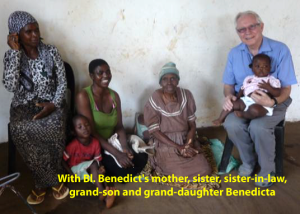
From 25th to 27th of this month, I went to Thohoyandou in Limpopo to enquire and learn more about the life and death of Blessed Benedict Daswa. Indeed, last year when he was beatified on 13th September 2015, I was not able to go. I was very lucky to stay over with Blessed Benedict’s cousin who knew him very well. On the second day, we were joined by Sister Claudette, who, with a team of lay people, worked very hard to promote Benedict’s beatification. With the two of them, I had the chance to visit all the places where Benedict lived, taught and became a headmaster. We celebrated Mass in the small church which he built with the help of his learners and the local Christians. I met also many members of his family, some of his children and especially his dear mother who is now 90 years old. Blessed Daswa left a very memorable souvenir in the minds and hearts of most people not only of his area, but also of the whole of South Africa. He was a real saint who lived his catholic faith to the end, even to accepting death. He always fought for truth, and we all know that he died for having opposed witchcraft which causes so much harm in society.

Newsletter South Africa No 62 picturebWhat is interesting about Benedict is that he was a very ordinary boy who grew up in a remote village of Limpopo in a very loving family; he was baptised as a catholic only when he was 17 years old he became a teacher, got married and fathered eight children. He became a real leader in his village, always guided by his catholic faith in action, and not only in words. He had a great love for all people, especially the youth whom he trained to become real good Christians and citizens. He can be a real inspiration and role model for each one of us. Pray through his intercession; ask him to help you discover your Christian vocation.

Keep well and keep smiling! God bless you! Fr. Michael Meunier, M.Afr

Eur-Echo May 2016

Euro-Echo May 2016Euro-Echo May b2016

EURO-ECHO SUMMER 2016 PDF FILE IN ENGLISH

EURO-ECHO ETE 2016 PDF FILE IN FRENCH

Mafrwestafrica – Lettre du 17 avril 2016

Mafrwestafrica logoAujourd’hui, les Missionnaires d’Afrique de l’Ouest vous proposent de visiter de nouvelles pages sur leur site www.mafrwestafrica.net :

 Dans la rubrique « Actualités » :
« Wilbert Gobbo, docteur en théologie » le père Gobbo, Tanzanien, vient de réussir sa thèse en théologie et nous sommes heureux de publier quelques photos(lire la suite)
« Nouvelles de Mauritanie », publication de la dernière lettre du diocèse de Nouakchott(lire la suite)
« Lettre de Laghouat Ghardaia, mars 2016. » les dernières nouvelles de ce diocèse dont notre confrère Mgr Claude Rault est l’évêque(lire la suite)

Dans la rubrique « Témoignages » :
« Nouvelles de Tema Bokin » un texte envoyé par le curé de cette paroisse du diocèse de Kaya, paroisse qui va fêter son cinquantenaire (lire la suite)

Dans la rubrique « Dialogue interreligieux » :
« Islam et christianisme » la présentation de deux livres et une allusion au fait que Marie est vénérée par l’Islam et le christianisme comme Vierge et Mère de Jésus. (lire la suite)

Dans la rubrique « Justice et Paix » :
« Protection des enfants » le Père Stéphane Joulain, qui est maintenant à Rome, y est « Coordinateur à l’Intégrité du Ministère ».
 (lire la suite)
« Le Pape François et les migrants » tout particulièrement lors de sa visite toute récente en Grèce, le pape pose des gestes significatifs (lire la suite)

Dans la rubrique « Vu au sud, vu du sud » :
« Le Tchad » et les nouvelles prises sur le site de RFI au sujet des élections qui y sont contestées par une partie de la population. (lire la suite)
« Les premiers africains chez les Missionnaires d’Afrique » un article publié par le Père Dominique Arnauld dans Voix d’Afrique n° 110 (lire la suite)
« Eglise d’Afrique du Nord et Subsaharienne » les mouvements de population ne sont sans doute pas étrangers au fait que la prochaine conférence de la CERNA se tiendra au Sénagal (lire la suite)


Invitation card for the Missionary Oath in Jerusalem, April 16, 2016.

Final Oath Jerusalem April 2016From Hervé Tougma.

I am sending you our invitation card for the Missionary Oath that is taking place next week on 16th April in Jerusalem in the presence of Fr Jos Van Boxtel, M.Afr. Thanks for your prayers and support!

Mafrwestafrica – Lettre du 1er avril 2016

Mafrwestafrica logoAujourd’hui, les Missionnaires d’Afrique de l’Ouest vous proposent de visiter de nouvelles pages sur leur site www.mafrwestafrica.net :

Dans la rubrique « Actualités » : « Baobab Echos n° 25 » la dernière édition du bulletin de la Province d’Afrique de l’Ouest (lire la suite)

« Liste des confrères travaillant dans la Province d’Afrique de l’Ouest » au mois de mars 2016, ainsi que leurs téléphones et adresses internet(lire la suite)

« Liste actualisée des confrères originaires de la P.A.O. » avec un lien pour avoir accès aux adresses internets et téléphones portables (lire la suite)

Dans la rubrique « Témoignages » : « Albert Kondemodre, diacre » le témoignage de l’un des trois diacres originaires de la PAO, qui termine ses études à Merrivale en Afrique du Sud (lire la suite)

« Année spirituelle à Bobo-Dioulasso », un texte de l’un des formateurs présents dans cette maison de formation à Samagan (lire la suite)

« 24 mars, journée des martyrs », un texte pris sur l’Agence « Fides » et qui parle de cette journée choisie pour faire mémoire des missionnaires martyrs (lire la suite)

« Lettre d’Algérie du Père Aldo Giannasi » qui explique le travail qui est le sien et témoigne de la présence bien évidente de missionnaires venant de la P.A.O, qu’il s’agisse de sœurs ou de prêtres.(lire la suite)

Dans la rubrique « Dialogue interreligieux » : « Sur le site de l’ARCRE » trois articles pris sur le site de l’Action pour la Rencontre des Cultures et des Religions en Europe (lire la suite) 

« Sérénité dans un dialogue en vérité » trois articles ayant pour source le journal « La Croix » (lire la suite)

Dans la rubrique « Justice et Paix » : « Comment vivre en produisant du lait ? » un nouvel article sur le site « abcburkina.net » qui fait prendre conscience de l’exploitation des producteurs laitiers. (lire la suite)

Dans la rubrique « Vu au sud, vu du sud » : « Milices populaires au Burkina » sur le site du journal « Le Monde » cet article parlant des milices populaires dans les campagnes du Burkina. (lire la suite)

Article about Kungoni Centre for Culture and Art published in the magazine The Eye, March – May 2016, Malawi.

Kungoni Theeye March 2016 01By Richard Hewitt, Kamuzu Academy

Later this year, on 2nd November, Kungoni Centre of Culture and Art will celebrate its fortieth anniversary. Mua Mission (between Salima and Balaka / Mangochi, just off the Lakeshore road), where Kungoni Centre is situated, dates further back, to 1902: its church, mission house, schools (including a deaf school) and hospital are significant institutions in their own right. However, it is Claude Boucher, now in his seventy-sixth year, and originally from Canada, who has made Mua distinctive among other religious missions in Malawi, and a necessary part of the itinerary of any visitor to Malawi with cultural and artistic interest.

Claude Boucher (himself an artist) attracted to Mua a number of artists (mostly carvers, but also painters and potters) to form what is now Kungoni Centre. The quality and invention of their work have won just renown, not only throughout Malawi but also across Africa and the world. It is in many styles: Christian and traditional (Chewa, Ngoni and Yao), offering not least a cheerful and satirical, sometime insightful, commentary on life in rural Malawi; but it is perhaps most stimulating to observe the attempt to translate ideas learned from missionaries into local idiom. Christ of the Kungoni Centre is definitely an African! The artists’ work is available for sale either at Kungoni Centre’s art gallery and showroom or at Lakeshore lodges and outlets in Blantyre and Lilongwe. Commissions are also accepted.

Kungoni Centre is famous also for the Chamare Museum, which must count among the most insightful ethnographic museums in southern Africa, and for its cultural troupe, which performs traditional dance not only for visitors to Kungoni Centre but as far afield as the Nc’wala Ceremony in Zambia. Last August Kungoni Centre came to national attention when, as part of its annual Open Day, it staged a play, incorporating Gule Wamkulu, which related the environmental devastation that is being worked in Malawi to the Chewa myth of creation. If you have not made the journey to Kungoni Centre, come to see what it has to offer; and be sure to spend a night at Namalikhate lodge, where the chalets are themselves works of art!

As Kungoni Centre began to reflect on forty years of achievement, it seemed right for a small body of friends to attempt the record of what will otherwise be lost together with its oral memory: we call this work the Kungoni Art Project. We have (thus far) collected the biographies of over 220 artists who have lived and worked at Kungoni Centre (incorporating often several generations of the same family); and have recorded some 3500 examples of their work throughout Malawi and in over twenty other countries. The variety of subject and approach is extraordinary, but time is running out! On the night of 15th November 2015 the church at Nyungwe (between Blantyre and Zomba) burned down: it was a fine example of Kungoni work dating back to the 1980’s; and it contained paintings by Claude Boucher and his (now deceased) collaborator P. Tambala Mponyani. It is fortunate that we had already recorded Nyungwe, but there is other work that is known only from old photographs or can be reconstructed only from Claude Boucher’s written notes and memory; and time, neglect and theft have all too often exacted their toll on what remains.

Our purpose is to create an archive of material, which will extend from Claude Boucher’s earliest artwork in his native Canada in the 1950’s, through his arrival in Malawi in 1967 and his encounter with the men who would become Kungoni Centre’s first artists, to the four decades of activity, each with their own emphases, that succeeded the establishment of Kungoni Centre in 1976.  CLICK HERE TO READ MORE – PDF FILE

Page 9 of 41

Powered by WordPress & Theme by Anders Norén