
 ISTANBUL – Hürriyet Daily News
United Nations Office on Drugs and Crime says almost every country in the world is complicit in human trafficking, urging them to fight against it
Almost every country in the world is complicit in human trafficking, as each one is an origin, transit or destination country for the trade, the executive director of the United Nations Office on Drugs and Crime (UNODC), Yury Fedotov, has said, adding that the victims of the crime are being exploited in almost every part of the world. (…)
Turkey a transit route
However, Fedotov heralded some good news, as the number of countries criminalizing human trafficking increased from 78 to 95 percent of the total considered in the report between 2008 and 2012. “The improvements are encouraging, but they are coming too slowly to help the millions of victims. A catalyst is needed. We need an inspirational, but totally realistic goal: a decade of concrete action to try to end human trafficking. Action built on cooperation and coordination,” he said. READ MORE
ISTANBUL – Hürriyet Daily News
United Nations Office on Drugs and Crime says almost every country in the world is complicit in human trafficking, urging them to fight against it
Almost every country in the world is complicit in human trafficking, as each one is an origin, transit or destination country for the trade, the executive director of the United Nations Office on Drugs and Crime (UNODC), Yury Fedotov, has said, adding that the victims of the crime are being exploited in almost every part of the world. (…)
Turkey a transit route
However, Fedotov heralded some good news, as the number of countries criminalizing human trafficking increased from 78 to 95 percent of the total considered in the report between 2008 and 2012. “The improvements are encouraging, but they are coming too slowly to help the millions of victims. A catalyst is needed. We need an inspirational, but totally realistic goal: a decade of concrete action to try to end human trafficking. Action built on cooperation and coordination,” he said. READ MORE
Category: Justice and Peace Page 4 of 6
125th Anniversary Antislavery Campaign – Bulletin of Justice and Peace, Rome
ISTANBUL – Hürriyet Daily News
United Nations Office on Drugs and Crime says almost every country in the world is complicit in human trafficking, urging them to fight against it
Almost every country in the world is complicit in human trafficking, as each one is an origin, transit or destination country for the trade, the executive director of the United Nations Office on Drugs and Crime (UNODC), Yury Fedotov, has said, adding that the victims of the crime are being exploited in almost every part of the world. (…)
Turkey a transit route
However, Fedotov heralded some good news, as the number of countries criminalizing human trafficking increased from 78 to 95 percent of the total considered in the report between 2008 and 2012. “The improvements are encouraging, but they are coming too slowly to help the millions of victims. A catalyst is needed. We need an inspirational, but totally realistic goal: a decade of concrete action to try to end human trafficking. Action built on cooperation and coordination,” he said. READ MORE
 New interview of the antislavery campaign with the Iranian Muslim scholar Seyed Amir Akrami
Amir shares with us his understanding of how Islam faces the challenge of slavery in its old and modern force. He says that “Muhammad was not able to eradicate or abolish the institution of slavery because that was tantamount to making such a radical revolution in his society that his time was not prepared for it. (…) It would be anachronistic to expect the Prophet of Islam to abolish slavery in his time. Drastic social or political changes need time and the confluence of many historical factors and elements to make it possible for them to occur (…) To me the fact that the Prophet of Islam was not able to abolish slavery is not problematic at all but what is problematic is for a Muslim individual or society in our time to argue from that historical fact for the impossibility or undesirability of abolishing slavery in Muslim societies now.”
Amir talks about the challenge faced by religious minorities in Muslim countries, also the situation of women when saying that “injustice or discrimination against women in many societies, and especially in Muslim countries, are modern forms of slavery that we need to be abolished.” He invites us to welcome the mystical tradition of Islam so to be enriched again by its core values.
READ MORE
New interview of the antislavery campaign with the Iranian Muslim scholar Seyed Amir Akrami
Amir shares with us his understanding of how Islam faces the challenge of slavery in its old and modern force. He says that “Muhammad was not able to eradicate or abolish the institution of slavery because that was tantamount to making such a radical revolution in his society that his time was not prepared for it. (…) It would be anachronistic to expect the Prophet of Islam to abolish slavery in his time. Drastic social or political changes need time and the confluence of many historical factors and elements to make it possible for them to occur (…) To me the fact that the Prophet of Islam was not able to abolish slavery is not problematic at all but what is problematic is for a Muslim individual or society in our time to argue from that historical fact for the impossibility or undesirability of abolishing slavery in Muslim societies now.”
Amir talks about the challenge faced by religious minorities in Muslim countries, also the situation of women when saying that “injustice or discrimination against women in many societies, and especially in Muslim countries, are modern forms of slavery that we need to be abolished.” He invites us to welcome the mystical tradition of Islam so to be enriched again by its core values.
READ MORE
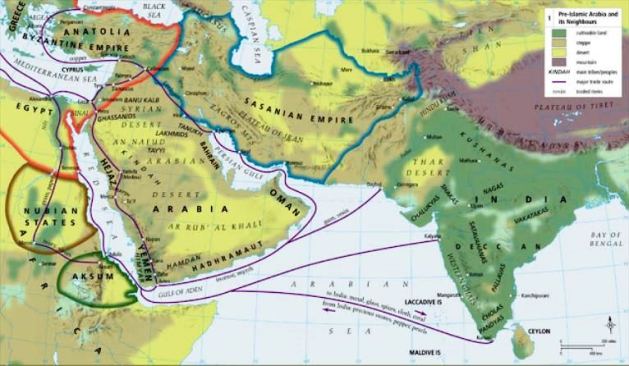 Pre-Islamic Arabia, including trade routes


Main slave trade routes in the Medieval Age

Slave Trade
Des millions d’enfants forcés de travailler comme domestiques dans le monde
Plus de 10,5 millions d’enfants de 5 à 17 ans travaillent comme domestiques dans le monde dans des conditions qui s’apparentent parfois à de l’esclavage, rapporte le Bureau international du travail (BIT). Une situation qu’a dénoncée avec force mercredi le pape François, au Vatican.
 Selon l’organisme BIT basé à Genève, qui a publié ces données mardi, à la veille de la Journée mondiale contre le travail des enfants, ces millions d’enfants employés par des particuliers constituent une main-d’œuvre vulnérable régulièrement soumise à des sévices physiques et psychologiques de toutes sortes.
« Ces enfants sont loin de leurs familles, ils sont isolés et sont en état de grande dépendance », a expliqué à l’Agence France-Presse la directrice du programme du BIT pour l’abolition du travail des enfants, Constance Thomas.
« Ils travaillent énormément d’heures, n’ont aucune liberté personnelle, et ce travail est le plus souvent clandestin. » — Constance Thomas, directrice du programme du BIT pour l’abolition du travail des enfants
« Tous les enfants doivent pouvoir jouer, étudier, prier et croître, dans leurs propres familles, dans un milieu harmonieux, d’amour et de sérénité : c’est leur droit et c’est notre devoir. » — Le pape François LIRE LA SUITE
Selon l’organisme BIT basé à Genève, qui a publié ces données mardi, à la veille de la Journée mondiale contre le travail des enfants, ces millions d’enfants employés par des particuliers constituent une main-d’œuvre vulnérable régulièrement soumise à des sévices physiques et psychologiques de toutes sortes.
« Ces enfants sont loin de leurs familles, ils sont isolés et sont en état de grande dépendance », a expliqué à l’Agence France-Presse la directrice du programme du BIT pour l’abolition du travail des enfants, Constance Thomas.
« Ils travaillent énormément d’heures, n’ont aucune liberté personnelle, et ce travail est le plus souvent clandestin. » — Constance Thomas, directrice du programme du BIT pour l’abolition du travail des enfants
« Tous les enfants doivent pouvoir jouer, étudier, prier et croître, dans leurs propres familles, dans un milieu harmonieux, d’amour et de sérénité : c’est leur droit et c’est notre devoir. » — Le pape François LIRE LA SUITE
 Ten million child labourers in domestic work
Millions of children worldwide work as domestic labourers, many of them in slavery-like conditions. New report on domestic work within the framework of the two International Labour Organisation (ILO) fundamental conventions on child labour and the recently adopted instruments on decent work for domestic workers.
Ten million child labourers in domestic work
Millions of children worldwide work as domestic labourers, many of them in slavery-like conditions. New report on domestic work within the framework of the two International Labour Organisation (ILO) fundamental conventions on child labour and the recently adopted instruments on decent work for domestic workers.
Selon l’organisme BIT basé à Genève, qui a publié ces données mardi, à la veille de la Journée mondiale contre le travail des enfants, ces millions d’enfants employés par des particuliers constituent une main-d’œuvre vulnérable régulièrement soumise à des sévices physiques et psychologiques de toutes sortes.
« Ces enfants sont loin de leurs familles, ils sont isolés et sont en état de grande dépendance », a expliqué à l’Agence France-Presse la directrice du programme du BIT pour l’abolition du travail des enfants, Constance Thomas.
« Ils travaillent énormément d’heures, n’ont aucune liberté personnelle, et ce travail est le plus souvent clandestin. » — Constance Thomas, directrice du programme du BIT pour l’abolition du travail des enfants
« Tous les enfants doivent pouvoir jouer, étudier, prier et croître, dans leurs propres familles, dans un milieu harmonieux, d’amour et de sérénité : c’est leur droit et c’est notre devoir. » — Le pape François LIRE LA SUITETen million child labourers in domestic work
Millions of children worldwide work as domestic labourers, many of them in slavery-like conditions. New report on domestic work within the framework of the two International Labour Organisation (ILO) fundamental conventions on child labour and the recently adopted instruments on decent work for domestic workers.
-

- De jeunes Indiens manifestent contre le travail des enfants. Photo : AFP/RAVI RAVEENDRAN
-

- Des jeunes filles manifestent contre le travail forcé et la déportation au Bangladesh. Photo : AFP/JEWEL SAMAD
-

- Des fillettes au travail en Inde. Photo : IS/iStock
-

- Child labour: http://www.ilo.org/ipecinfo/product/download.do?type=document&id=21515
-

- Child labour: http://www.ilo.org/ipecinfo/product/download.do?type=document&id=21515
-

- Child labour: http://www.ilo.org/ipecinfo/product/download.do?type=document&id=21515
-

- Child labour: http://www.ilo.org/ipecinfo/product/download.do?type=document&id=21515
-

- Child labour: http://www.ilo.org/ipecinfo/product/download.do?type=document&id=21515
-

- Child labour: http://www.ilo.org/ipecinfo/product/download.do?type=document&id=21515
-

- Child labour: http://www.ilo.org/ipecinfo/product/download.do?type=document&id=21515
-

- Child labour: http://www.ilo.org/ipecinfo/product/download.do?type=document&id=21515
-

- Child labour: http://www.ilo.org/ipecinfo/product/download.do?type=document&id=21515
-

- Child labour: http://www.ilo.org/ipecinfo/product/download.do?type=document&id=21515
-

- Child labour: http://www.ilo.org/ipecinfo/product/download.do?type=document&id=21515
 They called their slave Inboekselings
In those stormy years between 1830s and 1850s the majority of Voortrekkers in the Transvaal were involved in a reprehensible though highly profitable occupation: the kidnapping of African children. It was a practice that sparked waves of terror in African homesteads. READ MORE
Slavery at the Cape
Jan Van Riebeck set foot at the Cape on 6 April 1652. His instructions from the Dutch East India Company were clear: he was forbidden to enslave the indigenous people of the Cape. However, slaves from elsewhere were another matter and in May 1652, only weeks after arriving at Table Bay, he asked for slaves to be sent to help erect the fort and till the land. For the first five years the only slaves at the Cape were stowaways or gifts from the captains of passing ships. In 1658 there were 11 slaves, eight women and three men.(…)
They called their slave Inboekselings
In those stormy years between 1830s and 1850s the majority of Voortrekkers in the Transvaal were involved in a reprehensible though highly profitable occupation: the kidnapping of African children. It was a practice that sparked waves of terror in African homesteads. READ MORE
Slavery at the Cape
Jan Van Riebeck set foot at the Cape on 6 April 1652. His instructions from the Dutch East India Company were clear: he was forbidden to enslave the indigenous people of the Cape. However, slaves from elsewhere were another matter and in May 1652, only weeks after arriving at Table Bay, he asked for slaves to be sent to help erect the fort and till the land. For the first five years the only slaves at the Cape were stowaways or gifts from the captains of passing ships. In 1658 there were 11 slaves, eight women and three men.(…)
 Slavery – the imposition of enforced servitude by a powerful group on another group – inevitably breeds fear in both groups, and resentment in the oppressed. There was also tension among the whites, who constantly feared a mass rebellion and death at the hand of a slave. There was always the fear that slaves who had run away might return to rob and kill, and so large rewards were offered for their recapture. READ MORE
Thanks to Didier Lemaire, M.Afr for sharing those articles with us.
 FENZA CONFERENCE …. FENZA CONFERENCE
Saturday, 22nd June 2013
Venue: Faith and Encounter Centre (FENZA),
Leopards Hill Road, Bauleni (near Mathia Mulumba Catholic Church or Yatsani Radio)
Time: 14:00 to 17:00 hours
Theme: Challenges of implementing Shariah Law in Modern Times
We have invited experts in Secular Law and Islamic Law (Dr Pamela Towela Nsambo, UNZA; Dr Sheick Twaha O. Chiwala, Imam; Fr. Felix Phiri, Scholar of Islamic Studies) to trigger off the discussion.
Governing the whole of Muslim life, in all places and at all times, is the God given law, the Shariah. In today’s globalized world, Muslims have to co-exist with the awareness that there are other inhabitants of the earth who are governed by laws different from theirs. Its all-encompassing nature and some manifestations of some of its laws – generally perceived by non-Muslims as extreme and incompatible with modernity – have widely generated prejudiced fear and suspicion not only among non-Muslims but also among some liberal Muslims.
In view of helping to understand the key issues preoccupying both sides of the divide, and in line with its goals – empowering Christians in Zambia to face the challenges of contemporary and traditional cultures with openness and to encounter people of different Christian denominations, contemporary religious movements and religions – FENZA will be organizing a Conference / Discussion on the 22nd of June, from 14.00hrs to 17.00hrs.
The theme of the conference will be: Challenges of Implementing Shariah Law in Modern Times.
It will be a threefold presentation: the first presentation by Dr Pamela Towela Nsambo, a full-time lecturer in the school of law at UNZA, will provide the general framework within which laws are generally understood in modern secular societies.
To provide a summary of the Muslim self-understanding of Shariah law will be Dr Sheikh Twaha O. Chiwala, an Islamic scholar of Shariah law, a Mufti and currently Imam of Taqwa and other mosques in Lusaka.
FENZA CONFERENCE …. FENZA CONFERENCE
Saturday, 22nd June 2013
Venue: Faith and Encounter Centre (FENZA),
Leopards Hill Road, Bauleni (near Mathia Mulumba Catholic Church or Yatsani Radio)
Time: 14:00 to 17:00 hours
Theme: Challenges of implementing Shariah Law in Modern Times
We have invited experts in Secular Law and Islamic Law (Dr Pamela Towela Nsambo, UNZA; Dr Sheick Twaha O. Chiwala, Imam; Fr. Felix Phiri, Scholar of Islamic Studies) to trigger off the discussion.
Governing the whole of Muslim life, in all places and at all times, is the God given law, the Shariah. In today’s globalized world, Muslims have to co-exist with the awareness that there are other inhabitants of the earth who are governed by laws different from theirs. Its all-encompassing nature and some manifestations of some of its laws – generally perceived by non-Muslims as extreme and incompatible with modernity – have widely generated prejudiced fear and suspicion not only among non-Muslims but also among some liberal Muslims.
In view of helping to understand the key issues preoccupying both sides of the divide, and in line with its goals – empowering Christians in Zambia to face the challenges of contemporary and traditional cultures with openness and to encounter people of different Christian denominations, contemporary religious movements and religions – FENZA will be organizing a Conference / Discussion on the 22nd of June, from 14.00hrs to 17.00hrs.
The theme of the conference will be: Challenges of Implementing Shariah Law in Modern Times.
It will be a threefold presentation: the first presentation by Dr Pamela Towela Nsambo, a full-time lecturer in the school of law at UNZA, will provide the general framework within which laws are generally understood in modern secular societies.
To provide a summary of the Muslim self-understanding of Shariah law will be Dr Sheikh Twaha O. Chiwala, an Islamic scholar of Shariah law, a Mufti and currently Imam of Taqwa and other mosques in Lusaka.
Finally, Fr. Felix J. Phiri, member of the FENZA team and scholar of Islamic studies, will highlight a number of ways in which the implementation of Shariah law is effectively a challenge to modern Society. The three presentations will be followed by the opening of the discussion to the audience, through questions, answers and personal contributions to the debate.
 By Dave Cullen, M.Afr
The Association of Religious Men of Zambia (ARMZ) here in Chipata decided that on the occasion of a meeting of members to elect a new executive it would be fitting at the same time to hold a day’s workshop on ‘Slavery in our midst’. It was our way of linking up with the 125th anniversary of Cardinal Lavigerie’s tour of Europe to campaign for the end of slavery as also to commemorate the birth of Livingstone 200 years ago.
there were 12 members of ARMZ present at the workshop, 4 of them Missionaries of Africa. Others who accepted our invitation to attend were 2 representatives from five Sister’s Congregations, 2 Dutch volunteers very much concerned with helping prostitutes in Chipata plus representatives from the local clergy, Caritas and Radio Maria. There were four very good presentations, on prostitution, street kids, child labour in rural areas and exploitation of the vulnerable through cheap labour. After each presentation there was group sharing on just one question: what can we do to overcome these forms of slavery in our midst? Hopefully we will take up the challenges presented and work through such bodies as ZAS, Caritas, NGO’s as well as those groups and individuals who show particular concern in these areas, amongst them presenters of these problems to us who were clearly concerned and actively committed to find solutions.
We shall hold another meeting next year at which we shall ask: what did you actually do about those resolutions you took at last year’s workshop? Hopefully there will be some positive progress recorded. If there is we shall share the good news with you.
By Dave Cullen, M.Afr
The Association of Religious Men of Zambia (ARMZ) here in Chipata decided that on the occasion of a meeting of members to elect a new executive it would be fitting at the same time to hold a day’s workshop on ‘Slavery in our midst’. It was our way of linking up with the 125th anniversary of Cardinal Lavigerie’s tour of Europe to campaign for the end of slavery as also to commemorate the birth of Livingstone 200 years ago.
there were 12 members of ARMZ present at the workshop, 4 of them Missionaries of Africa. Others who accepted our invitation to attend were 2 representatives from five Sister’s Congregations, 2 Dutch volunteers very much concerned with helping prostitutes in Chipata plus representatives from the local clergy, Caritas and Radio Maria. There were four very good presentations, on prostitution, street kids, child labour in rural areas and exploitation of the vulnerable through cheap labour. After each presentation there was group sharing on just one question: what can we do to overcome these forms of slavery in our midst? Hopefully we will take up the challenges presented and work through such bodies as ZAS, Caritas, NGO’s as well as those groups and individuals who show particular concern in these areas, amongst them presenters of these problems to us who were clearly concerned and actively committed to find solutions.
We shall hold another meeting next year at which we shall ask: what did you actually do about those resolutions you took at last year’s workshop? Hopefully there will be some positive progress recorded. If there is we shall share the good news with you.
 Quotations from the address:
… Consequently the financial crisis which we are experiencing makes us forget that its ultimate origin is to be found in a profound human crisis. In the denial of the primacy of human beings! We have created new idols. The worship of the golden calf of old (cf. Ex 32:15-34) has found a new and heartless image in the cult of money and the dictatorship of an economy which is faceless and lacking any truly humane goal.
The worldwide financial and economic crisis seems to highlight their distortions and above all the gravely deficient human perspective, which reduces man to one of his needs alone, namely, consumption. Worse yet, human beings themselves are nowadays considered as consumer goods which can be used and thrown away. We have started a throw-away culture. This tendency is seen on the level of individuals and whole societies; and it is being promoted! In circumstances like these, solidarity, which is the treasure of the poor, is often considered counterproductive, opposed to the logic of finance and the economy. While the income of a minority is increasing exponentially, that of the majority is crumbling. This imbalance results from ideologies which uphold the absolute autonomy of markets and financial speculation, and thus deny the right of control to States, which are themselves charged with providing for the common good. A new, invisible and at times virtual, tyranny is established, one which unilaterally and irremediably imposes its own laws and rules. Moreover, indebtedness and credit distance countries from their real economy and citizens from their real buying power. Added to this, as if it were needed, is widespread corruption and selfish fiscal evasion which have taken on worldwide dimensions. The will to power and of possession has become limitless…
… there is a need for financial reform along ethical lines that would produce in its turn an economic reform to benefit everyone. This would nevertheless require a courageous change of attitude on the part of political leaders. I urge them to face this challenge with determination and farsightedness, taking account, naturally, of their particular situations. Money has to serve, not to rule! The Pope loves everyone, rich and poor alike, but the Pope has the duty, in Christ’s name, to remind the rich to help the poor, to respect them, to promote them. The Pope appeals for disinterested solidarity and for a return to person-centred ethics in the world of finance and economics…
FULL ADDRESS
ALSO
Pope Francis Shakes up the Ambassadors Meeting and Addresses Economic Issues
Discours du Pape François au sujet de la dictature de l’économie
Quotations from the address:
… Consequently the financial crisis which we are experiencing makes us forget that its ultimate origin is to be found in a profound human crisis. In the denial of the primacy of human beings! We have created new idols. The worship of the golden calf of old (cf. Ex 32:15-34) has found a new and heartless image in the cult of money and the dictatorship of an economy which is faceless and lacking any truly humane goal.
The worldwide financial and economic crisis seems to highlight their distortions and above all the gravely deficient human perspective, which reduces man to one of his needs alone, namely, consumption. Worse yet, human beings themselves are nowadays considered as consumer goods which can be used and thrown away. We have started a throw-away culture. This tendency is seen on the level of individuals and whole societies; and it is being promoted! In circumstances like these, solidarity, which is the treasure of the poor, is often considered counterproductive, opposed to the logic of finance and the economy. While the income of a minority is increasing exponentially, that of the majority is crumbling. This imbalance results from ideologies which uphold the absolute autonomy of markets and financial speculation, and thus deny the right of control to States, which are themselves charged with providing for the common good. A new, invisible and at times virtual, tyranny is established, one which unilaterally and irremediably imposes its own laws and rules. Moreover, indebtedness and credit distance countries from their real economy and citizens from their real buying power. Added to this, as if it were needed, is widespread corruption and selfish fiscal evasion which have taken on worldwide dimensions. The will to power and of possession has become limitless…
… there is a need for financial reform along ethical lines that would produce in its turn an economic reform to benefit everyone. This would nevertheless require a courageous change of attitude on the part of political leaders. I urge them to face this challenge with determination and farsightedness, taking account, naturally, of their particular situations. Money has to serve, not to rule! The Pope loves everyone, rich and poor alike, but the Pope has the duty, in Christ’s name, to remind the rich to help the poor, to respect them, to promote them. The Pope appeals for disinterested solidarity and for a return to person-centred ethics in the world of finance and economics…
FULL ADDRESS
ALSO
Pope Francis Shakes up the Ambassadors Meeting and Addresses Economic Issues
Discours du Pape François au sujet de la dictature de l’économie
 Planning the Antislavery Campaign in Mozambique
All the confreres working in Mozambique met in Nazaré (Beira) on March 18-25th to take stock of the situation and plan for the future, including what to do concerning the Antislavery Campaign in our Sector.
Claudio Zuccala was with us as part of his one-month-long visit to Mozambique and he was chosen as the moderator. He shared with us ideas, suggestions, material and some of the initiatives taken in the SAP, whereupon the Sector proceeded to sketch out its own plan.
Among various events which were suggested, we plan events in the different parishes where we work (Sussundenga, Dombe, possibly the future Parish in Tete and the Centre of Nazaré) and a Social Week in Nazaré with conferences, debates a photographic exhibition. Dates were put forward (September) and tasks were allotted.
Social Week
The archdiocesan Centre on the outskirts of Beira was also the venue for a conference organized by the Mozambican Conference of Religious Men and Women (CIRM-CONFEREMO).
Fifty three people took part, representing 40 Institutes. Four of us were also present: Hugh Seenan, Timothée Bationo, Richard Ujwigowa and Florent Sawadogo.
It started on April 23rd and the main topics were: The Land issue (the question of ownership and the impact of mega-projects which cause, among others, land grabbing and summary evictions), Human Trafficking and Violence against girls.
It is worth mentioning that though the Government of Mozambique does not fully comply with the minimum standards for the elimination of trafficking, all the same it is making significant efforts to do so. Mozambique demonstrated an increased commitment to combating trafficking in 2008, particularly through the enactment of comprehensive anti-trafficking legislation, the creation of an anti-trafficking police unit, and the conviction and sentencing of two child traffickers.
The Archbishop of Beira, Mgr. Claudio Dalla Zuanna (Italian, 54, of the Priests of the Sacred Heart of Jesus) opened the Social Week explaining the role of the Centre and the necessity of holding meetings of this kind. He made it clear that Religious Men and Women in Mozambique should be the critical conscience of the local Church and of society at large.
Seven different speakers helped the participants to obtain a clearer vision and a deeper knowledge of the issues at stake and the conference ended on April 25th with a solemn declaration of commitment and engagement by CIRM-CONFEREMO in the three areas and the adoption of a plan of action for the future.
By Florent Sawadogo (translation and adaptation by Claudio Zuccala)
Planning the Antislavery Campaign in Mozambique
All the confreres working in Mozambique met in Nazaré (Beira) on March 18-25th to take stock of the situation and plan for the future, including what to do concerning the Antislavery Campaign in our Sector.
Claudio Zuccala was with us as part of his one-month-long visit to Mozambique and he was chosen as the moderator. He shared with us ideas, suggestions, material and some of the initiatives taken in the SAP, whereupon the Sector proceeded to sketch out its own plan.
Among various events which were suggested, we plan events in the different parishes where we work (Sussundenga, Dombe, possibly the future Parish in Tete and the Centre of Nazaré) and a Social Week in Nazaré with conferences, debates a photographic exhibition. Dates were put forward (September) and tasks were allotted.
Social Week
The archdiocesan Centre on the outskirts of Beira was also the venue for a conference organized by the Mozambican Conference of Religious Men and Women (CIRM-CONFEREMO).
Fifty three people took part, representing 40 Institutes. Four of us were also present: Hugh Seenan, Timothée Bationo, Richard Ujwigowa and Florent Sawadogo.
It started on April 23rd and the main topics were: The Land issue (the question of ownership and the impact of mega-projects which cause, among others, land grabbing and summary evictions), Human Trafficking and Violence against girls.
It is worth mentioning that though the Government of Mozambique does not fully comply with the minimum standards for the elimination of trafficking, all the same it is making significant efforts to do so. Mozambique demonstrated an increased commitment to combating trafficking in 2008, particularly through the enactment of comprehensive anti-trafficking legislation, the creation of an anti-trafficking police unit, and the conviction and sentencing of two child traffickers.
The Archbishop of Beira, Mgr. Claudio Dalla Zuanna (Italian, 54, of the Priests of the Sacred Heart of Jesus) opened the Social Week explaining the role of the Centre and the necessity of holding meetings of this kind. He made it clear that Religious Men and Women in Mozambique should be the critical conscience of the local Church and of society at large.
Seven different speakers helped the participants to obtain a clearer vision and a deeper knowledge of the issues at stake and the conference ended on April 25th with a solemn declaration of commitment and engagement by CIRM-CONFEREMO in the three areas and the adoption of a plan of action for the future.
By Florent Sawadogo (translation and adaptation by Claudio Zuccala)
If interested in getting all the documentation available (in Portuguese) concerning the Social Week, please contact Claudio Zuccala through this blog or directly at c_zuccala@hotmail.com
 Dear confreres,
One thing that the new Pope feels he is called upon to do as Bishop of Rome is to bring hope to the world. “Let the star of hope shine out”, he says. We all need hope, and we should all bring hope. Speaking at his inaugural Mass on the 19th of March, Pope Francis explains how this can be done: by becoming guardians of Creation and by seeing every man and every woman with an eye of goodness and tenderness. Yes, he says, with tenderness and we ought not to be afraid of tenderness. Far from being an attitude of weakness, tenderness denotes strength of soul and the capacity for attention, compassion, and a true openness to one another. READ MORE


